
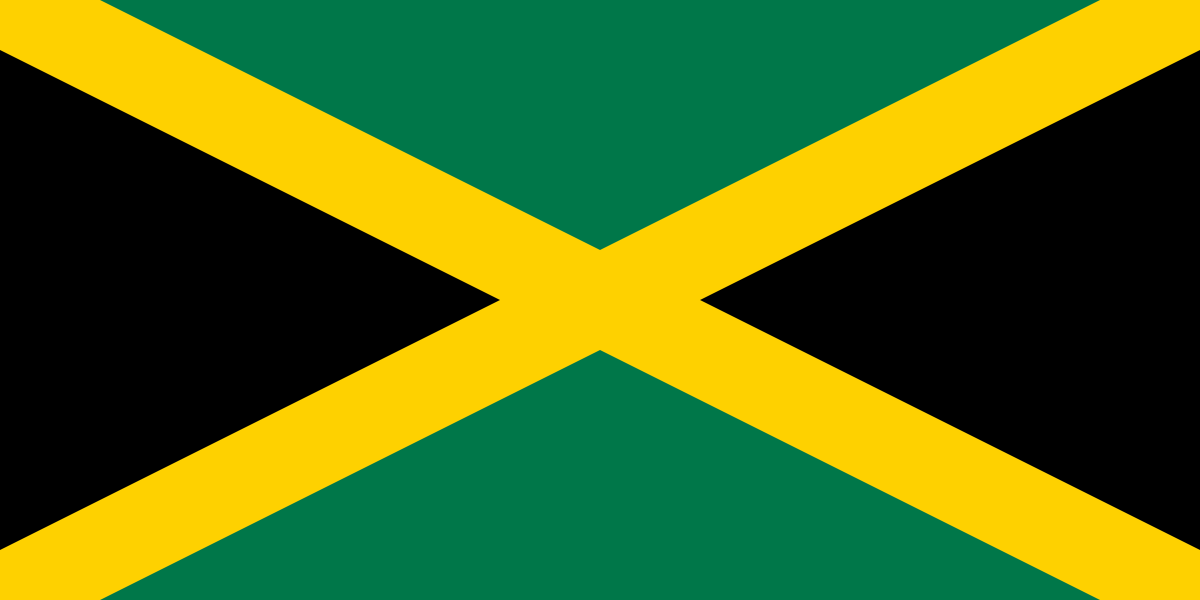
Flag of Jamaica
Native & traditional name: The Cross, the Sunshine, and the Green Fields
| Entity | Jamaica (JM) |
|---|---|
| Type | Sovereign national flag (national, civil) |
| Proportion | 1:2 (1:2) |
| Primary colors | green, yellow, black |
| Main symbol | saltire |
| Arrangement | diagonal saltire |
| Official adoption | 1962-08-06 |
| Region | Caribbean |
Plain-language visual description
The national flag of Jamaica features a gold diagonal saltire cross dividing the field into four triangles of green (top and bottom) and black (hoist and fly) in a 1:2 aspect ratio.
Construction and geometry
Proportion & symmetry: The Flag of Jamaica uses a statutory 1:2 height-to-width ratio on a rectangular field with both mirror symmetry. Gold diagonal saltire with width 1/6 of flag height, dividing four triangles.
Official colors and specification system
Rather than manufacturing false RGB precision where a statute specifies dyed cloth, Pantone, Munsell, or CIE coordinates, the table below records the governing color system alongside a calibrated display hex approximation.
| Color | Official shade name | Specification system | Statutory / standard code | Display hex |
|---|---|---|---|---|
| green | Emerald Green | pantone | Pantone 340 C | #007749 |
| yellow | Gold | pantone | Pantone 109 C | #FED100 |
| black | Black | statute-named | Named in statute | #000000 |
Meaning and symbolism
Documented symbolism
The National Symbols Act of 1962 and the 1996 symbolism revision establish: black reflects the strength and creativity of the people; gold represents natural wealth and sunlight; and green symbolizes agriculture and hope.
Jamaica's flag is the only sovereign national flag in the world that does not include red, white, or blue.
Common interpretations
The original 1962 motto was 'Hardships there are, but the land is green and the sun shineth'—linking black to hardships, gold to sunshine, and green to the land.
History and design evolution
The national flag of Jamaica was created to mark the island nation's independence from the United Kingdom on August 6, 1962. Prior to independence, Jamaica flew the British Blue Ensign defaced with the colonial coat of arms, a pattern shared across the British Empire. In the months leading up to independence, a bipartisan joint committee of the Jamaican Parliament held a nationwide design competition that received several hundred entries.
The committee initially selected a design composed of horizontal stripes in green, gold, and black. However, when government officials reviewed international flag registries, they discovered that the proposed design was dangerously similar to the national flag of Tanganyika (now part of Tanzania), which had gained independence the previous year in 1961. To ensure distinctiveness, the committee redesigned the flag into a diagonal saltire cross, drawing inspiration from the Scottish cross of Saint Andrew.
The final design—a bold gold saltire dividing the field into four alternating triangles of emerald green and black—was formally approved by the Jamaican House of Representatives on June 20, 1962. When first adopted, the symbolism was explained with the phrase 'Hardships there are, but the land is green and the sun shineth,' reflecting black for hardships, gold for sunshine, and green for agriculture. In 1996, the government updated the official interpretation to celebrate the strength and creativity of the people (black), natural wealth and sunshine (gold), and hope and agricultural prosperity (green). Jamaica's flag remains unique among all United Nations member states as the only national flag that does not contain red, white, or blue.
Key historical milestones
- 1962Independence Adoption: Adopted on 6 August 1962 upon Jamaican independence.
- 1996Symbolism Update: Official symbolism updated to emphasize national strength and optimism.
Visually and structurally similar flags
Ranked deterministically across layout family (35%), color overlap and stripe order (25%), symbols (20%), aspect ratio (10%), and stripe/symmetry geometry (10%):
Sources and image-rights provenance
- The National Symbols Act of 1962 — Acts of Jamaica, 1962 No. 1
- The National Flag of Jamaica: History and Protocol
SVG artwork provenance: Constructed from statutory specifications (public-domain-statute, verified 2026-10-14, SHA-256 e41861022420…).