
Austria vs. Latvia: Flag Comparison
Austria and Latvia both fly horizontal red-white-red tribands, but Latvia uses an elongated 1:2 ratio with 2:1:2 stripe proportions and a distinctive dark carmine red.

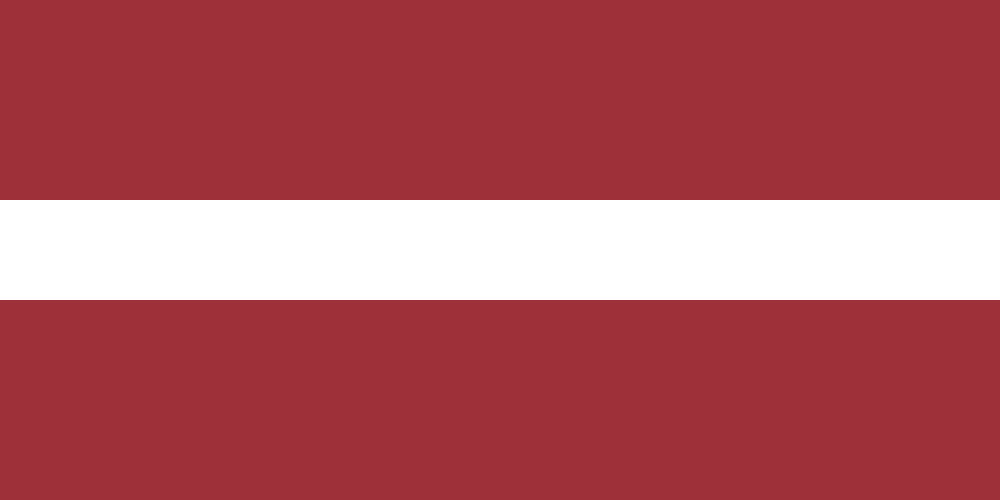
How to tell Austria and Latvia apart at a glance
- Check the stripe thickness: Austria has three equal bands (1:1:1 ratio); Latvia has a much thinner white center stripe (half the height of each red band, a 2:1:2 ratio).
- Compare the shade of red: Austria uses a bright, vibrant heraldic red (Pantone 186 C); Latvia uses a distinctive dark carmine maroon (Pantone 201 C / 1807 C).
- Check the aspect ratio: Austria is 2:3; Latvia is 1:2.
Side-by-side structural comparison
| Attribute | Austria | Latvia |
|---|---|---|
| Aspect ratio | 2:3 (2:3) | 1:2 (1:2) |
| Layout & orientation | horizontal triband | horizontal triband |
| Band / color sequence | red · white · red | maroon · white · maroon |
| Official color specs | Rot (Red) (Pantone 186 C); Weiß (White) (statute-named) | Latvian Carmine (Carmine Red) (Pantone 201 C / 1807 C); Balta (White) (statute-named) |
| Official adoption | 1945-05-01 | 1990-02-27 |
| Region | Central Europe | Northern Europe |
| Visual similarity score | 77/100 (Layout 35/35 · Colors 8.3/25 · Symbols 20/20 · Ratio 3.3/10 · Geometry 10/10) | |
Why these two flags look alike
At first glance, both flags appear to be horizontal red-white-red tribands. However, Austria's three stripes are of equal height (1:1:1), flying in a 2:3 aspect ratio with standard bright red. Latvia's flag uses a much narrower central white stripe (2:1:2 ratio, white takes only 20% of the height) on an elongated 1:2 field with a somber carmine red shade.
Austria uses a vibrant heraldic red (Pantone 186 C, approx. #ED2939), while Latvia uses a statutory dark carmine red (Pantone 201 C / 1807 C, approx. #9E3039), historically known as 'Latvian red.' Check the stripe thickness and the shade of red: Austria has three equal bands in bright red; Latvia has a much thinner white center stripe (half the height of each red stripe) and a much deeper, darker maroon/carmine red.
Both designs date to the 13th century: Austria's Babenberg Bindenschild dates to 1230, while Latvia's banner was recorded in the Livonian Rhymed Chronicle around 1279. When Latvia formalized its flag in 1917–1921, artist Ansis Cīrulis deliberately chose the 2:1:2 ratio and darker carmine shade to prevent confusion with Austria.
Explore each flag in detail
Read the complete statutory specification, color table, and historical timeline on the Flag of Austria page or the Flag of Latvia page, or return to all flag comparisons.
Sources
- Federal Constitutional Law on the Flag of Austria — BGBl. Nr. 102/1981
- Law on the National Flag of Latvia