
Flag of the United States
Native & traditional name: Stars and Stripes / Old Glory
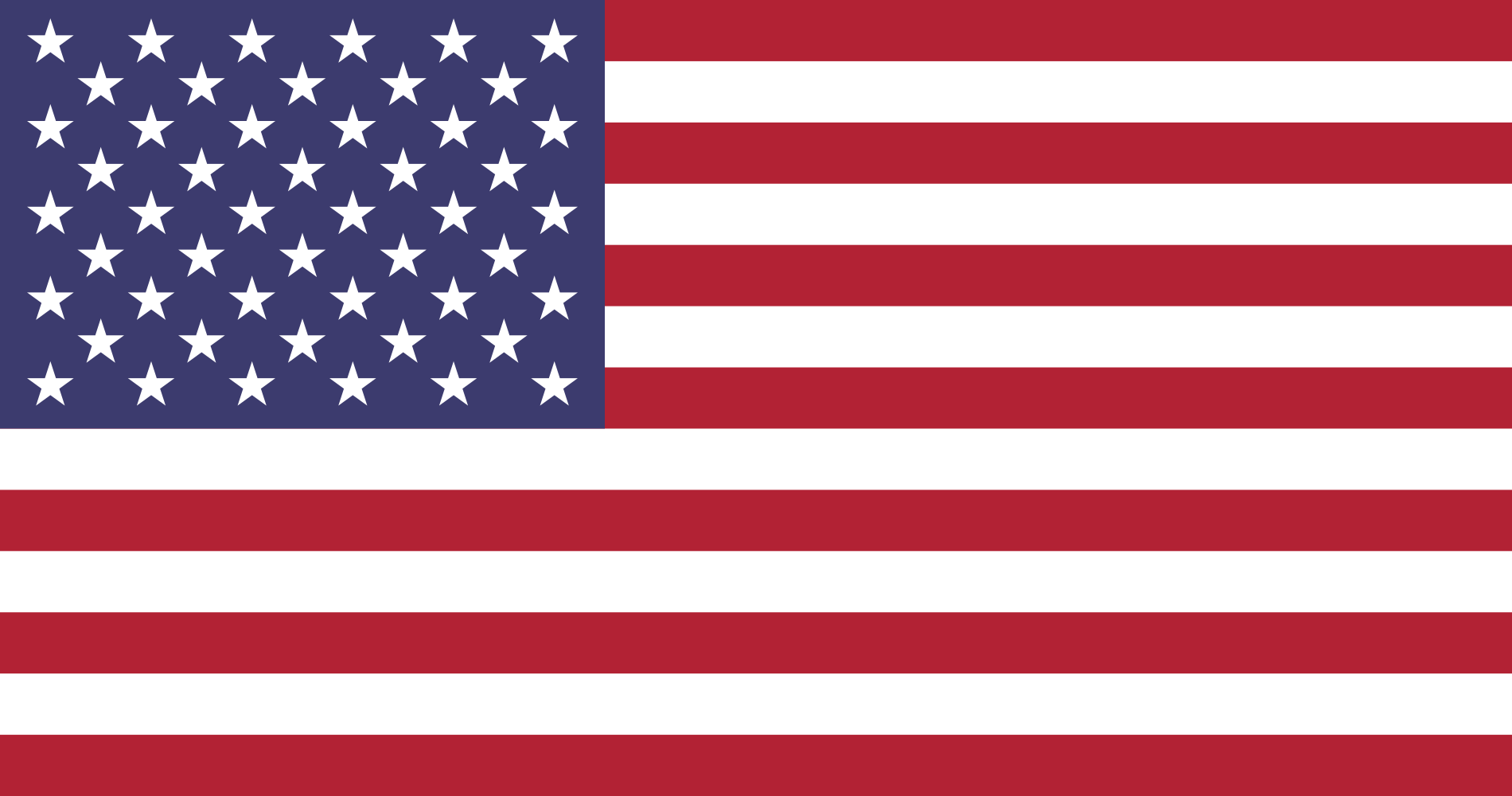
| Flag | United States (US) |
|---|---|
| Type | National flag (national, civil, state, war, naval-ensign) |
| Proportion | 10:19 (10:19) |
| Primary colors | red, white, blue |
| Main symbol | star (×50), stripe (×13) |
| Arrangement | canton canton |
| Official adoption | 1960-07-04 — 50-star arrangement under Executive Order 10834 (1959-08-21); original Stars and Stripes Flag Resolution enacted 1777-06-14 |
| Region | Northern America |
Plain-language visual description
The flag of the United States is a 10:19 rectangle of thirteen alternating red and white horizontal stripes with a dark blue upper-hoist canton containing fifty white five-pointed stars in nine staggered rows.
Construction and geometry
Proportion & symmetry: The Flag of the United States uses a statutory 10:19 height-to-width ratio on a rectangular field with none mirror symmetry. Hoist A = 1.0, Fly B = 1.9, Union height C = 7/13 (0.5385), Union width D = 0.76, stripe width L = 1/13 (0.0769), star diameter K = 0.0616.
- Executive Order 10834 (1959) fixes government proportions at 10:19 (A = 1.0, B = 1.9). The blue canton spans seven stripes in height (C = 7/13 ≈ 0.5385) and 0.76 of the hoist height in width.
- The fifty stars are arranged in nine alternating horizontal rows of six and five stars, with each star having a circumscribed diameter of K = 0.0616.
Official colors and specification system
Rather than manufacturing false RGB precision where a statute specifies dyed cloth, Pantone, Munsell, or CIE coordinates, the table below records the governing color system alongside a calibrated display hex approximation.
| Color | Official shade name | Specification system | Statutory / standard code | Display hex |
|---|---|---|---|---|
| red | Old Glory Red | cable-number | CAUS Standard Color Reference Cable No. 70180 | #B22234 |
| white | White | cable-number | CAUS Standard Color Reference Cable No. 70001 | #FFFFFF |
| blue | Old Glory Blue | cable-number | CAUS Standard Color Reference Cable No. 70075 | #3C3B6E |
Meaning and symbolism
Documented symbolism
Under the Second Continental Congress Flag Resolution of 14 June 1777 and the Flag Act of 1818 (4 U.S.C. §§ 1–2), the thirteen horizontal stripes represent the original thirteen colonies that declared independence, and the fifty stars in the blue canton ('the union') represent the fifty states of the Union as a new constellation.
Common interpretations
While the 1777 Flag Resolution did not assign meanings to the individual colors, Charles Thomson, Secretary of the Continental Congress, wrote in 1782 regarding the Great Seal of the United States that white signifies purity and innocence, red signifies hardiness and valor, and blue (the chief of the shield) signifies vigilance, perseverance, and justice.
History and design evolution
In January 1776 the Continental Army raised the Continental Colors (Grand Union Flag), which paired thirteen red-and-white stripes with the British Union Flag in the canton. On 14 June 1777 the Second Continental Congress replaced the British canton with 'thirteen stars, white in a blue field, representing a new constellation.'
When Vermont and Kentucky joined the Union, Congress temporarily expanded both the stars and the stripes to fifteen in 1795—the 'Star-Spangled Banner' that flew over Fort McHenry in 1814. Recognizing that adding more stripes would clutter the field, Congress enacted the Flag Act of 4 April 1818, permanently restoring thirteen stripes and providing that one new star be added on the fourth of July following the admission of each new state.
After Alaska and Hawaii achieved statehood in 1959, President Dwight D. Eisenhower issued Executive Order 10834 on 21 August 1959 adopting the current 50-star staggered grid—famously parallel to a school project submitted by Ohio high school student Robert G. Heft—which became official on 4 July 1960.
Key historical milestones
- 1777Continental Congress Flag Resolution: Establishes thirteen alternating red and white stripes and thirteen white stars on a blue canton on 14 June 1777.
- 1818Flag Act of 1818: Fixes the stripe count permanently at thirteen and adds one star on 4 July after each new state enters the Union.
- 196050-star arrangement takes effect: Executive Order 10834 adds the fiftieth star for Hawaii on 4 July 1960.
Visually and structurally similar flags
Ranked deterministically across layout family (35%), color overlap and stripe order (25%), symbols (20%), aspect ratio (10%), and stripe/symmetry geometry (10%):
Sources and image-rights provenance
- U.S. National Archives — Executive Order 10834: Proportions and Sizes of Flags and Position of Stars
- United States Code, Title 4, Chapter 1 — The Flag (4 U.S.C. §§ 1–10)
SVG artwork provenance: Constructed from statutory specifications (public-domain-us-gov, verified 2026-10-13, SHA-256 a2d6cbadc6c2…).