
Canada vs. Peru: Flag Comparison
Canada and Peru both fly striking vertical red-white-red tribands, but Canada uses a 1:2 Canadian pale with an 11-pointed maple leaf, while Peru flies equal 1:1:1 stripes in a 2:3 proportion.
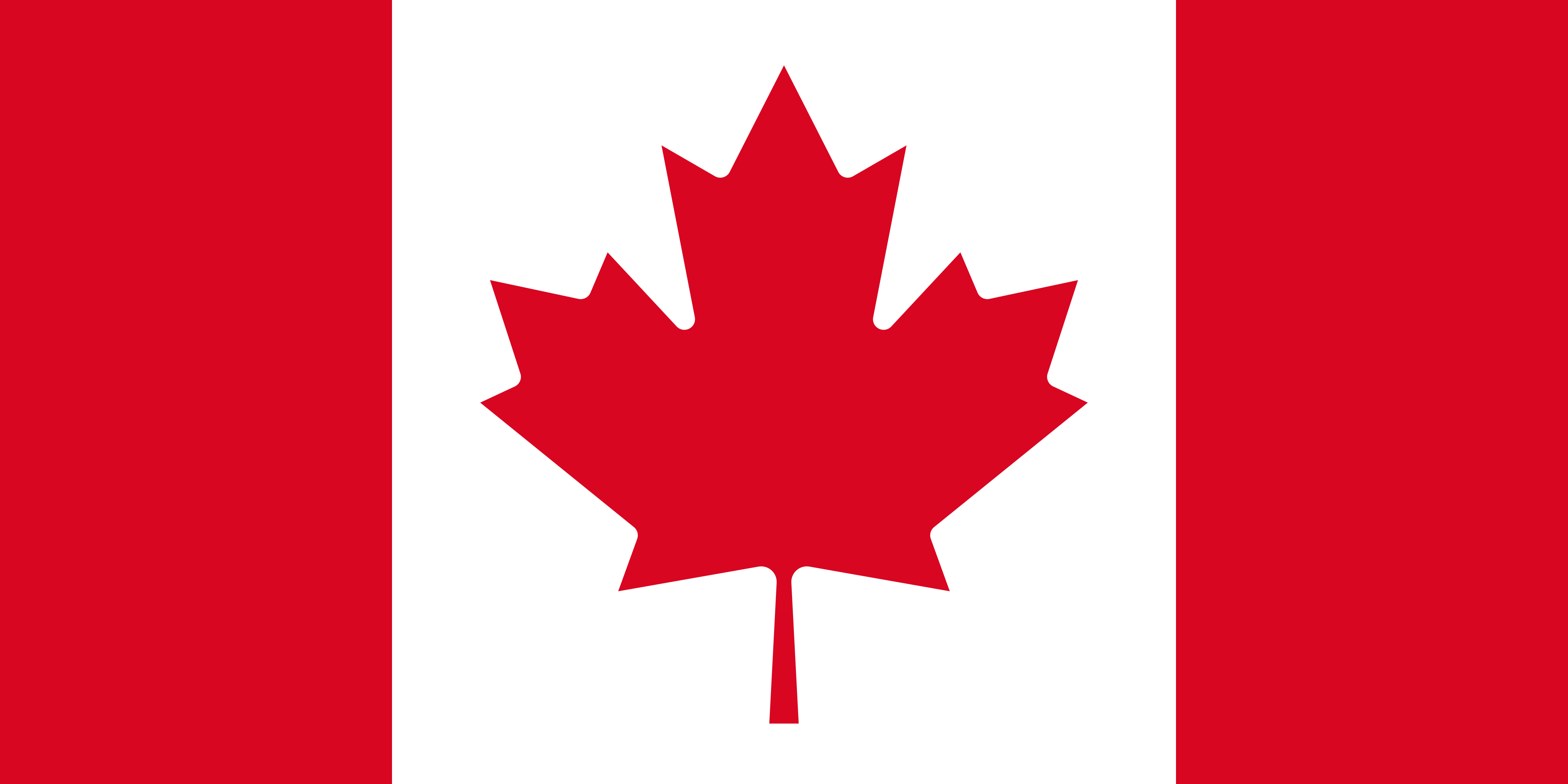

How to tell Canada and Peru apart at a glance
- Look for the central emblem: Canada features a stylized 11-pointed red maple leaf in the center; Peru's civil flag has an uncharged, plain white center band.
- Compare stripe widths: Canada uses a Canadian pale where the central white square is twice as wide as each red band (1:2:1 ratio); Peru uses three equal vertical stripes (1:1:1 ratio).
- Compare the aspect ratio: Canada is an elongated 1:2 rectangle, while Peru is a standard 2:3 rectangle.
Side-by-side structural comparison
| Attribute | Canada | Peru |
|---|---|---|
| Aspect ratio | 1:2 (1:2) | 2:3 (2:3) |
| Layout & orientation | vertical triband | vertical triband |
| Band / color sequence | red · white · red | red · white · red |
| Official color specs | FIP Red (Pantone 032 C); White (statute-named) | Rojo (Red) (Pantone 186 C); Blanco (White) (statute-named) |
| Official adoption | 1965-02-15 | 1950-03-31 |
| Region | Northern America | South America |
| Visual similarity score | 87/100 (Layout 35/35 · Colors 25/25 · Symbols 14/20 · Ratio 3.3/10 · Geometry 10/10) | |
Why these two flags look alike
Both national flags feature outer red vertical bands flanking a central white pale. In Canada's flag, the central white band is a square (half the total width, creating a 1:2:1 ratio) bearing the stylized 11-pointed red maple leaf. In Peru's civil flag, all three bands are equal in width (1:1:1 ratio) with no central charge, and the flag is significantly more compact (2:3 vs. 1:2).
Canada uses FIP Red (Pantone 032 C, approx. #D80621), while Peru uses Rojo Bandera (Pantone 186 C, approx. #D91023). Look for the central emblem and the aspect ratio: if you see a red maple leaf on an elongated 1:2 flag where the white section is twice as wide as each red section, it is Canada. If you see three equal vertical stripes on a 2:3 banner with no emblem, it is Peru.
Peru's vertical red-white-red triband was established in 1825 during the Latin American wars of independence and simplified to a plain civil triband in 1950. Canada's maple leaf flag was adopted in 1965 after the Great Flag Debate. The two designs arose completely independently from different heraldic traditions.
Explore each flag in detail
Read the complete statutory specification, color table, and historical timeline on the Flag of Canada page or the Flag of Peru page, or return to all flag comparisons.
Sources
- Department of Canadian Heritage: National Flag
- Decreto Ley No. 11323: Símbolos Patrios — El Peruano, Diario Oficial