
Hungary vs. Bulgaria: Flag Comparison
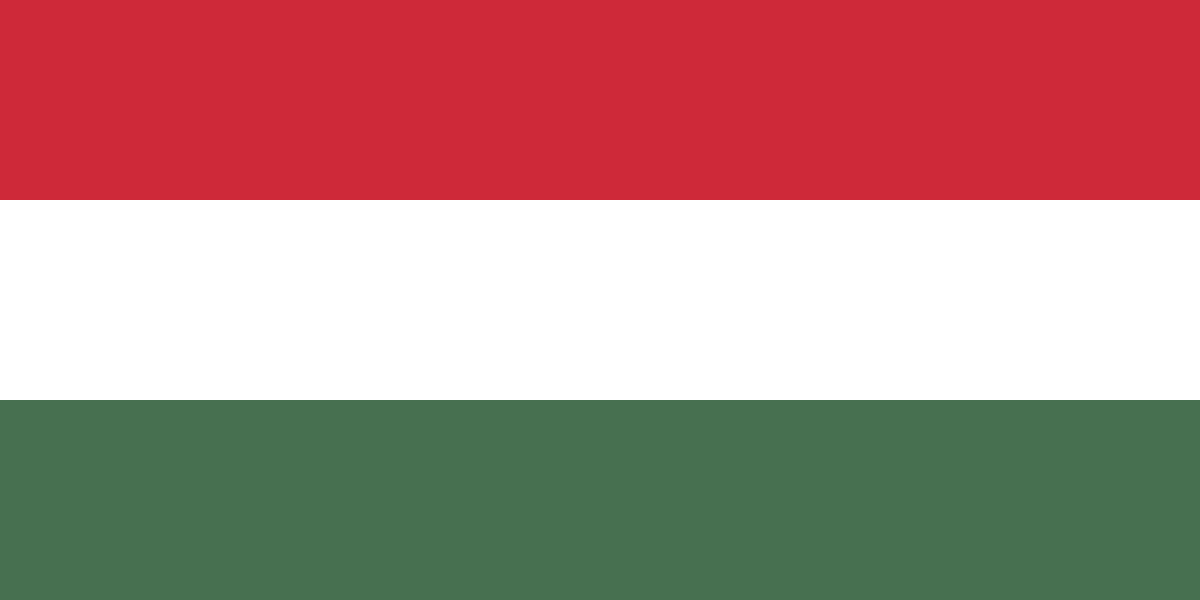
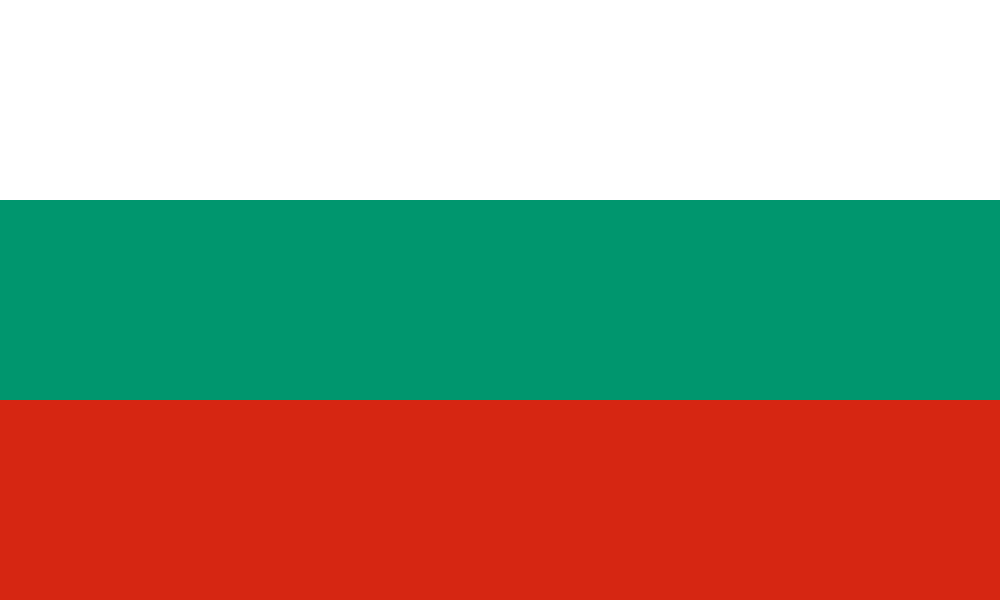
Hungary and Bulgaria both fly horizontal tricolors composed of red, white, and green, but Hungary places red at the top in a 1:2 ratio, while Bulgaria places white at the top in a 3:5 ratio.
How to tell Hungary and Bulgaria apart at a glance
- Check the top stripe: Hungary starts with Red at the top (Red-White-Green); Bulgaria starts with White at the top (White-Green-Red).
- Compare the aspect ratio: Hungary is a longer 1:2 rectangle; Bulgaria is a 3:5 rectangle.
- Compare the green stripe: Hungary uses a darker forest green; Bulgaria uses a brighter emerald green (Pantone 347 C).
Side-by-side structural comparison
| Attribute | Hungary | Bulgaria |
|---|---|---|
| Aspect ratio | 1:2 (1:2) | 3:5 (3:5) |
| Layout & orientation | horizontal tricolor | horizontal tricolor |
| Band / color sequence | red · white · green | white · green · red |
| Official color specs | Piros (Red) (Pantone 18-1660 TCX); Fehér (White) (statute-named); Zöld (Green) (Pantone 18-6320 TCX) | White (statute-named); Green (Pantone 347 C); Red (Pantone 485 C) |
| Official adoption | 1957-05-23 | 1991-07-12 |
| Region | Central Europe | Eastern Europe |
| Visual similarity score | 84/100 (Layout 35/35 · Colors 13/25 · Symbols 20/20 · Ratio 6/10 · Geometry 10/10) | |
Why these two flags look alike
Both flags share the exact same three tincture colors arranged in horizontal bands. Hungary's bands run red at the top, white in the middle, and green at the bottom. Bulgaria's bands run white at the top, green in the middle, and red at the bottom.
Hungary's green is a darker forest green (#477050); Bulgaria's green is a vibrant emerald green (Pantone 347 C, #00966E). Look at the top stripe: if the top stripe is red, it is Hungary; if the top stripe is white, it is Bulgaria.
Hungary's tricolor was adopted during the 1848 revolution, combining traditional medieval royal colors into a French-style tricolor. Bulgaria's tricolor was adopted in 1879, taking the Pan-Slavic white-blue-red tricolor and replacing blue with green to represent agriculture and freedom fighters.
Explore each flag in detail
Read the complete statutory specification, color table, and historical timeline on the Flag of Hungary page or the Flag of Bulgaria page, or return to all flag comparisons.
Sources
- The Fundamental Law of Hungary
- State Gazette No. 47/1998: National Flag Law — DV No. 47/1998