
Netherlands vs. Luxembourg: Flag Comparison
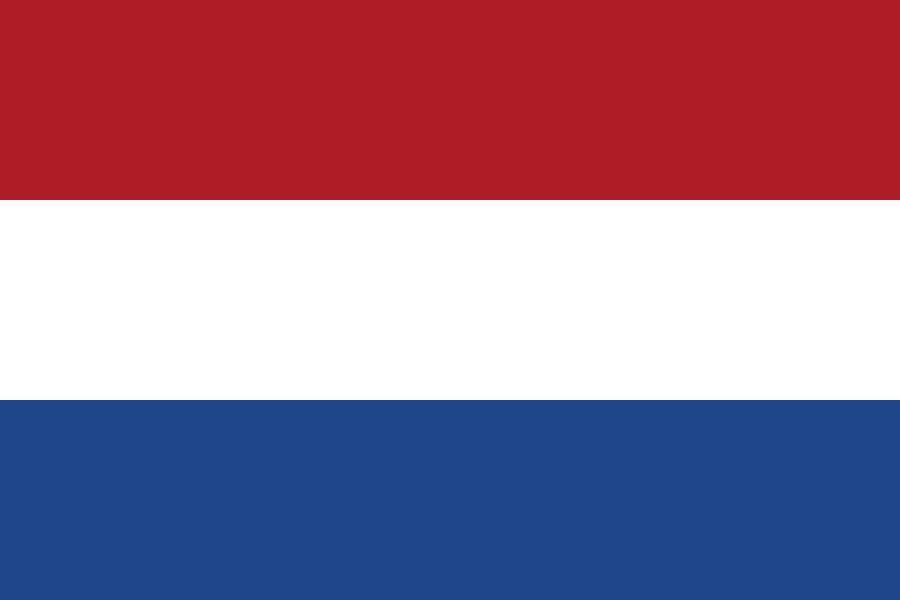
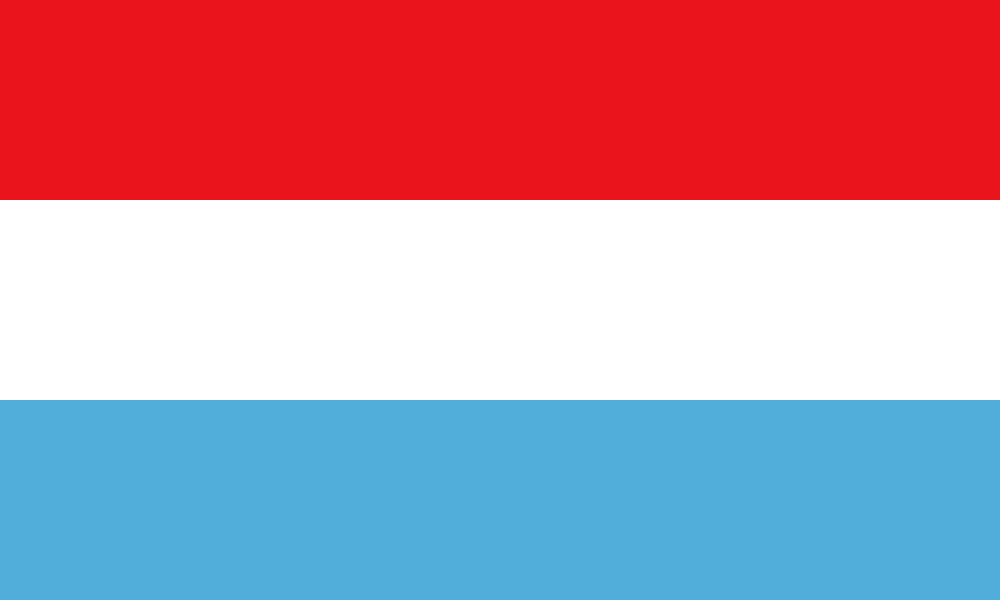
The Netherlands and Luxembourg both fly horizontal red-white-blue tricolors, but Luxembourg uses a bright sky-blue bottom stripe (Pantone 299 C) and a longer 3:5 (or 1:2) ratio, while the Netherlands uses dark cobalt blue and a 2:3 ratio.
How to tell Netherlands and Luxembourg apart at a glance
- Bottom blue shade: The Netherlands uses a dark cobalt blue (kobaltblauw, defined colorimetrically in Dutch standard NEN 3055 and commonly rendered #21468B), while Luxembourg's 1993 Grand-Ducal Regulation mandates bright sky blue (Pantone 299 C). Pantone publishes 299 C as #00A3E0.
- Top red shade: The Netherlands uses a bright vermilion (helder vermiljoen, commonly rendered #AE1C28), whereas Luxembourg's regulation specifies Pantone 032 C red (published by Pantone as #EF3340).
- Aspect ratio: The Dutch flag is conventionally 2:3 (no ratio is fixed by law), whereas Luxembourg's law sets a more elongated 3:5 (or 1:2).
Side-by-side structural comparison
| Attribute | Netherlands | Luxembourg |
|---|---|---|
| Aspect ratio | 2:3 (2:3) | 3:5 (3:5) |
| Layout & orientation | horizontal tricolor | horizontal tricolor |
| Band / color sequence | red · white · blue | red · white · light blue |
| Color specifications | Bright Vermilion (Helder vermiljoen) (named in law, no code); Bright White (Helder wit) (named in law, no code); Cobalt Blue (Kobaltblauw) (named in law, no code) | Red (Pantone 032C (official)); White (named in law, no code); Light Blue (Bleu) (Pantone 299C (official)) |
| Official adoption | 1937-02-19 | 1972-06-23 |
| Region | Western Europe | Western Europe |
| Visual similarity score | 87/100 (Layout 35/35 · Colors 14.5/25 · Symbols 20/20 · Ratio 7.3/10 · Geometry 10/10) | |
Why these two flags look alike
Although the Netherlands and Luxembourg were linked in personal union under the House of Orange-Nassau from 1815 to 1890, their horizontal red-white-blue flags come from separate heraldic origins. The Dutch flag evolved from the sixteenth-century Prinsenvlag of William the Silent and its colours were fixed as red, white and blue by Queen Wilhelmina's Royal Decree of 19 February 1937; the shades bright vermilion and cobalt blue were specified by a Minister of the Navy decision of 16 August 1949, and their colour parameters were defined by the NEN in November 1958.
Luxembourg's tricolor derives its tinctures from the thirteenth-century coat of arms of Count Henry V (a red lion on a white-and-blue striped field) and was formally regulated in 1845 and 1972. A Grand-Ducal Regulation of 27 July 1993 fixed its red as Pantone 032 C and its lower band as Pantone 299 C sky blue, which in practice sets it apart from the darker Dutch blue; the regulation itself states no purpose.
Explore each flag in detail
Read the full specification, color table, and historical timeline on the Flag of the Netherlands page or the Flag of Luxembourg page, or return to all flag comparisons.