
Flag of Luxembourg
Native & traditional name: Lëtzebuerger Fändel
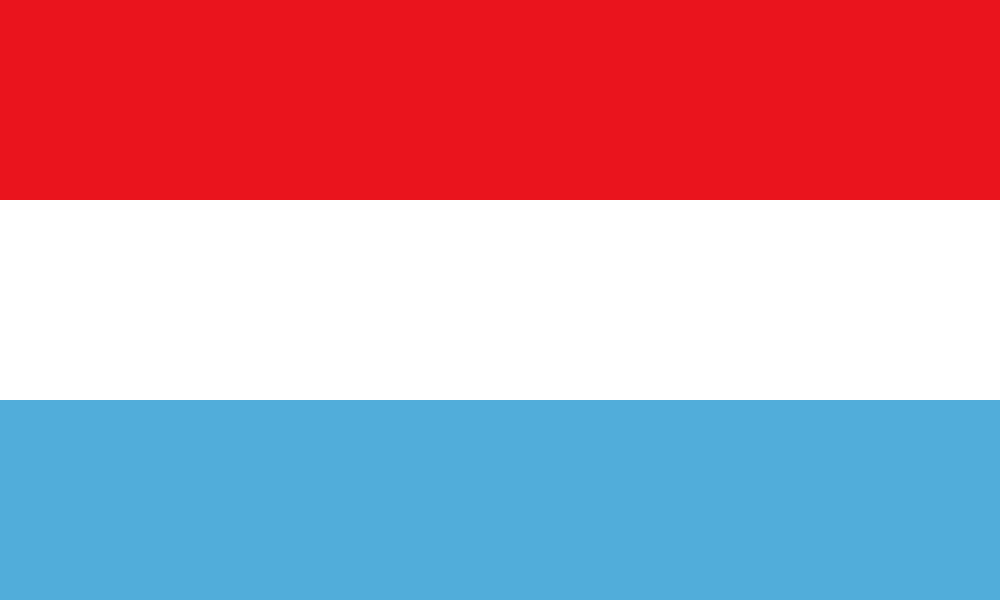
| Flag | Luxembourg (LU) |
|---|---|
| Type | National flag (national, civil, state) |
| Proportion | 3:5 (3:5) |
| Primary colors | red, white, light blue |
| Main symbol | None (geometric bands) |
| Arrangement | horizontal tricolor (red · white · light-blue) |
| Official adoption | 1972-06-23 — Law on National Emblems (colors dated to 1845; exact Pantone shades fixed by Grand-Ducal Regulation of 1993-07-27) |
| Region | Western Europe |
Plain-language visual description
Luxembourg's national flag is a 3:5 rectangular horizontal tricolor with three equal bands of red on top, white in the center, and bright sky blue on the bottom.
Construction and geometry
Proportion & symmetry: The Flag of Luxembourg uses a statutory 3:5 height-to-width ratio on a rectangular field with vertical mirror symmetry. 3:5 (or 1:2) aspect ratio with three equal horizontal stripes of red, white, and Pantone 299 C sky blue.
- Official ratio is 3:5 (or 1:2), which is longer than the Dutch 2:3 ratio.
- The Grand-Ducal Regulation of 27 July 1993 specifies Pantone 032 C for red and Pantone 299 C (bright sky blue) for the bottom stripe to ensure clear visual distinction from the dark cobalt blue of the Netherlands.
Official colors and specification system
Rather than manufacturing false RGB precision where a statute specifies dyed cloth, Pantone, Munsell, or CIE coordinates, the table below records the governing color system alongside a calibrated display hex approximation.
| Color | Official shade name | Specification system | Statutory / standard code | Display hex |
|---|---|---|---|---|
| red | Red | pantone | Pantone 032 C | #EA141D |
| white | White | statute-named | Named in statute | #FFFFFF |
| light blue | Sky Blue (Bleu ciel) | pantone | Pantone 299 C | #51ADDA |
Meaning and symbolism
Documented symbolism
As codified in the 1972 Law on National Emblems, the red, white, and light-blue stripes derive from the thirteenth-century coat of arms of the Counts and Dukes of Luxembourg: a red crowned lion rampant on a field of ten silver-white and azure-blue horizontal bars.
Common interpretations
Because Luxembourg and the Netherlands shared the same monarch in personal union from 1815 to 1890, many assume Luxembourg simply adopted the Dutch flag; while the three-band layout was influenced by nineteenth-century tricolor conventions, the colors themselves come from Luxembourg's medieval Lusignan heraldic shield.
History and design evolution
Although the red, white, and blue tinctures of the House of Luxembourg date back to Count Henry V the Blond in the 1240s, a horizontal tricolor combining the three colors was first recorded in 1830 during the Belgian Revolution and formally defined by Governor Ignace de la Fontaine's administrative circular on 12 June 1845.
Throughout the nineteenth and early twentieth centuries the horizontal tricolor was flown alongside the Grand Ducal coat of arms without a single unified national statute. On 23 June 1972, the Chamber of Deputies passed the Law on National Emblems, establishing the red-white-blue horizontal tricolor in a 3:5 or 1:2 ratio and introducing the armorial 'Roude Léiw' (Red Lion) ensign for maritime and aviation registration.
To eliminate recurring visual confusion with the darker flag of the Netherlands at international events, the Grand-Ducal Regulation of 27 July 1993 legally fixed the lower stripe as bright sky blue (Pantone 299 C) and the upper stripe as Pantone 032 C red.
Key historical milestones
- 1845Administrative circular defining colors: Governor De la Fontaine formally records the horizontal red-white-blue arrangement on 12 June 1845.
- 1972Law on National Emblems: Establishes the 3:5 and 1:2 ratios and the Red Lion maritime/aviation ensign.
- 1993Grand-Ducal Regulation on Pantone shades: Locks the bottom band to Pantone 299 C sky blue to distinguish Luxembourg from the Netherlands.
Frequently confused with
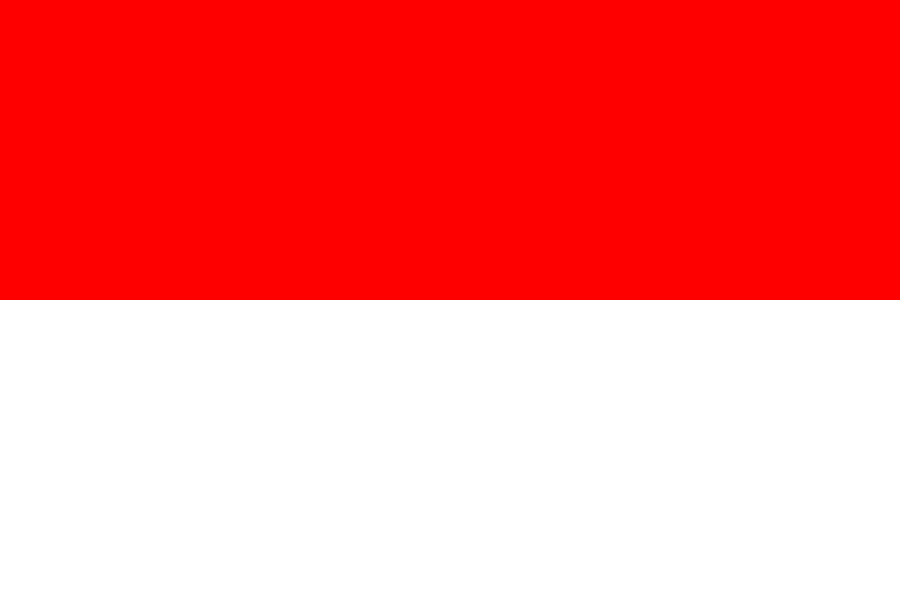
The Flag of Luxembourg is commonly confused with the following national flags due to shared colors, stripe geometry, or central emblems:

Visually and structurally similar flags
Ranked deterministically across layout family (35%), color overlap and stripe order (25%), symbols (20%), aspect ratio (10%), and stripe/symmetry geometry (10%):




Sources and image-rights provenance
- Legilux — Règlement grand-ducal du 27 juillet 1993 précisant la composition chromatique du drapeau national
- Gouvernement du Grand-Duché de Luxembourg — Emblèmes nationaux
SVG artwork provenance: Constructed from statutory specifications (public-domain-statute, verified 2026-10-13, SHA-256 ca39014da37a…).