
Norway vs. Iceland: Flag Comparison
Iceland's 1915/1944 flag is, in effect, a color inversion of Norway's 1821 flag: Norway places a white-bordered blue Nordic cross on a red field (8:11), whereas Iceland places a white-bordered red Nordic cross on a blue field (18:25).
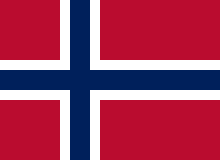
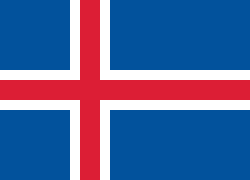
How to tell Norway and Iceland apart at a glance
- Look at the main background field: Norway has a RED background with a BLUE inner cross; Iceland has a BLUE background with a RED inner cross.
- Compare the aspect ratio and cantons: Norway's hoist cantons are perfect 6×6 squares in an 8:11 (16:22) grid, whereas Iceland's hoist cantons are 7×7 squares in a slightly wider 18:25 grid.
Side-by-side structural comparison
| Attribute | Norway | Iceland |
|---|---|---|
| Aspect ratio | 8:11 (8:11) | 18:25 (18:25) |
| Layout & orientation | horizontal nordic cross | horizontal nordic cross |
| Band / color sequence | red · white · blue | blue · white · red |
| Color specifications | Crimson Red (Høyrød) (named in law, no code; commonly Pantone 200 (unofficial)); White (named in law, no code); Dark Blue (Mørkeblå) (named in law, no code; commonly Pantone 281 (unofficial)) | Sky Blue (Heiðblár) (Pantone nr. 287 (official)); Snow White (Mjallhvítur) (RGB nr. 255/255/255 (official)); Fiery Red (Eldrauður) (Pantone nr. 199 (official)) |
| Official adoption | 1821-07-13 | 1944-06-17 |
| Region | Northern Europe | Northern Europe |
| Visual similarity score | 92/100 (Layout 35/35 · Colors 25/25 · Symbols 12/20 · Ratio 9.7/10 · Geometry 10/10) | |
Why these two flags look alike
Both Norway and Iceland are members of the three-color fimbriated branch of the Scandinavian Nordic cross family. When Frederik Meltzer designed Norway's flag in 1821, he added a dark-blue cross with a white fimbriation border over the red-and-white Danish Dannebrog, arguing that red, white and blue were the colours of liberty seen in the French, Dutch, American and British flags.
Iceland's tricolor goes back to a design Matthías Þórðarson presented in 1906: a white cross on a blue field with a red cross inside the white one, the colours meant to stand for the blue of the mountains, the ice and the fire. After the King refused the popular blue-and-white flag (the Hvítbláinn) because it looked too much like the Greek flag (a study by the principal of the Maritime College also found that it could be confused with the Swedish flag in poor visibility), the sky-blue design with a white cross and a bright-red cross inside it was confirmed by royal decree on 19 June 1915, giving a flag that reads as Norway's with the red and blue swapped.
Beyond the inverse background and inner-cross colors, the two flags also differ subtly in their statutory unit grids: Norway uses an 8:11 (16:22) proportion with 6×6 square hoist cantons, whereas Iceland uses an 18:25 proportion with 7×7 square hoist cantons.
Explore each flag in detail
Read the full specification, color table, and historical timeline on the Flag of Norway page or the Flag of Iceland page, or return to all flag comparisons.