
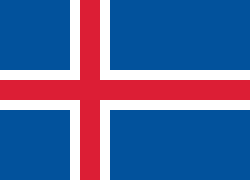
Flag of Iceland
Native & traditional name: Tjúgufáni / Hin íslenska fáni
| Entity | Iceland (IS) |
|---|---|
| Type | Sovereign national flag (national, civil) |
| Proportion | 18:25 (18:25) |
| Primary colors | blue, white, red |
| Main symbol | cross |
| Arrangement | horizontal nordic cross |
| Official adoption | 1944-06-17 |
| Region | Northern Europe |
Plain-language visual description
The national flag of Iceland features a sky-blue rectangular field charged with a snow-white Nordic cross shifted toward the hoist and an inner fiery-red Nordic cross, in an 18:25 aspect ratio.
Construction and geometry
Proportion & symmetry: The Flag of Iceland uses a statutory 18:25 height-to-width ratio on a rectangular field with horizontal mirror symmetry. Horizontal proportions 7:1:2:1:14 (total 25); vertical proportions 7:1:2:1:7 (total 18).
- Aspect ratio is 18:25.
- Horizontal proportions along the width (25 units): 7 (hoist cantons) : 1 (white border) : 2 (red cross) : 1 (white border) : 14 (fly cantons).
- Vertical proportions along the height (18 units): 7 (upper cantons) : 1 (white border) : 2 (red cross) : 1 (white border) : 7 (lower cantons).
Official colors and specification system
Rather than manufacturing false RGB precision where a statute specifies dyed cloth, Pantone, Munsell, or CIE coordinates, the table below records the governing color system alongside a calibrated display hex approximation.
| Color | Official shade name | Specification system | Statutory / standard code | Display hex |
|---|---|---|---|---|
| blue | Sky Blue (Heiðblár) | pantone | Pantone 287 C (SCOTDIC 693009) | #02529C |
| white | Snow White (Snjóhvítur) | pantone | SCOTDIC 95 | #FFFFFF |
| red | Fiery Red (Eldrauður) | pantone | Pantone 199 C (SCOTDIC ICELAND FLAG RED) | #DC1E35 |
Meaning and symbolism
Documented symbolism
Law No. 34/1944 defines the civil national flag as 'sky blue with a snow-white cross, and a fiery-red cross inside the white cross.'
Designer Matthías Þórðarson explained the three colors through Iceland's landscape: blue for the mountains viewed from the coast, white for the ice and snow covering the island, and fiery red for the volcanic fires erupting through the glaciers.
Common interpretations
By inverting the colors of the Norwegian flag (which has a red field and a blue inner cross), Iceland's flag honors its medieval Norse settlement from Norway while asserting distinct national identity.
History and design evolution
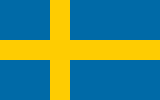
In 1897, poet Einar Benediktsson proposed a blue flag with a white Nordic cross known as the Hvítbláinn ('the White-Blue'), which became wildly popular among Icelandic home-rule advocates. However, Danish authorities and maritime observers objected that the blue-and-white flag was virtually indistinguishable at sea from the Greek cross flag of Greece (1822–1978) and the Swedish flag in faded light.
A parliamentary flag committee incorporated Matthías Þórðarson's proposal to place a fiery-red inner cross inside the white cross. King Christian X of Denmark approved the three-color flag by royal decree on 19 June 1915 for use on land, and on 1 December 1918 it became the maritime flag of the Sovereign Kingdom of Iceland.
When Iceland voted to dissolve its personal union with the Danish crown and establish the Republic of Iceland at Þingvellir on 17 June 1944, Law No. 34/1944 codified the 18:25 geometry and the swallowtailed state flag (Tjúgufáni). Prime Minister's Office Notice No. 32/2016 later standardized the exact SCOTDIC and Pantone shades.
Key historical milestones
- 1897Hvítbláinn Proposal: Einar Benediktsson introduces the unofficial blue-and-white Nordic cross flag.
- 1915Royal Approval: King Christian X approves the blue-white-red Nordic cross design on 19 June 1915.
- 1944Republic Flag Act: Law No. 34/1944 of 17 June 1944 codifies the 18:25 national flag of the Republic of Iceland.
- 2016Color Notice No. 32/2016: The Prime Minister's Office standardizes the SCOTDIC, Pantone, and CMYK values.
Frequently confused with
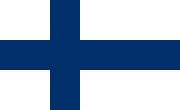
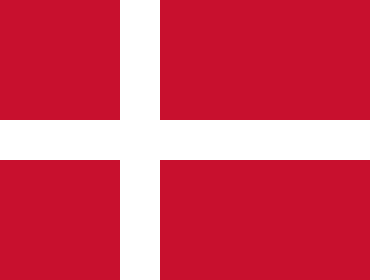
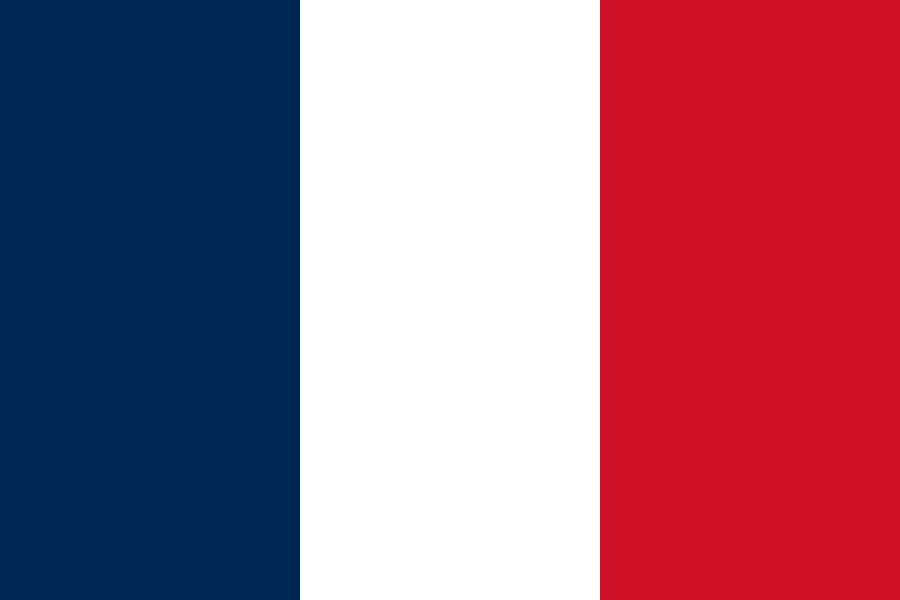
The Flag of Iceland is commonly confused with or compared alongside the following flags due to shared colors, stripe geometry, or central emblems:
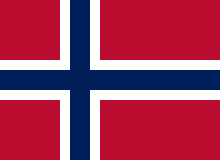
Visually and structurally similar flags
Ranked deterministically across layout family (35%), color overlap and stripe order (25%), symbols (20%), aspect ratio (10%), and stripe/symmetry geometry (10%):

Sources and image-rights provenance
- Law No. 34/1944 on the National Flag of the Icelanders and the State Arms & Notice No. 32/2016
- World Factbook: Iceland Flag Description
SVG artwork provenance: Constructed from statutory specifications (public-domain-statute, verified 2026-10-13, SHA-256 0ad2c0e5a7d9…).