
Flag of Sweden
Native & traditional name: Sveriges flagga
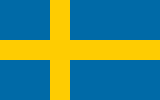
| Flag | Sweden (SE) |
|---|---|
| Type | National flag (national, civil, state) |
| Proportion | 5:8 (5:8) |
| Primary colors | blue, yellow |
| Main symbol | cross |
| Arrangement | horizontal nordic cross |
| Official adoption | 1906-06-22 — Flag Act of 1906 following the dissolution of the union with Norway; currently regulated by Lag (1982:269) om Sveriges flagga |
| Region | Northern Europe |
Plain-language visual description
Sweden's national flag is a 5:8 blue rectangular field bearing a golden-yellow Nordic cross shifted toward the hoist.
Construction and geometry
Proportion & symmetry: The Flag of Sweden uses a statutory 5:8 height-to-width ratio on a rectangular field with horizontal mirror symmetry. 10:16 (5:8) rectangle. Vertical proportions are 4:2:4; horizontal proportions are 5:2:9.
- Regulated by the Flag Act (1982:269) in a 10:16 (5:8) aspect ratio: vertical proportions are 4:2:4 and horizontal proportions are 5:2:9.
- Ordinance 1983:826 specifies the colors using the Swedish Natural Color System (NCS): NCS 4055-R95B for blue and NCS 0580-Y10R for yellow.
Official colors and specification system
Rather than manufacturing false RGB precision where a statute specifies dyed cloth, Pantone, Munsell, or CIE coordinates, the table below records the governing color system alongside a calibrated display hex approximation.
| Color | Official shade name | Specification system | Statutory / standard code | Display hex |
|---|---|---|---|---|
| blue | Swedish Blue | cielab | NCS 4055-R95B | #006AA7 |
| yellow | Golden Yellow | cielab | NCS 0580-Y10R | #FECC02 |
Meaning and symbolism
Documented symbolism
The blue and yellow colors derive from the royal coat of arms of Sweden—three golden crowns on an azure field combined with the Folkunga lion—dating to King Magnus III Ladulås (1275) and the 1442 coat of arms of King Christopher of Bavaria, arranged in the Nordic cross pattern modeled on Denmark's Dannebrog.
Common interpretations
A sixteenth-century legend parallels the Danish myth by claiming King Eric IX the Saint saw a golden cross against the blue sky when landing in Finland during the First Swedish Crusade around 1157, though historians note no contemporaneous evidence for that story.
History and design evolution
Blue and gold banners were used at the Swedish court in the fifteenth century during King Karl Knutsson Bonde's reign to counter the red-and-white Danish Dannebrog. Following Sweden's exit from the Kalmar Union under Gustav Vasa, a royal warrant of 19 April 1562 and a decree by King John III in 1569 mandated that the golden cross always be borne on Swedish royal banners and battle standards.
By the 1620s, under King Gustavus Adolphus, the rectangular blue flag with a yellow cross was flown across Swedish warships and merchant vessels. Between 1844 and 1905, during the personal union with Norway, Swedish flags carried the combined union mark in the upper hoist canton.
After the union dissolved in 1905, the Riksdag enacted the Flag Act of 22 June 1906, removing the union canton, brightening the blue from a dark nineteenth-century navy to a clearer medium blue, and fixing the 4:2:4 by 5:2:9 geometry.
Key historical milestones
- 1562Earliest royal warrant for yellow on blue: Royal decrees of 1562 and 1569 mandate a golden cross on Swedish royal standards.
- 1906Swedish Flag Act of 1906: Removes the Norwegian union canton and fixes the modern brighter blue and 5:8 proportions.
- 1982Lag (1982:269) & NCS color specification: Modernizes flag law and defines exact NCS color coordinates in Ordinance 1983:826.
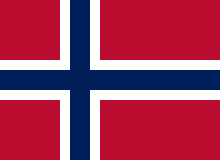
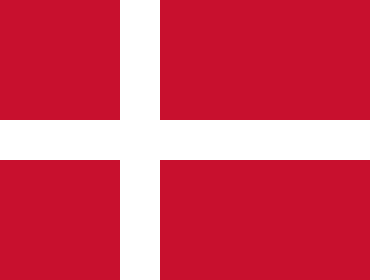
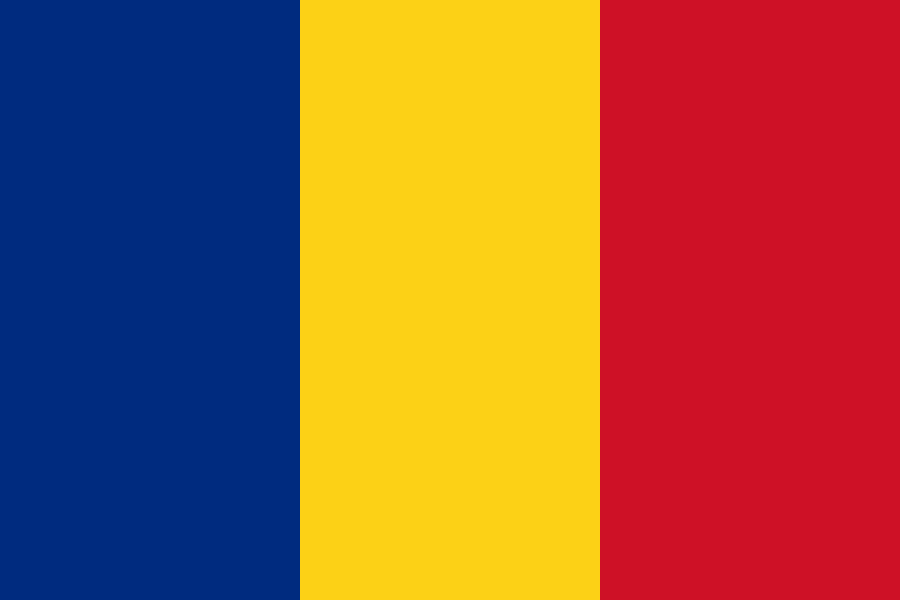
Visually and structurally similar flags
Ranked deterministically across layout family (35%), color overlap and stripe order (25%), symbols (20%), aspect ratio (10%), and stripe/symmetry geometry (10%):
Sources and image-rights provenance
- Sveriges Riksdag — Lag (1982:269) om Sveriges flagga
- Riksarkivet (National Archives of Sweden) — Sveriges flagga
SVG artwork provenance: Constructed from statutory specifications (public-domain-statute, verified 2026-10-13, SHA-256 62aa697bbd68…).