
Flag of Romania
Native & traditional name: Drapelul României
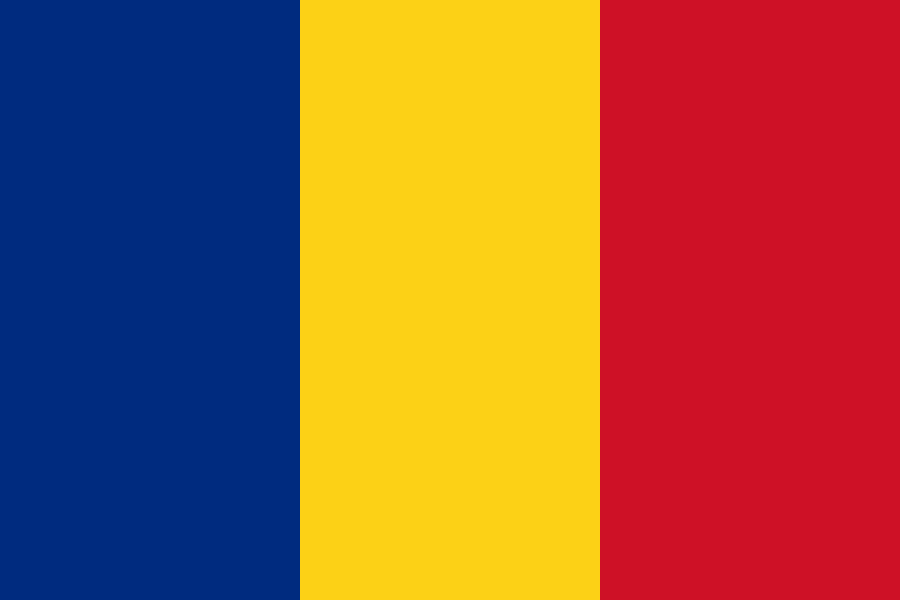
| Flag | Romania (RO) |
|---|---|
| Type | National flag (national, civil, state, war) |
| Proportion | 2:3 (2:3) |
| Primary colors | blue, yellow, red |
| Main symbol | None (geometric bands) |
| Arrangement | vertical tricolor (blue · yellow · red) |
| Official adoption | 1989-12-27 — Plain tricolor restored by Decree-Law No. 2/1989 (originally adopted in Wallachia in 1848 and Principalities in 1866); regulated by Law No. 75/1994 |
| Region | Eastern Europe |
Plain-language visual description
Romania's national flag is a 2:3 vertical tricolor with three equal bands of cobalt blue at the hoist, chrome yellow in the center, and vermilion red at the fly.
Construction and geometry
Proportion & symmetry: The Flag of Romania uses a statutory 2:3 height-to-width ratio on a rectangular field with horizontal mirror symmetry. Height is 2/3 of length; three equal vertical bands with cobalt blue at the hoist, chrome yellow in the center, and vermilion red at the fly.
- Regulated by Law No. 75/1994: height is 2/3 of length (2:3), divided into three equal vertical stripes with cobalt blue always at the hoist.
Official colors and specification system
Rather than manufacturing false RGB precision where a statute specifies dyed cloth, Pantone, Munsell, or CIE coordinates, the table below records the governing color system alongside a calibrated display hex approximation.
| Color | Official shade name | Specification system | Statutory / standard code | Display hex |
|---|---|---|---|---|
| blue | Cobalt Blue (Albastru cobalt) | statute-named | Albastru cobalt (Law No. 75/1994) | #002B7F |
| yellow | Chrome Yellow (Galben crom) | statute-named | Galben crom (Law No. 75/1994) | #FCD116 |
| red | Vermilion Red (Roșu vermion) | statute-named | Roșu vermion (Law No. 75/1994) | #CE1126 |
Meaning and symbolism
Documented symbolism
Romanian revolutionary decrees of 1848 associated the three colors with the motto 'Liberty, Justice, Fraternity,' and later nineteenth-century historiography connected cobalt blue, chrome yellow, and vermilion red to the traditional heraldic colors of Moldavia, Wallachia, and Transylvania.
Common interpretations
Popular accounts often trace the combination to ancient Dacian banners or medieval charters of Stephen the Great; documented vexillological history places the first combined three-color standard in the 1834 Wallachian militia flags.
History and design evolution
Blue, yellow, and red first appeared together on military standards granted to the Wallachian militia by Sultan Mahmud II and Prince Alexandru II Ghica in 1834. During the Wallachian Revolution of June 1848, the provisional government adopted the blue-yellow-red tricolor as the national banner, initially with horizontal bands before switching to vertical stripes modeled on the French tricolor.
Following the unification of Moldavia and Wallachia, the 1866 Constitution fixed the vertical arrangement with blue at the hoist, yellow in the center, and red at the fly. After World War II, the communist regime placed its state coat of arms in the center of the yellow stripe from 1948 until 1989.
During the December 1989 Romanian Revolution, demonstrators cut the communist emblem out of the center of the flag, and on 27 December 1989 Decree-Law No. 2 officially restored the plain unadorned tricolor—making it visually nearly identical to the flag Chad had adopted in 1959.
Key historical milestones
- 1848Wallachian Revolution decree: Revolutionaries decree the blue, yellow, and red tricolor as the national banner.
- 1867Vertical hoist-blue order standardized: The vertical arrangement with blue at the hoist is standardized for the United Principalities.
- 1989Restoration of the plain tricolor: The communist coat of arms is removed on 27 December 1989, restoring the plain tricolor later codified in Law No. 75/1994.
Frequently confused with
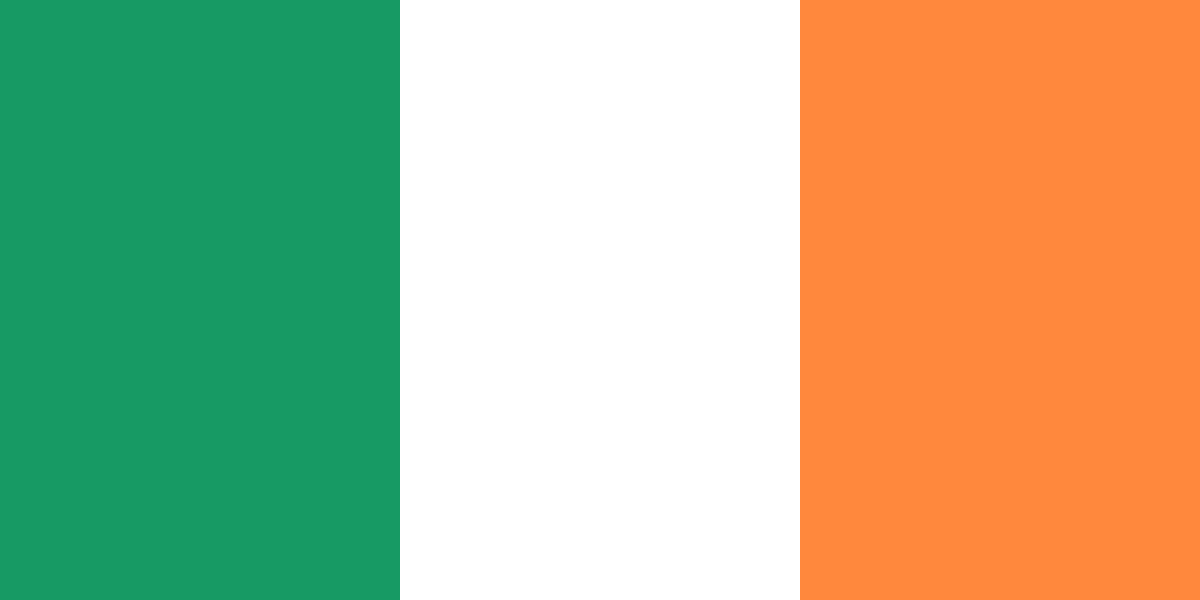
The Flag of Romania is commonly confused with the following national flags due to shared colors, stripe geometry, or central emblems:
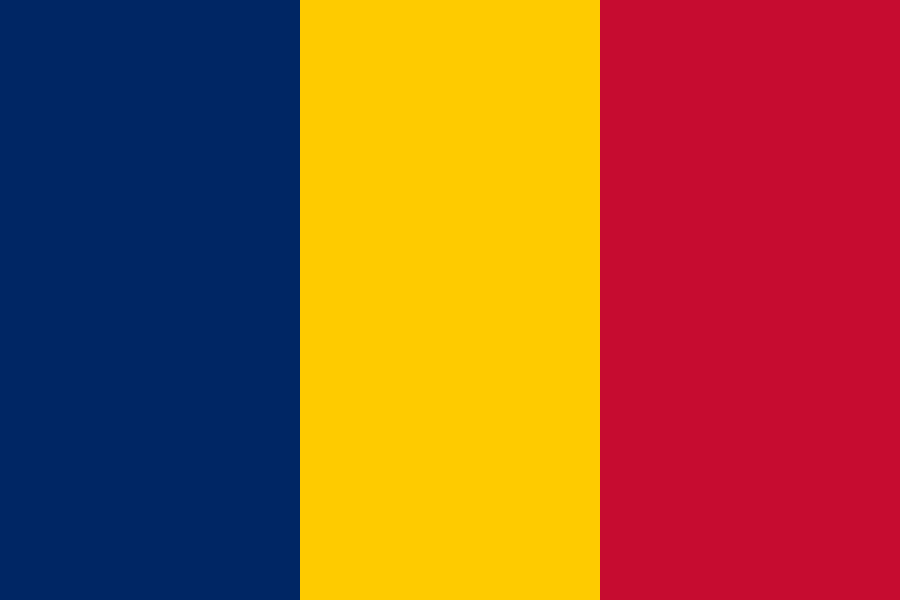
Visually and structurally similar flags
Ranked deterministically across layout family (35%), color overlap and stripe order (25%), symbols (20%), aspect ratio (10%), and stripe/symmetry geometry (10%):




Sources and image-rights provenance
- Parliament of Romania — Law No. 75 of July 16, 1994 regarding the hoisting of the flag of Romania
- Constitution of Romania (1991/2003), Article 12
SVG artwork provenance: Constructed from statutory specifications (public-domain-statute, verified 2026-10-13, SHA-256 d0860aef4132…).