
Flag of Denmark
Native & traditional name: Dannebrog
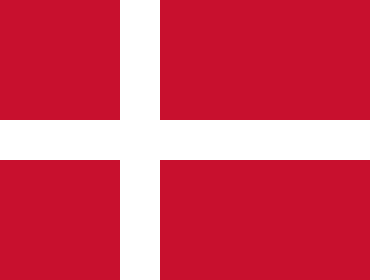
| Flag | Denmark (DK) |
|---|---|
| Type | National flag (national, civil) |
| Proportion | 28:37 (28:37) |
| Primary colors | red, white |
| Main symbol | cross |
| Arrangement | horizontal nordic cross |
| Official adoption | 1748-06-11 — Royal Regulation fixing the 12:4:21 construction of the Dannebrog (traditionally dated to 1219 and attested in the Gelre Armorial c. 1370) |
| Region | Northern Europe |
Plain-language visual description
Denmark's national flag (the Dannebrog) is a 28:37 red rectangular field bearing an asymmetric white Nordic cross whose vertical bar is shifted toward the hoist.
Construction and geometry
Proportion & symmetry: The Flag of Denmark uses a statutory 28:37 height-to-width ratio on a rectangular field with horizontal mirror symmetry. Vertical ratio 12:4:12 (28 units); horizontal ratio 12:4:21 (37 units, expanding to 12:4:29 as the flag wears at the fly).
- Under the Royal Regulation of 11 June 1748, the hoist height is 28 units (12 red + 4 white + 12 red) and the fly length is 37 units (12 red + 4 white + 21 red), making the two hoist cantons perfect 12×12 squares.
- Modern Danish rules allow the fly to extend up to 12:4:29 on outdoor flags so the cloth can be trimmed as the fly frays in the wind.
Official colors and specification system
Rather than manufacturing false RGB precision where a statute specifies dyed cloth, Pantone, Munsell, or CIE coordinates, the table below records the governing color system alongside a calibrated display hex approximation.
| Color | Official shade name | Specification system | Statutory / standard code | Display hex |
|---|---|---|---|---|
| red | Dannebrog Red (Dannebrogsrød) | pantone | Pantone 186 C | #C8102E |
| white | White | statute-named | Named in statute | #FFFFFF |
Meaning and symbolism
Documented symbolism
The white cross on a red field originated as a medieval Christian crusading banner and royal war standard in the Baltic region, later becoming the prototype for the entire Nordic cross design family.
Common interpretations
Sixteenth-century Danish chronicles (notably Christiern Pedersen and Petrus Olai) recount the legend that the Dannebrog fell from the sky during King Valdemar II's Battle of Lyndanisse near Tallinn on 15 June 1219, turning defeat into victory.
History and design evolution
Recognized by Guinness World Records and vexillologists as the oldest continuously used sovereign national flag, the Dannebrog ('Danish cloth') is first visually attested in the late fourteenth-century Gelre Armorial (c. 1370–1386), which depicts a red banner with a white cross alongside the arms of King Valdemar IV Atterdag, and on a 1397 seal of Queen Margaret I's Kalmar Union.
Originally a square banner carried on a lance, the cross was elongated along the fly for maritime use, producing the characteristic hoist-shifted cross that Sweden, Norway, Finland, Iceland, the Faroe Islands, and Åland later adopted.
King Frederick V codified the exact 12:4:21 merchant-flag geometry on 11 June 1748. While private citizens were initially barred from flying the flag on land in 1834, King Frederick VII lifted the restriction in 1854, making the rectangular Stutflag the universal Danish civil and national flag while reserving the swallowtailed Splitflag for the state and crown.
Key historical milestones
- 1219Traditional Battle of Lyndanisse date: Legendary origin of the Dannebrog during King Valdemar II's campaign in Estonia.
- 1370Earliest surviving illustration: Depicted in the Gelre Armorial alongside the royal arms of Denmark.
- 1748Royal Regulation on proportions: Fixes the 12:4:12 by 12:4:21 construction geometry still used today.
Frequently confused with
The Flag of Denmark is commonly confused with the following national flags due to shared colors, stripe geometry, or central emblems:

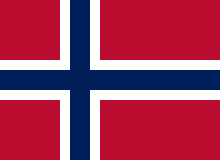
Visually and structurally similar flags
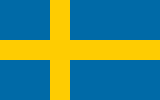
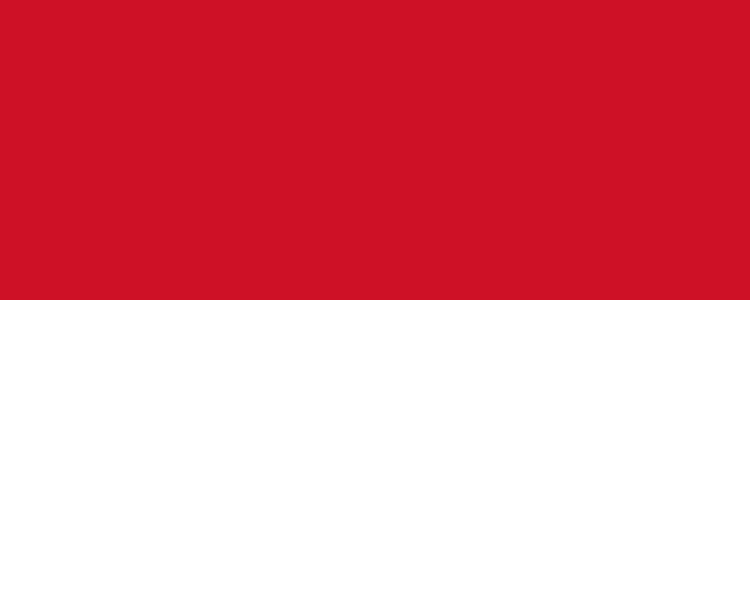
Ranked deterministically across layout family (35%), color overlap and stripe order (25%), symbols (20%), aspect ratio (10%), and stripe/symmetry geometry (10%):



Sources and image-rights provenance
- Justitsministeriet (Ministry of Justice of Denmark) — Flagning i Danmark
- DanmarksSamfundet — Dannebrogs historie og proportioner
SVG artwork provenance: Constructed from statutory specifications (public-domain-statute, verified 2026-10-13, SHA-256 ea1a35331751…).