
Flag of Switzerland
Native & traditional name: Schweizerfahne / Drapeau suisse / Bandiera svizzera

| Flag | Switzerland (CH) |
|---|---|
| Type | National flag (national, civil, state, war) |
| Proportion | 1:1 (1:1) |
| Primary colors | red, white |
| Main symbol | cross |
| Arrangement | centered centered emblem |
| Official adoption | 1889-12-12 — Federal decree fixing the cross arm proportions at 7:6; reaffirmed in the Federal Coat of Arms Protection Act (SR 232.21) on 2017-01-01 |
| Region | Western Europe |
Plain-language visual description
Switzerland's national flag is a 1:1 square red field charged in the center with a bold, couped (free-standing) white Greek cross.
Construction and geometry
Proportion & symmetry: The Flag of Switzerland uses a statutory 1:1 height-to-width ratio on a square field with both mirror symmetry. Square 1:1 field (32×32 units); centered white Greek cross whose four arms are 1/6 longer than their width (7:6 arm ratio).
- Defined in Annex 2 of the Federal Coat of Arms Protection Act (SR 232.21): a 1:1 square (32×32 units) with a centered white cross whose four equal arms are 1/6 longer than they are wide (7 units long by 6 units wide, spanning 20 of the 32 units).
- Note: the Swiss civil and state maritime ensign flown by sea-going vessels and Rhine barges uses a rectangular 2:3 field while keeping the same centered white cross.
Official colors and specification system
Rather than manufacturing false RGB precision where a statute specifies dyed cloth, Pantone, Munsell, or CIE coordinates, the table below records the governing color system alongside a calibrated display hex approximation.
| Color | Official shade name | Specification system | Statutory / standard code | Display hex |
|---|---|---|---|---|
| red | Swiss Red | pantone | Pantone 485 C / CMYK 0-100-100-0 | #DA291C |
| white | White | statute-named | Named in statute | #FFFFFF |
Meaning and symbolism
Documented symbolism
The white cross on a red field derives from the medieval battle sign of the Old Swiss Confederacy, traced to the thirteenth-century Imperial Banner of the Holy Roman Empire and the canton of Schwyz, where confederate troops sewed white cloth crosses onto their tunics and cantonal banners as a shared field sign.
Common interpretations
Switzerland is one of only two sovereign states (alongside Vatican City) to use a square 1:1 land flag; its inverted colors (a red cross on a white field) were deliberately adopted by the 1864 Geneva Convention as the neutral protective emblem of the International Red Cross in tribute to Switzerland.
History and design evolution
At the Battle of Laupen in 1339, soldiers of the Old Swiss Confederacy attached two strips of white cloth in the shape of a cross to their armor to distinguish themselves from Habsburg forces on the battlefield. Over the fifteenth and sixteenth centuries, this white confederate cross was placed directly onto cantonal war banners and triangular military standards.
Following the Napoleonic Helvetic Republic (which briefly used a green-red-yellow tricolor from 1798 to 1803), the reorganized Swiss federal army adopted a unified red square banner with a centered white cross in 1815, championed by General Guillaume-Henri Dufour. In 1848 the new Federal Constitution made the federal cross the national emblem of the modern Swiss confederation.
On 12 December 1889 the Federal Assembly standardized the cross geometry so that each arm is one-sixth longer than its width, and the 2017 Coat of Arms Protection Act added official Pantone 485 C and CMYK specifications alongside rules for the 2:3 maritime ensign.
Key historical milestones
- 1339Battle of Laupen field sign: Confederate troops wear white cloth crosses over red tunics as a common battle emblem.
- 1848Federal flag of modern Switzerland: Adopted for the newly federated Swiss state at the recommendation of General Guillaume-Henri Dufour.
- 1889Federal decree on 7:6 cross arm geometry: Standardizes the couped cross arms at 1/6 longer than their width on a square field.
Frequently confused with
The Flag of Switzerland is commonly confused with the following national flags due to shared colors, stripe geometry, or central emblems:
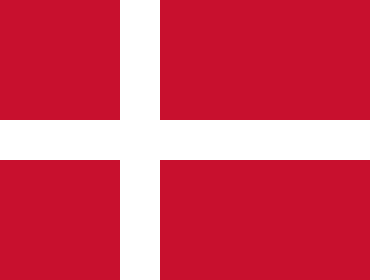
Visually and structurally similar flags
Ranked deterministically across layout family (35%), color overlap and stripe order (25%), symbols (20%), aspect ratio (10%), and stripe/symmetry geometry (10%):


Sources and image-rights provenance
- Fedlex — Federal Act on the Protection of the Coat of Arms of Switzerland and Other Public Signs (SR 232.21)
- Historical Dictionary of Switzerland — Fahnen (Flags)
SVG artwork provenance: Constructed from statutory specifications (public-domain-statute, verified 2026-10-13, SHA-256 2e22a8df7600…). Insignia notice: Swiss Federal Act on the Protection of the Coat of Arms of Switzerland and Other Public Signs (SR 232.21) regulates commercial misuse as a trademark or false origin mark.