
Flag of Japan
Native & traditional name: 日章旗 (Nisshōki) / 日の丸 (Hinomaru)
| Flag | Japan (JP) |
|---|---|
| Type | National flag (national, civil, state) |
| Proportion | 2:3 (2:3) |
| Primary colors | white, red |
| Main symbol | disc |
| Arrangement | centered centered emblem |
| Official adoption | 1870-02-27 — Proclamation No. 57 (civil merchant ensign); codified in exact 2:3 centered geometry by the Act on National Flag and Anthem on 1999-08-13 |
| Region | Eastern Asia |
Plain-language visual description
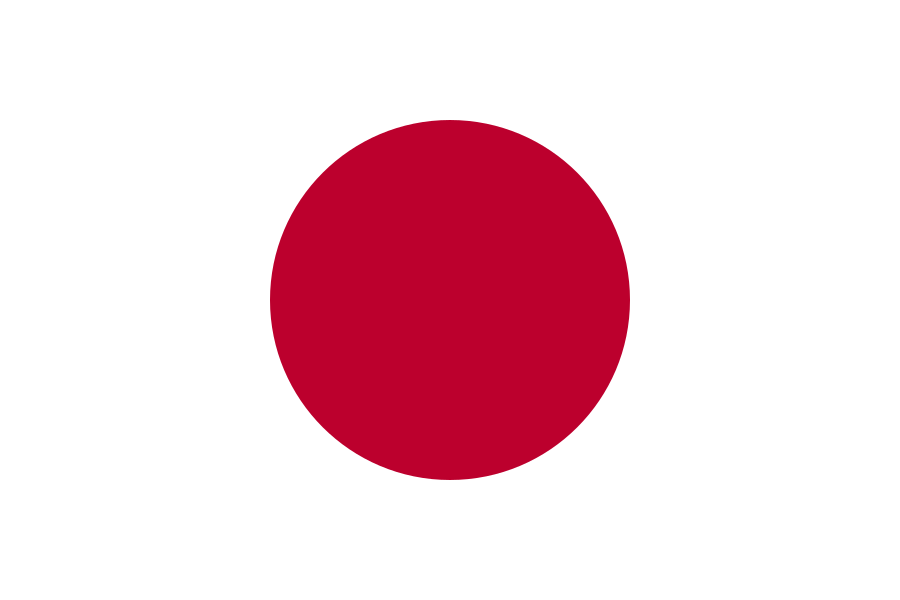
Japan's national flag consists of a solid crimson-red circular disc centered on a pure white rectangular field in a 2:3 aspect ratio.
Construction and geometry
Proportion & symmetry: The Flag of Japan uses a statutory 2:3 height-to-width ratio on a rectangular field with both mirror symmetry. Disc diameter is exactly 3/5 of the vertical hoist height, centered both horizontally and vertically.
- The 1999 Act standardized the flag's geometry: the vertical hoist to horizontal fly ratio is 2:3, the diameter of the crimson disc is 3/5 of the vertical hoist length, and the center of the disc coincides exactly with the geometric center of the rectangle.
- Prior to the 1999 reform, the 1870 Proclamation No. 57 placed the sun disc 1/100 of the flag's length closer to the hoist.
Official colors and specification system
Rather than manufacturing false RGB precision where a statute specifies dyed cloth, Pantone, Munsell, or CIE coordinates, the table below records the governing color system alongside a calibrated display hex approximation.
| Color | Official shade name | Specification system | Statutory / standard code | Display hex |
|---|---|---|---|---|
| white | White | munsell | N 9.4 (cloth standard) | #FFFFFF |
| red | Crimson (Beni-iro) | munsell | 5.7R 3.7/15.5 | #BC002D |
Meaning and symbolism
Documented symbolism
Under the 1999 Act on the National Flag and Anthem (Law No. 127 of 1999) and its predecessors, the red disc (Hinomaru, 'circle of the sun') represents the rising sun, reflecting Japan's ancient epithet Nihon ('source of the sun') recorded in seventh-century diplomatic correspondence and imperial court banners.
Common interpretations
Popular tradition often associates the red and white pairing with honesty, purity, and passion, or links the pairing to the red-and-white banners of the Taira and Minamoto clans during the twelfth-century Genpei War, though the 1999 statute does not codify moral attributes for the two colors.
History and design evolution
Sun-disc banners appeared in Japanese court and military heraldry at least as early as the Asuka and Nara periods, when Emperor Mommu used a golden sun standard at his 701 New Year court ceremony. During the sixteenth and seventeenth centuries, feudal daimyō and Tokugawa shogunate trading vessels flew red-sun ensigns on white cloth to identify Japanese ships at sea.
After the opening of Japanese ports in 1854, the Tokugawa shogunate ordered all Japanese vessels to fly the white banner with a red sun disc as a common civil naval sign. Following the Meiji Restoration, the Daijō-kan issued Proclamation No. 57 on 27 February 1870, establishing the Nisshōki as the official merchant ensign on a 7:10 field with the disc shifted 1 percent toward the hoist.
Although used de facto as the national flag on land and sea for more than a century, its legal status remained tied to maritime proclamations until the National Diet passed the Act on the National Flag and Anthem on 13 August 1999. That statute fixed the modern 2:3 proportion, moved the disc to the exact geometric center, and established Munsell color coordinates for government acrylic bunting.
Key historical milestones
- 1854Tokugawa maritime adoption: The Tokugawa shogunate designates the white banner with a crimson sun disc as the identifying ensign for Japanese ships.
- 1870Daijō-kan Proclamation No. 57: Codifies the Nisshōki in a 7:10 ratio with the sun disc shifted 1/100 toward the hoist.
- 1999Act on National Flag and Anthem: Law No. 127 formalizes the 2:3 ratio and centers the crimson disc exactly in the middle of the field.
Frequently confused with
The Flag of Japan is commonly confused with the following national flags due to shared colors, stripe geometry, or central emblems:

Visually and structurally similar flags
Ranked deterministically across layout family (35%), color overlap and stripe order (25%), symbols (20%), aspect ratio (10%), and stripe/symmetry geometry (10%):





Sources and image-rights provenance
- Act on National Flag and Anthem (Law No. 127 of August 13, 1999)
- Cabinet Office of Japan — National Flag and Anthem Protocol
SVG artwork provenance: Constructed from statutory specifications (public-domain-statute, verified 2026-10-13, SHA-256 73ab0203f5d8…).