
Flag of Bangladesh
Native & traditional name: বাংলাদেশের জাতীয় পতাকা (Jātīẏa Patākā)
| Entity | Bangladesh (BD) |
|---|---|
| Type | Sovereign national flag (national, civil, state) |
| Proportion | 3:5 (3:5) |
| Primary colors | green, red |
| Main symbol | disc |
| Arrangement | centered centered emblem |
| Official adoption | 1972-01-17 — Specified by the People's Republic of Bangladesh Flag Rules, 1972, which describe the 1971 Liberation War flag without its golden map; the published text of the Rules carries no date of issue |
| Region | Southern Asia |
Plain-language visual description
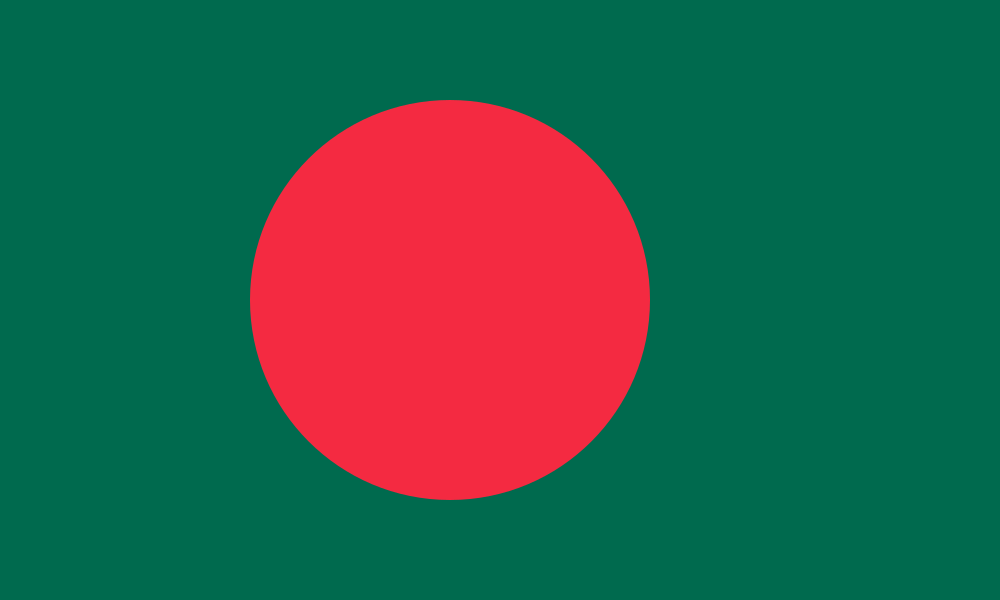
The flag of Bangladesh features a dark bottle-green rectangular field in a 3:5 proportion charged with a large bright red circular disc shifted slightly toward the hoist.
Construction and geometry
Proportion & symmetry: The Flag of Bangladesh uses a 3:5 height-to-width ratio (Bangladesh National Anthem, Flag and Emblem Order, 1972 (P.O. No. 130 of 1972), Second Schedule, para 2: a 10 ft flag is 6 ft wide) on a rectangular field with mirror symmetry about its horizontal centre line (the top and bottom halves match). Length to width is 10:6 (3:5). The red disc has a radius of 1/5 of the flag length and is centered on the horizontal midline at 9/20 of the length from the hoist; the offset is commonly explained as making the disc appear centered when flying.
- The flag's length-to-width ratio is 10:6 (3:5). The red disc has a radius equal to 1/5 of the flag's length.
- Its center lies on the horizontal midline at 9/20 (45 percent) of the length from the hoist edge (4½ ft on a 10 ft flag); the offset is commonly explained as making the disc appear centered when the fly flutters in the wind.
Colors and how they are specified
A color code is marked official only when the governing law, decree or official government specification itself gives it, and the source is quoted below the table. Where the law names a color without a code, or sets no shade at all, the table says so and the display hex is an approximation. Commonly used but unofficial codes are labelled as such. Unless the table names another source for it, a hex shown beside a Pantone code is Pantone's own published sRGB value for that code.
| Color | Shade name | Specification system | Code | Display hex |
|---|---|---|---|---|
| green | Bottle Green | statute-named | named in law, no code | #006A4E |
| red | Bright Red | statute-named | named in law, no code | #F42A41 |
- Bottle Green (statute-named): Bangladesh National Anthem, Flag and Emblem Order, 1972 (P.O. No. 130 of 1972), Second Schedule, para 3(a) —
3. The colour of the Flag shall be- (a) The green background of the flag: Procion Brilliant Green- H-2RS, 50 parts per 1000.
- Bright Red (statute-named): Bangladesh National Anthem, Flag and Emblem Order, 1972 (P.O. No. 130 of 1972), Second Schedule, para 3(b) —
(b) The red circular part: Procion Brilliant Orange-H-2RS, 60 parts per 1000.
Meaning and symbolism
Documented symbolism
The Bangladesh National Anthem, Flag and Emblem Order, 1972 (P.O. No. 130 of 1972) assigns no meaning to the colours: Article 3 describes the flag only as a circle coloured red throughout its area resting on a green background, and its Second Schedule fixes sizes, proportions and dye recipes.
Common interpretations
Commonly repeated descriptions say the green stands for the lush landscape and vitality of Bengal and the red disc for the sun rising over Bengal and the blood shed during the 1971 Liberation War; these meanings are not set out in the 1972 Order.
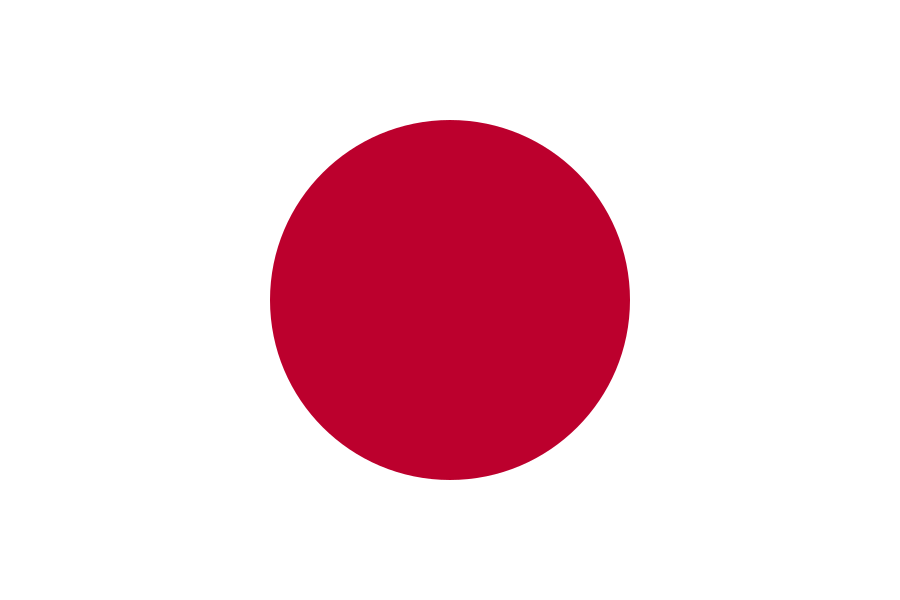
Commentators frequently compare the design to Japan's Hinomaru, though the Bangladeshi flag grew out of a 1970 student-activist design that deliberately excluded the star and crescent associated with Pakistan.
History and design evolution
The precursor to the Bangladeshi national flag was created in June 1970 by student leaders of the Swadhin Bangla Nucleus at the University of Dhaka, including Shib Narayan Das, who placed a golden silhouette map of East Bengal inside a red sun disc on a dark green field. The design deliberately avoided the crescent and star of the Pakistani flag.
This map-bearing flag was first raised publicly at the University of Dhaka on 2 March 1971 and served as the rallying standard of the provisional government and Mukti Bahini guerrilla forces throughout the nine-month Bangladesh Liberation War.
Shortly after independence, on 17 January 1972, the government adopted the simplified definitive design, credited to artist Quamrul Hassan. The new design removed the intricate golden map (one reason given was the difficulty of rendering the map correctly on both sides of the cloth) and established the 10:6 ratio with a slight hoist offset.
Key historical milestones
- 1970Student activist design: Student leaders at Dhaka University design a green flag with a red disc containing a golden map of East Bengal.
- 1971First public hoisting: Raised at Dhaka University on 2 March 1971 and used throughout the Liberation War.
- 1972Simplified national flag adopted: The 1972 Flag Rules remove the central map and establish the 10:6 ratio with the 9/20 hoist-offset red disc.
Frequently confused with
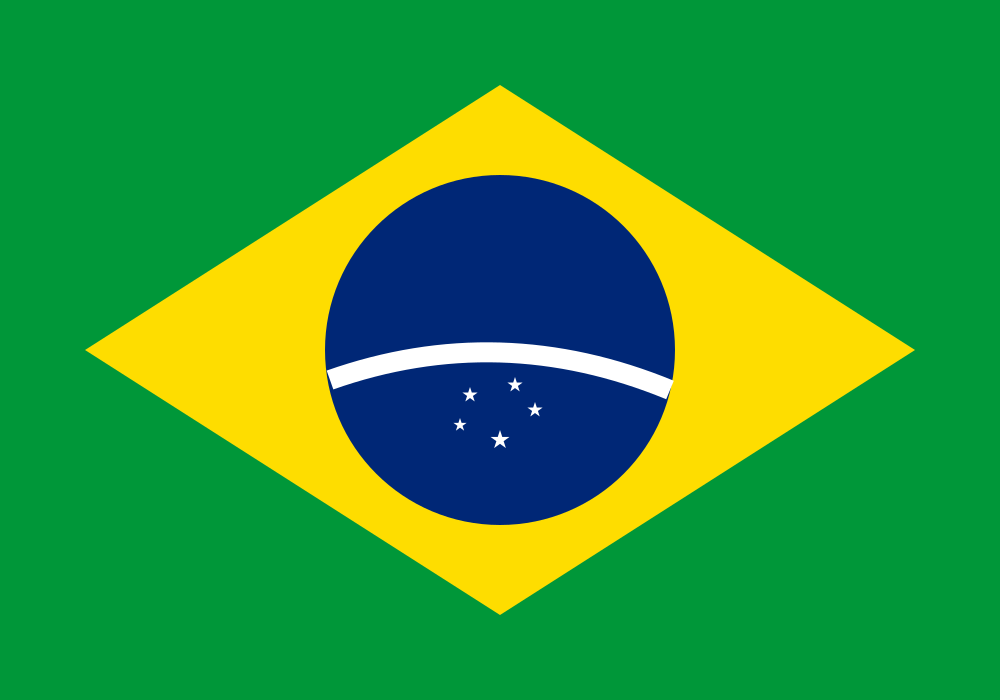
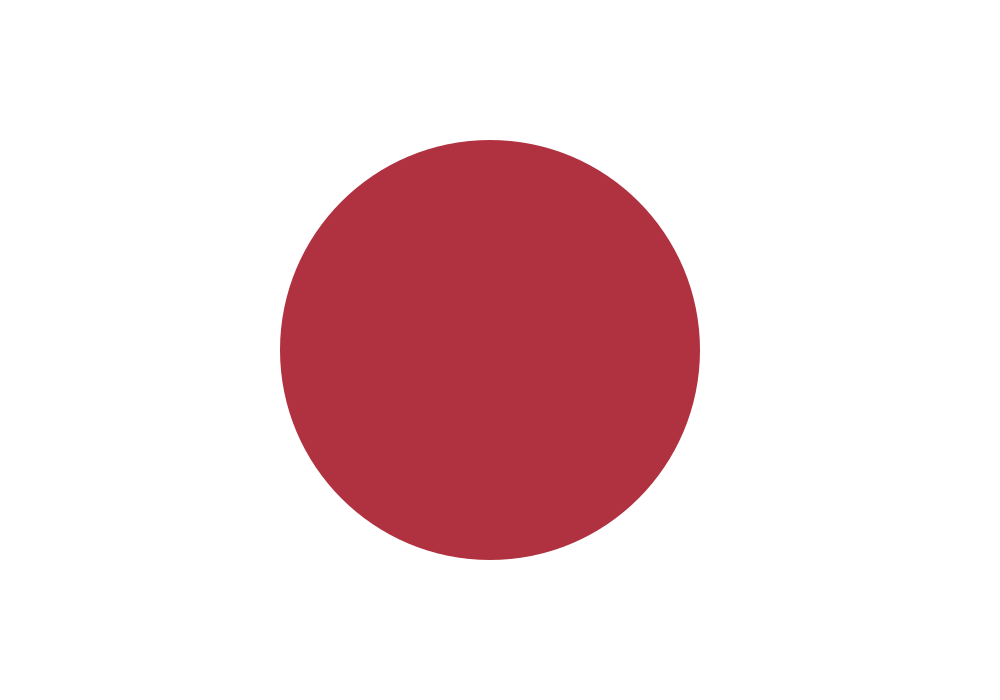
The Flag of Bangladesh is commonly confused with or compared alongside the following catalog flags due to shared colors, stripe geometry, or central emblems:
Visually and structurally similar flags in this catalog
Ranked deterministically across layout family, orientation and shape (35%), color overlap and stripe order (25%), symbols (20%), aspect ratio (10%), and stripe/symmetry geometry (10%):


Sources and image-rights provenance
- Bangladesh National Anthem, Flag and Emblem Order, 1972 (President's Order No. 130 of 1972), Article 3 and Second Schedule
- Banglapedia — National Flag
SVG artwork provenance: Original FastFlags drawing generated by scripts/generate-seed-svg-assets.ts from this record's ratio, layout and display colours; not an official construction sheet. (public-domain-statute, checked 2026-10-15, SHA-256 7b714df8c57e…).