
Flag of Monaco
Native & traditional name: Drapeau de Monaco

| Flag | Monaco (MC) |
|---|---|
| Type | National flag (national, civil) |
| Proportion | 4:5 (4:5) |
| Primary colors | red, white |
| Main symbol | None (geometric bands) |
| Arrangement | horizontal bicolor (red · white) |
| Official adoption | 1881-04-04 — Sovereign Ordinance of Prince Charles III; retained in Article 7 of the 1962 Constitution |
| Region | Western Europe |
Plain-language visual description
Monaco's national and civil flag is a 4:5 rectangular horizontal bicolor with an upper band of heraldic red and a lower band of white.
Construction and geometry
Proportion & symmetry: The Flag of Monaco uses a statutory 4:5 height-to-width ratio on a rectangular field with vertical mirror symmetry. Official standard proportion is 4:5 (though 2:3 is also flown internationally), divided into two equal horizontal bands of red over white.
- Official government proportion is 4:5 (height to length) with two equal horizontal stripes of red over white, although 2:3 flags are also seen in international protocol.
- Monaco also maintains a distinct State Flag showing the full Grimaldi coat of arms on a white field, flown over the Prince's Palace and ministries.
Official colors and specification system
Rather than manufacturing false RGB precision where a statute specifies dyed cloth, Pantone, Munsell, or CIE coordinates, the table below records the governing color system alongside a calibrated display hex approximation.
| Color | Official shade name | Specification system | Statutory / standard code | Display hex |
|---|---|---|---|---|
| red | Grimaldi Red | pantone | Pantone 186 C | #CE1126 |
| white | White | statute-named | Named in statute | #FFFFFF |
Meaning and symbolism
Documented symbolism
As documented by the Princely Government of Monaco, the red and white colors derive directly from the silver-and-gules lozengy shield of the House of Grimaldi, used by the ruling dynasty since at least 1339.
Common interpretations
Monaco's horizontal bicolor is routinely confused with Indonesia's flag; the primary structural distinction is Monaco's squarer 4:5 official proportion (compared with Indonesia's 2:3 rectangle) and slightly deeper Pantone 186 C red.
History and design evolution
Red and white have been the heraldic livery colors of the House of Grimaldi since François Grimaldi seized the fortress of Monaco in 1297 and the red-and-silver lozengy shield was recorded in fourteenth-century Genoese and Monegasque seals. For centuries the principality's main banner was either a white field bearing the full princely coat of arms or a lozengy red-and-white banner.
On 4 April 1881, Prince Charles III issued a Sovereign Ordinance simplifying the national and civil flag to two equal horizontal bands of red over white while reserving the armorial banner on a white field for state buildings, diplomatic missions, and the sovereign's presence.
When Indonesia proclaimed independence in 1945 with its own red-over-white horizontal bicolor, the Princely Government of Monaco noted the visual overlap through diplomatic channels, but because Indonesia's Austronesian red-and-white tradition also dated back centuries and used a wider 2:3 ratio, both flags remained unchanged and were constitutionalized in Monaco's 1962 Constitution.
Key historical milestones
- 1339Grimaldi red-and-white heraldry: Red and white lozenges are documented as the heraldic colors of the House of Grimaldi.
- 1881Sovereign Ordinance of Prince Charles III: Establishes the simplified red-over-white horizontal bicolor on 4 April 1881.
- 1962Constitutional codification: Article 7 of the Monegasque Constitution confirms both the princely armorial standard and the red-over-white national flag.
Frequently confused with
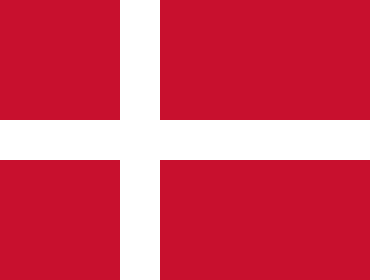
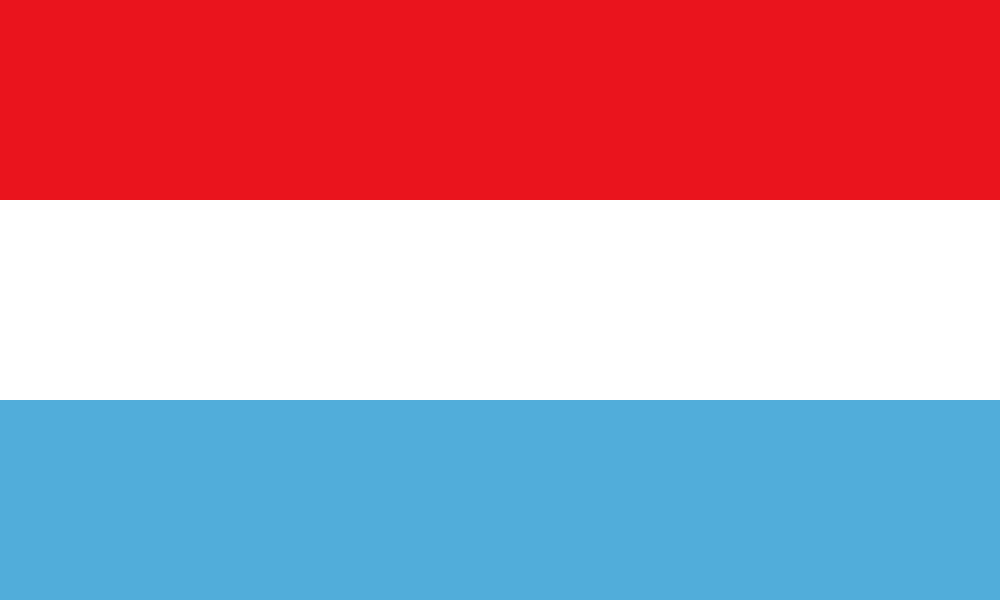
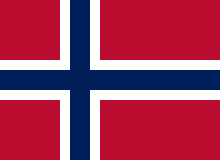
The Flag of Monaco is commonly confused with the following national flags due to shared colors, stripe geometry, or central emblems:


Visually and structurally similar flags
Ranked deterministically across layout family (35%), color overlap and stripe order (25%), symbols (20%), aspect ratio (10%), and stripe/symmetry geometry (10%):

Sources and image-rights provenance
- Princely Government of Monaco — Red and White Flag
- Constitution of the Principality of Monaco (1962), Article 7
SVG artwork provenance: Constructed from statutory specifications (public-domain-statute, verified 2026-10-13, SHA-256 490ad5362adf…).