
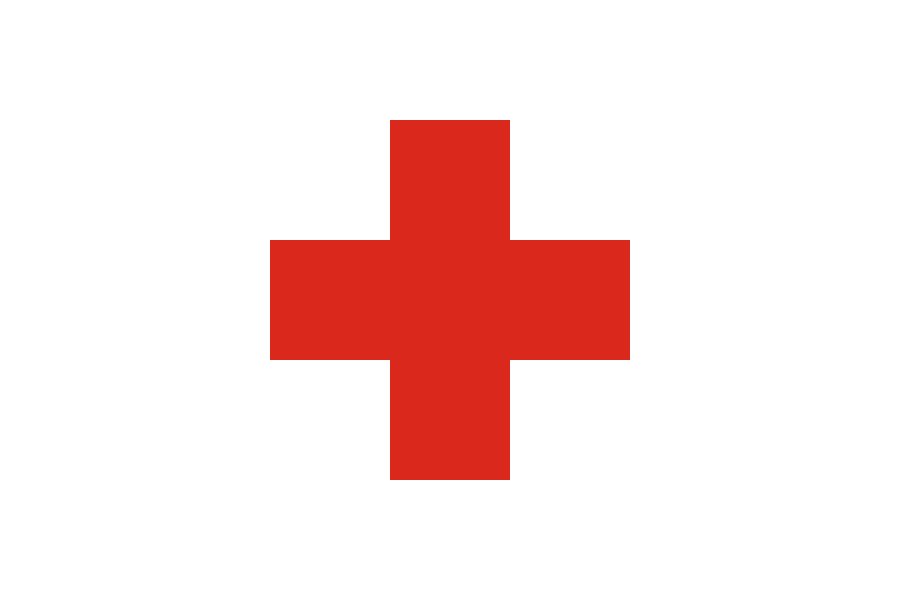
Flag of the Red Cross
Native & traditional name: Geneva Convention Protective Emblem
| Entity | International Red Cross |
|---|---|
| Type | International organization / treaty emblem (organizational) |
| Proportion | 2:3 (2:3) |
| Primary colors | white, red |
| Main symbol | cross |
| Arrangement | centered st george cross |
| Official adoption | 1864-08-22 |
| Region | International Humanitarian Law |
Plain-language visual description
The protective flag of the Red Cross consists of a plain white field charged in the center with a free-standing red Greek cross formed of five equal squares.
Construction and geometry
Proportion & symmetry: The Flag of the Red Cross uses a statutory 2:3 height-to-width ratio on a rectangular field with both mirror symmetry. White field charged in the center with a free-standing red Greek cross formed of five equal squares.
- Typically rendered in a 2:3 ratio with a central Greek cross composed of five equal squares (each arm equal in length and width).
- Under the Geneva Conventions, no rigid shade of red or exact arm ratio is required for battlefield validity, ensuring that improvised medical flags remain legally protected.
Official colors and specification system
Rather than manufacturing false RGB precision where a statute specifies dyed cloth, Pantone, Munsell, or CIE coordinates, the table below records the governing color system alongside a calibrated display hex approximation.
| Color | Official shade name | Specification system | Statutory / standard code | Display hex |
|---|---|---|---|---|
| white | White | statute-named | Named in statute | #FFFFFF |
| red | Red | pantone | Pantone 485 C (ICRC visual identity; Geneva Conventions specify any clear red) | #DA291C |
Meaning and symbolism
Documented symbolism
Article 38 of the First Geneva Convention of 1949 explicitly records the origin and meaning of the emblem: 'As a compliment to Switzerland, the heraldic emblem of the red cross on a white ground, formed by reversing the Federal colours, is retained as the emblem and distinctive sign of the Medical Service of armed forces.'
Primarily a protective sign under International Humanitarian Law, the flag signals to combatants that medical personnel, hospitals, ambulances, and hospital ships are neutral and must not be attacked.
Common interpretations
Because the emblem is a Greek cross, the Ottoman Empire introduced the Red Crescent in 1876 (formally recognized in 1929), and Additional Protocol III of 2005 added the Red Crystal as a neutral third protective emblem.
History and design evolution
After witnessing the horrific aftermath of the June 1859 Battle of Solferino in northern Italy, Swiss businessman and humanitarian Henry Dunant published A Memory of Solferino in 1862, calling for the creation of permanent voluntary relief societies and an binding international treaty protecting battlefield medical services under a single uniform flag.
In October 1863, the International Committee in Geneva—known as the Committee of Five and led by Dunant, Gustave Moynier, General Guillaume-Henri Dufour, Dr. Louis Appia, and Dr. Théodore Maunoir—proposed a white armlet and flag bearing a red cross. The diplomatic conference convened by the Swiss Federal Council that adopted the First Geneva Convention on 22 August 1864 codified the red cross on a white ground as the universal protective sign.
In 1906, the revised Geneva Convention added the formal treaty statement that the emblem was created by reversing the federal colors of Switzerland. Because its life-saving effectiveness depends on strict visual exclusivity, domestic statutes worldwide prohibit commercial trademarks, pharmacies, or unauthorized third parties from using a red cross on a white ground.
Key historical milestones
- 1863Geneva Conference: The International Committee proposes a red cross on a white ground on 29 October 1863.
- 1864First Geneva Convention: Article 7 of the 22 August 1864 treaty establishes the Red Cross protective flag in international law.
- 1906Swiss Inversion Codified: The 1906 Geneva Convention records that the emblem reverses the federal colors of Switzerland.
Frequently confused with
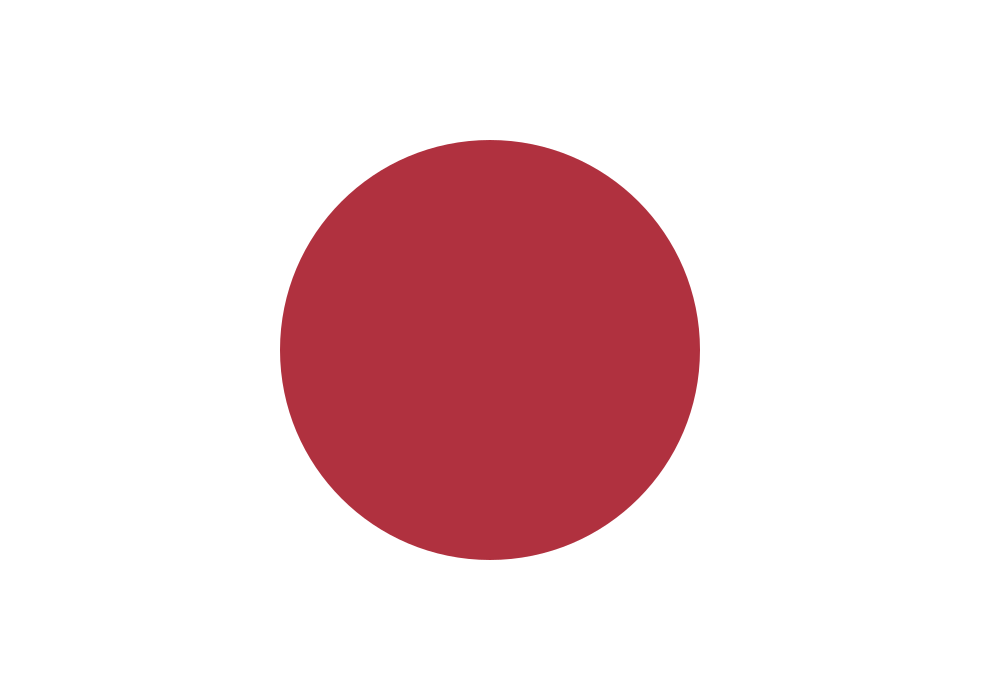
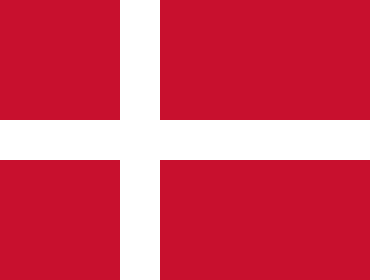
The Flag of the Red Cross is commonly confused with or compared alongside the following flags due to shared colors, stripe geometry, or central emblems:

Visually and structurally similar flags
Ranked deterministically across layout family (35%), color overlap and stripe order (25%), symbols (20%), aspect ratio (10%), and stripe/symmetry geometry (10%):



Sources and image-rights provenance
- The History of the Emblems of the International Red Cross and Red Crescent Movement
- Geneva Convention (I) for the Amelioration of the Condition of the Wounded and Sick in Armed Forces in the Field, Article 38 — 75 UNTS 31
SVG artwork provenance: Constructed from statutory specifications (public-domain-statute, verified 2026-10-13, SHA-256 da11c8a46367…). Insignia notice: Strictly protected protective emblem under the 1949 Geneva Conventions; unauthorized commercial or imitative use is prohibited by international and domestic law.