
Flag of Brazil
Native & traditional name: Bandeira do Brasil (Auriverde)
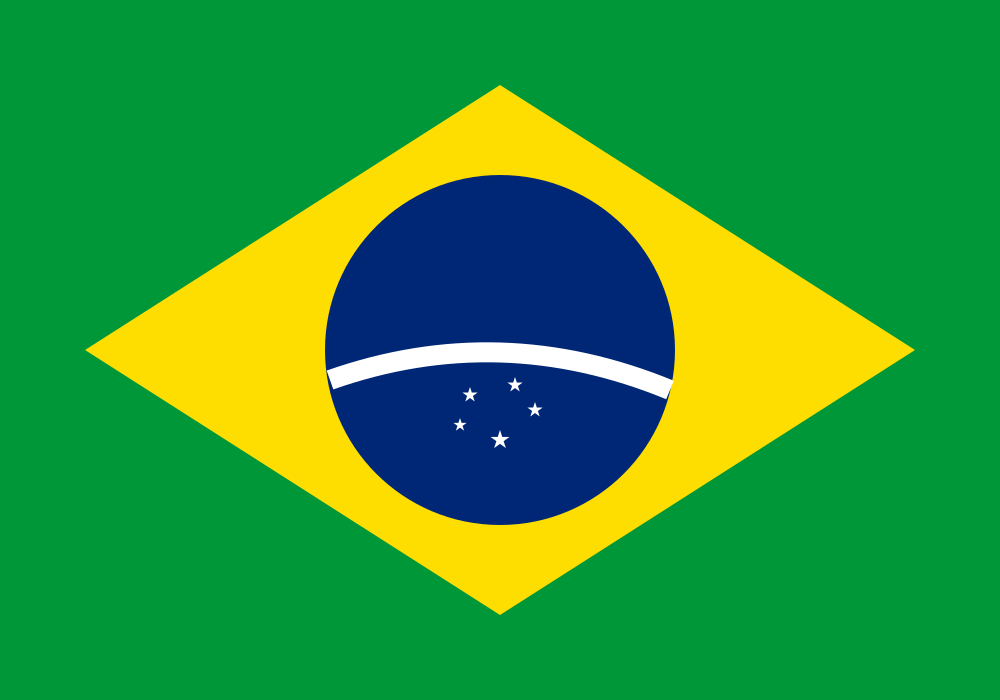
| Entity | Brazil (BR) |
|---|---|
| Type | Sovereign national flag (national, civil) |
| Proportion | 7:10 (7:10) |
| Primary colors | green, yellow, blue, white |
| Main symbol | disc |
| Arrangement | centered centered emblem |
| Official adoption | 1889-11-19 |
| Region | South America |
Plain-language visual description
The national flag of Brazil features a green field with a large yellow rhombus, enclosing a blue celestial globe with 27 white stars and a white curved motto band reading 'Ordem e Progresso' in a 7:10 ratio.
Construction and geometry
Proportion & symmetry: The Flag of Brazil uses a statutory 7:10 height-to-width ratio on a rectangular field with both mirror symmetry. Green 7:10 field with yellow rhombus and blue celestial globe with 27 stars.
Official colors and specification system
Rather than manufacturing false RGB precision where a statute specifies dyed cloth, Pantone, Munsell, or CIE coordinates, the table below records the governing color system alongside a calibrated display hex approximation.
| Color | Official shade name | Specification system | Statutory / standard code | Display hex |
|---|---|---|---|---|
| green | Verde (Green) | pantone | Pantone 2420 C | #009739 |
| yellow | Amarelo (Yellow) | pantone | Pantone Yellow C | #FEDD00 |
| blue | Azul (Blue) | pantone | Pantone 280 C | #002776 |
| white | Branco (White) | statute-named | Named in statute | #FFFFFF |
Meaning and symbolism
Documented symbolism
Decree No. 4 of 1889 and Law 8.421 of 1992 govern the flag. The green field represents the House of Braganza and yellow represents the House of Habsburg.
The blue celestial globe depicts the starry sky over Rio de Janeiro on the morning of 15 November 1889, when the Republic was proclaimed.
The 27 white stars represent the 26 states and the Federal District, arranged according to actual astronomical constellations.
Common interpretations
Modern popular lore teaches that green represents the Amazon rainforest and yellow represents Brazil's mineral and gold wealth.
History and design evolution
The national flag of Brazil, known as the Auriverde ('gold and green'), was adopted on November 19, 1889, four days after the proclamation of the Republic that overthrew Emperor Dom Pedro II. The flag was created through a collaboration between philosopher Raimundo Teixeira Mendes, astronomer Manuel Pereira Reis, and painter Décio Villares. It deliberately built upon the imperial flag designed in 1822 by French artist Jean-Baptiste Debret for the Empire of Brazil.
Debret's imperial flag had featured a green field (representing the royal House of Braganza of Emperor Pedro I) with a yellow rhombus (representing the House of Habsburg-Lorraine of Empress Maria Leopoldina) enclosing the imperial coat of arms. When the republic was established in 1889, an interim flag with thirteen horizontal green and yellow stripes and a blue canton of stars—closely mimicking the flag of the United States—was hoisted for just four days. President Deodoro da Fonseca rejected that derivative design, insisting that Brazil's national flag should preserve the familiar green field and yellow rhombus of its sovereign heritage.
The designers replaced the imperial coat of arms inside the rhombus with an indigo-blue celestial sphere tilted at the angle of the ecliptic. Across the globe, an ascending white ribbon displays the national motto 'Ordem e Progresso' ('Order and Progress'), inspired by Auguste Comte's positivist motto. The globe depicts the star constellations as they appeared in the sky over Rio de Janeiro on the morning of November 15, 1889, the day the republic was proclaimed. Each star corresponds to a specific Brazilian state, and federal law mandates that whenever a new state is created, a star must be added to the constellation.
Key historical milestones
- 1889Republican Adoption: Decree No. 4 adopts the republican flag on 19 November 1889.
- 1992Law 8.421: Standardizes the 27-star constellation arrangement.
Visually and structurally similar flags
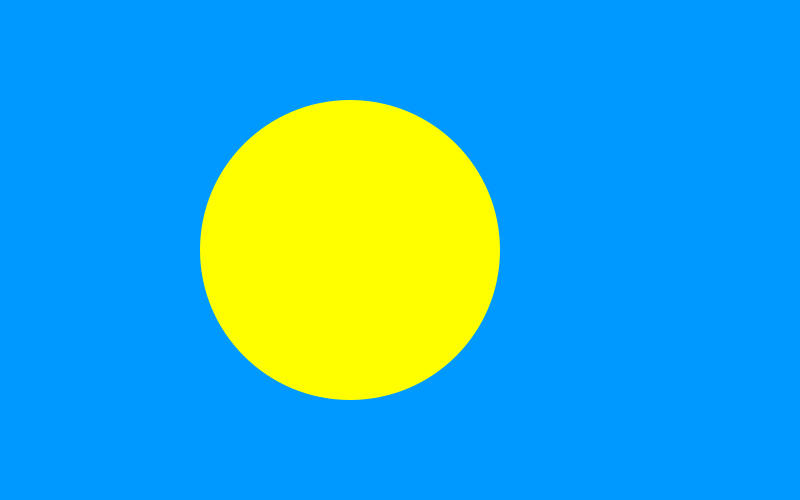
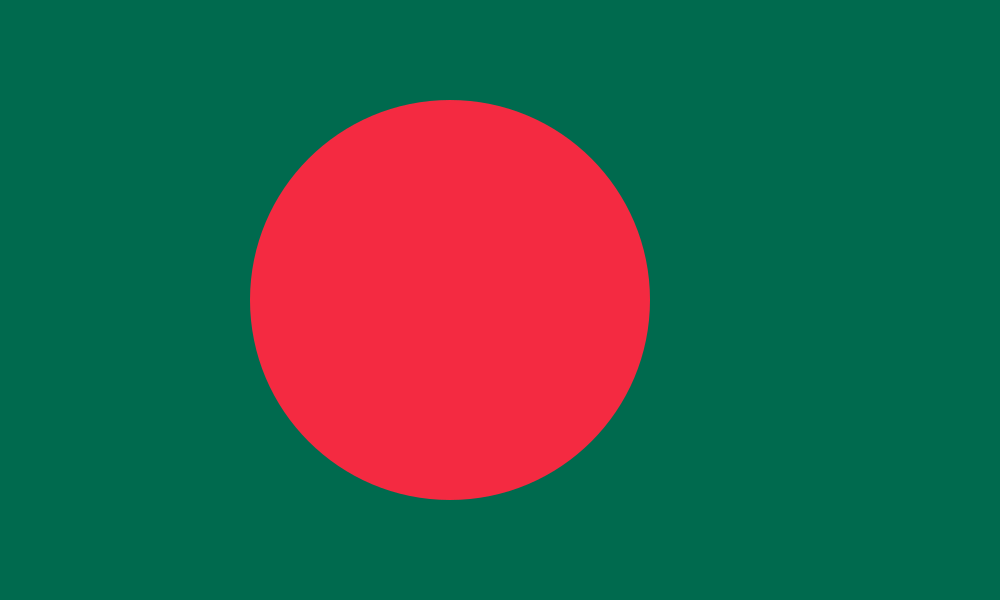
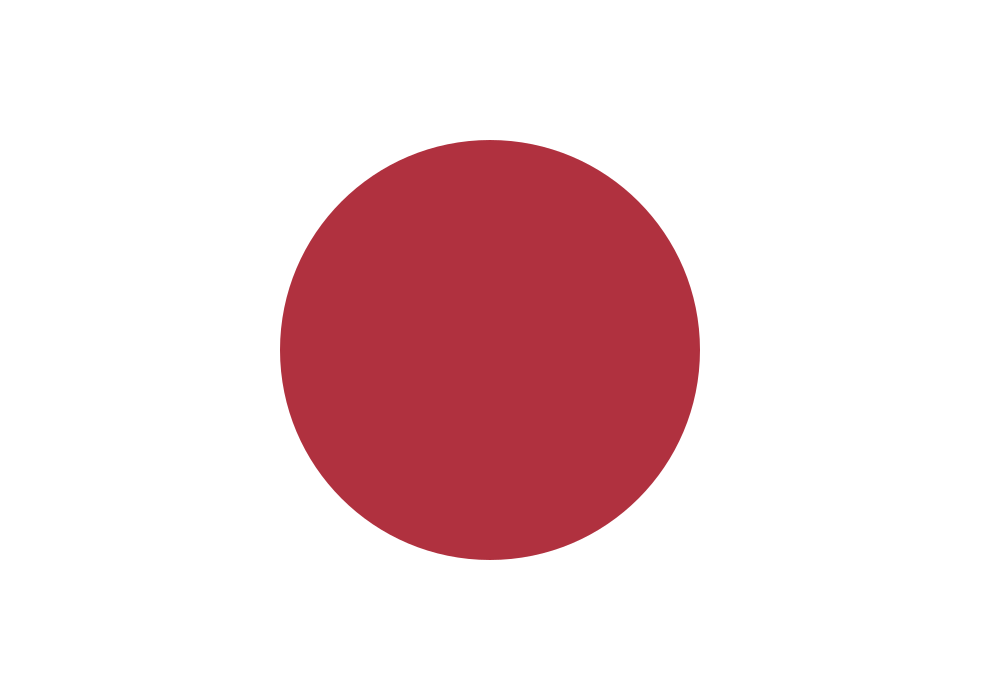
Ranked deterministically across layout family (35%), color overlap and stripe order (25%), symbols (20%), aspect ratio (10%), and stripe/symmetry geometry (10%):



Sources and image-rights provenance
- Decreto No. 4 de 19 de novembro de 1889 — Coleção de Leis do Brasil
- Lei No. 8.421 de 11 de maio de 1992
SVG artwork provenance: Constructed from statutory specifications (public-domain-statute, verified 2026-10-14, SHA-256 5a774b8d965c…).