
Flag of the European Union
Native & traditional name: Flag of Europe
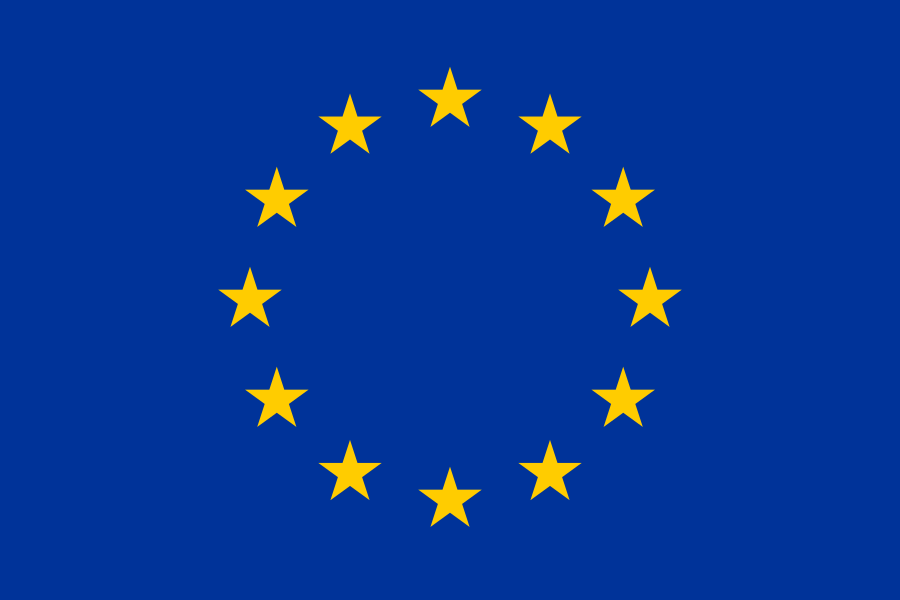
| Entity | European Union (EU) |
|---|---|
| Type | International organization / treaty emblem (organizational) |
| Proportion | 2:3 (2:3) |
| Primary colors | blue, yellow |
| Main symbol | star (×12) |
| Arrangement | centered centered emblem |
| Official adoption | 1955-12-08 |
| Region | European Union & Council of Europe |
Plain-language visual description
The Flag of Europe (flag of the European Union and the Council of Europe) features a circle of twelve upright golden five-pointed stars centered on an azure (Pantone Reflex Blue) field in a 2:3 aspect ratio.
Construction and geometry
Proportion & symmetry: The Flag of the European Union uses a statutory 2:3 height-to-width ratio on a rectangular field with both mirror symmetry. 2:3 ratio; circle of 12 upright five-pointed stars (radius of circle = 1/3 of hoist height; radius of each star = 1/18 of hoist height).
- Aspect ratio is 2:3.
- Circle of 12 stars has a radius equal to 1/3 of the hoist height, centered at the intersection of the diagonals.
- Each five-pointed star is circumscribed in an invisible circle of radius 1/18 of the hoist height, with one point directed straight upward (not radially outward) at the 12 hour positions of a clock face.
Official colors and specification system
Rather than manufacturing false RGB precision where a statute specifies dyed cloth, Pantone, Munsell, or CIE coordinates, the table below records the governing color system alongside a calibrated display hex approximation.
| Color | Official shade name | Specification system | Statutory / standard code | Display hex |
|---|---|---|---|---|
| blue | Pantone Reflex Blue | pantone | Pantone Reflex Blue (RGB 0, 51, 153) | #003399 |
| yellow | Pantone Yellow | pantone | Pantone Yellow (RGB 255, 204, 0) | #FFCC00 |
Meaning and symbolism
Documented symbolism
The official 1955 Council of Europe resolution states: 'Against the blue sky of the Western world, the stars symbolize the peoples of Europe in a form of a circle, a sign of union. Their number shall be invariably set at twelve, the symbol of completeness and perfection.'
Crucially, the twelve stars do not represent the number of member states; the count was fixed permanently at twelve in 1955 (when the Council of Europe had 15 members and the European Coal and Steel Community had 6) so the flag would never require redesign upon enlargement.
Common interpretations
Co-designer Arsène Heitz later noted that he had also been inspired by the circle of twelve stars in the Book of Revelation (12:1), though Council of Europe Secretary-General Léon Marchand and heraldists Paul M. G. Lévy emphasized the secular symbolism of the clock face, calendar months, and classical perfection.
History and design evolution
Beginning in 1950, the Council of Europe established a committee to select a visual emblem for European unity, reviewing more than a hundred proposals ranging from Richard von Coudenhove-Kalergi's red cross on a golden sun to Salvador de Madariaga's constellation map of European capitals.
Strasbourg draftsman Arsène Heitz and Belgian information director Paul M. G. Lévy converged on a ring of golden five-pointed stars on a dark blue field. After rejecting fifteen stars (due to a dispute over the status of the Saar protectorate) and fourteen stars, the Council of Europe Committee of Ministers unanimously adopted the twelve-star circle on 8 December 1955.
In 1983 the European Parliament endorsed the Council of Europe flag as the emblem of the European Communities, and following the June 1985 Milan Summit, it was formally hoisted outside the Berlaymont building in Brussels on 29 May 1986, remaining the shared emblem of both the Council of Europe and the European Union.
Key historical milestones
- 1955Council of Europe Adoption: Committee of Ministers Resolution (55) 32 adopts the 12-star circle on 8 December 1955.
- 1986European Communities Adoption: Formally raised by the European institutions in Brussels on 29 May 1986.
- 1996Joint Graphic Guide: Council of Europe and European Commission publish the joint geometric and Pantone specification.
Visually and structurally similar flags
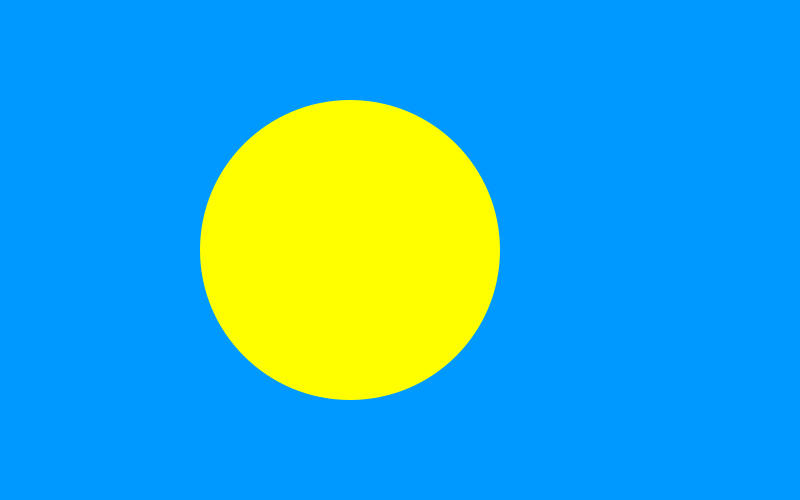
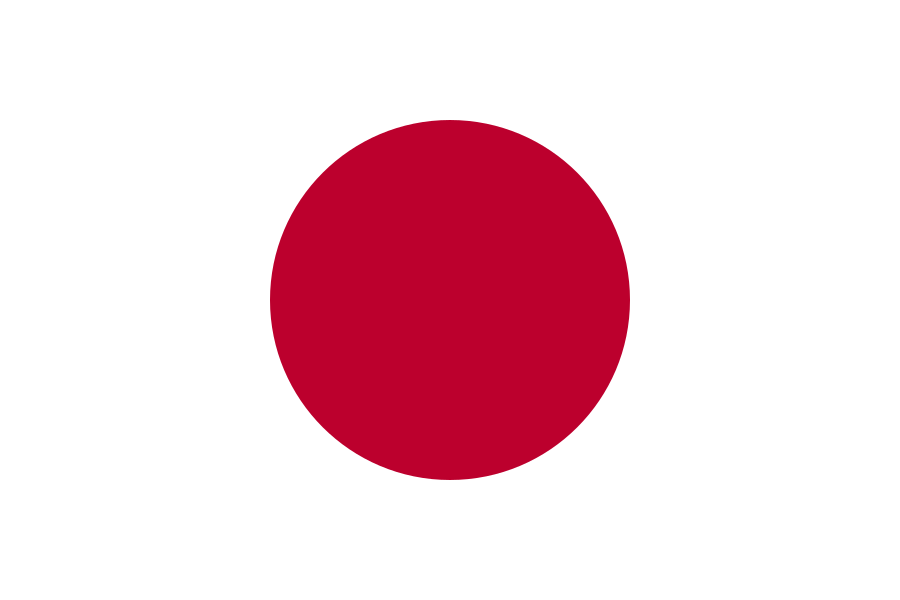
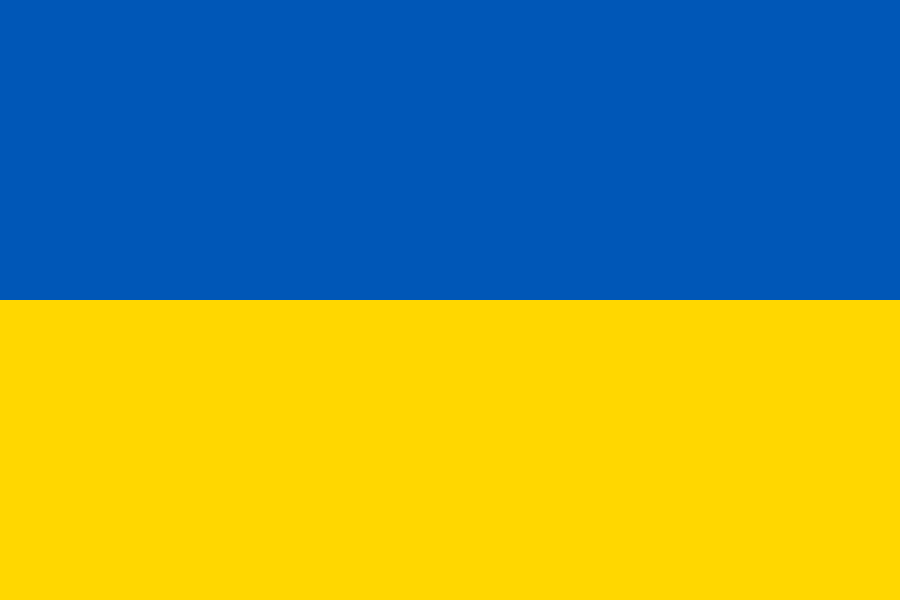
Ranked deterministically across layout family (35%), color overlap and stripe order (25%), symbols (20%), aspect ratio (10%), and stripe/symmetry geometry (10%):

Sources and image-rights provenance
- Graphic Guide to the European Emblem
- Resolution (55) 32 of the Committee of Ministers of the Council of Europe — 8 December 1955
SVG artwork provenance: Constructed from statutory specifications (public-domain-statute, verified 2026-10-13, SHA-256 9c932abfeef4…). Insignia notice: Protected under Article 6ter of the Paris Convention for the Protection of Industrial Property; commercial use suggesting official EU endorsement is prohibited.