
Flag of Chile
Native & traditional name: La Estrella Solitaria (Bandera de Chile)
| Entity | Chile (CL) |
|---|---|
| Type | Sovereign national flag (national, civil, state) |
| Proportion | 2:3 (2:3) |
| Primary colors | red, white, blue |
| Main symbol | star |
| Arrangement | horizontal canton (white · red) |
| Official adoption | 1817-10-18 |
| Region | South America |
Plain-language visual description
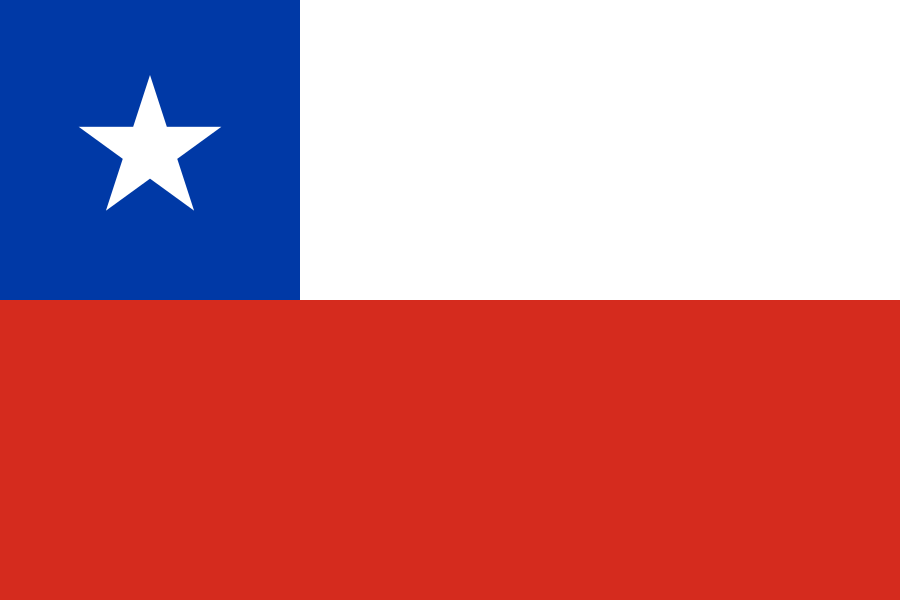
The national flag of Chile consists of two unequal horizontal bands of white (top) and red (bottom), with a square blue canton in the upper hoist corner containing a centered white five-pointed star.
Construction and geometry
Proportion & symmetry: The Flag of Chile uses a statutory 2:3 height-to-width ratio on a rectangular field with none mirror symmetry. 2:3 ratio; white upper band and full-width red lower band, with a square blue canton (side = 1/2 hoist) containing a centered white five-pointed star (diameter = 1/2 canton side).
- Aspect ratio is 2:3.
- Upper horizontal band is white, lower horizontal band is red (each 1/2 of hoist height).
- Upper hoist canton is a square of side 1/2 of hoist height (1/3 of fly length); white star diameter is 1/2 of canton side (1/4 of hoist height).
Official colors and specification system
Rather than manufacturing false RGB precision where a statute specifies dyed cloth, Pantone, Munsell, or CIE coordinates, the table below records the governing color system alongside a calibrated display hex approximation.
| Color | Official shade name | Specification system | Statutory / standard code | Display hex |
|---|---|---|---|---|
| red | Red (Rojo) | pantone | Pantone 485 C | #D52B1E |
| white | White (Blanco) | statute-named | Named in statute | #FFFFFF |
| blue | Turquí Blue (Azul Turquí) | pantone | Pantone 286 C | #0039A6 |
Meaning and symbolism
Documented symbolism
Known as La Estrella Solitaria ('The Lone Star'), the flag's colors are officially attributed to Chile's geography and independence struggle: blue represents the Pacific Ocean and the clear Chilean sky; white represents the snow-covered peaks of the Andes; and red represents the blood spilled by patriots in the War of Independence.
The single five-pointed star in the canton symbolizes the powers of the unitary republic (executive, legislative, and judicial) guiding the nation as a single indivisible state.
Common interpretations
Early independence leaders also connected the lone star to the Mapuche morning star (Guñelve, Venus) and to the redness of the copihue flower.
Adopted in 1817, Chile's flag predates the 1839 Lone Star Flag of Texas by more than two decades; the two are distinguished because Chile's blue field is a square canton solely in the upper hoist, whereas Texas's blue stripe runs the full height of the hoist.
History and design evolution
Chile flew two earlier national flags during its struggle against Spanish rule: José Miguel Carrera's blue-white-yellow Patria Vieja horizontal tricolor (1812–1814) and the blue-white-red Patria Nueva transition tricolor introduced after the Battle of Chacabuco in 1817. Because the transition flag lacked a star and closely resembled the Dutch tricolor at sea, Minister of War José Ignacio Zenteno and Spanish-born military engineer Antonio Arcos designed the current canton-and-star layout.
The flag was adopted by decree of Supreme Director Bernardo O'Higgins on 18 October 1817 and carried at the formal oath of Chilean independence on 12 February 1818. In 1854, President Manuel Montt commissioned a geometric survey that refined the placement and proportions of the canton and five-pointed star.
Law No. 2,597 of 11 January 1912 and Supreme Decree No. 1,534 of 1967 established the modern statutory construction: a 2:3 flag with a square blue canton (side equal to half the hoist) and a centered five-pointed star whose circumscribed circle equals half the canton side.
Key historical milestones
- 1812Patria Vieja Flag: José Miguel Carrera introduces the first blue-white-yellow horizontal tricolor.
- 1817La Estrella Solitaria: Bernardo O'Higgins's government adopts the modern lone-star flag on 18 October 1817.
- 1912Law No. 2,597: Codifies the 2:3 aspect ratio, square canton, and star diameter.
Frequently confused with
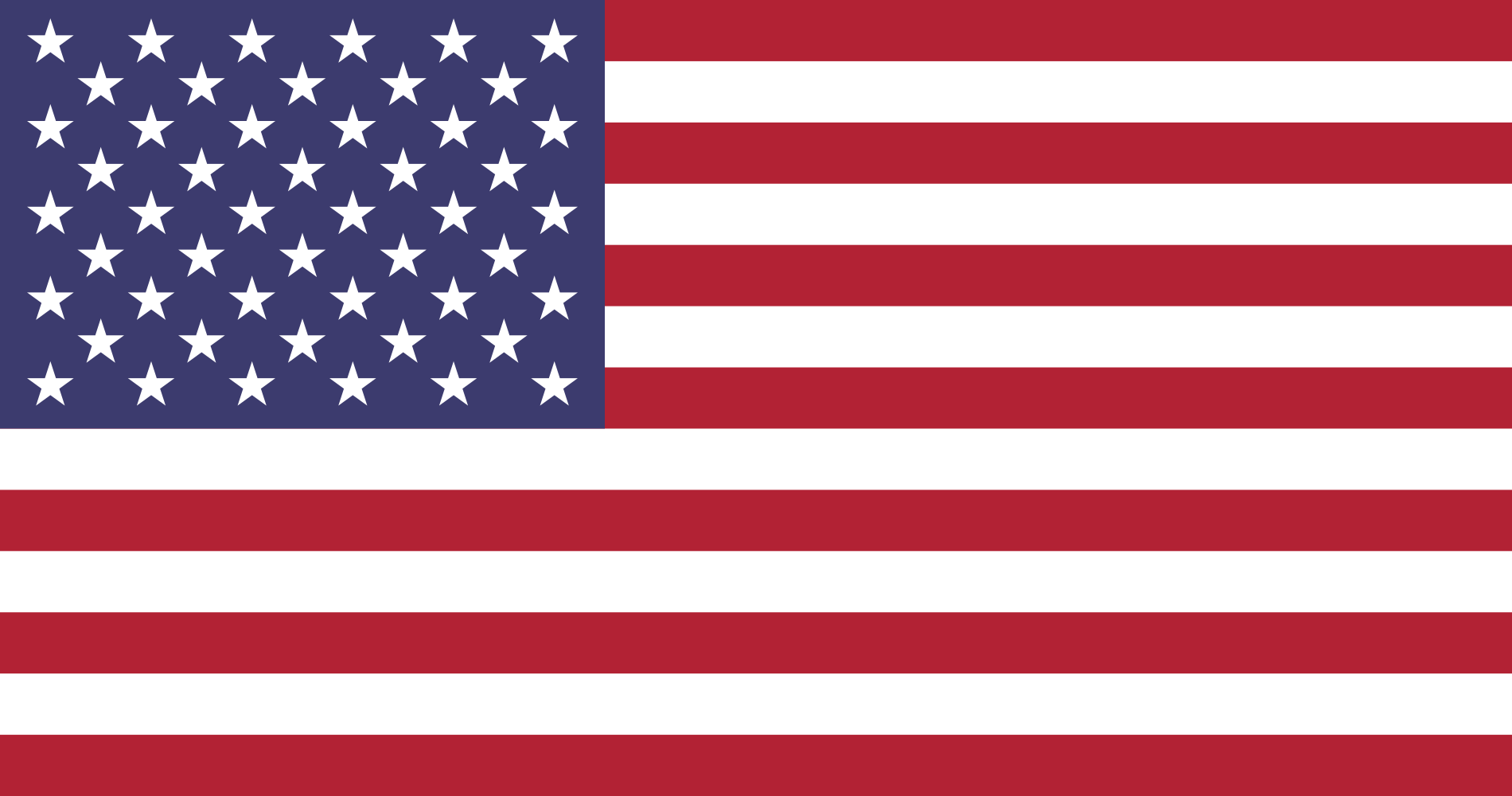
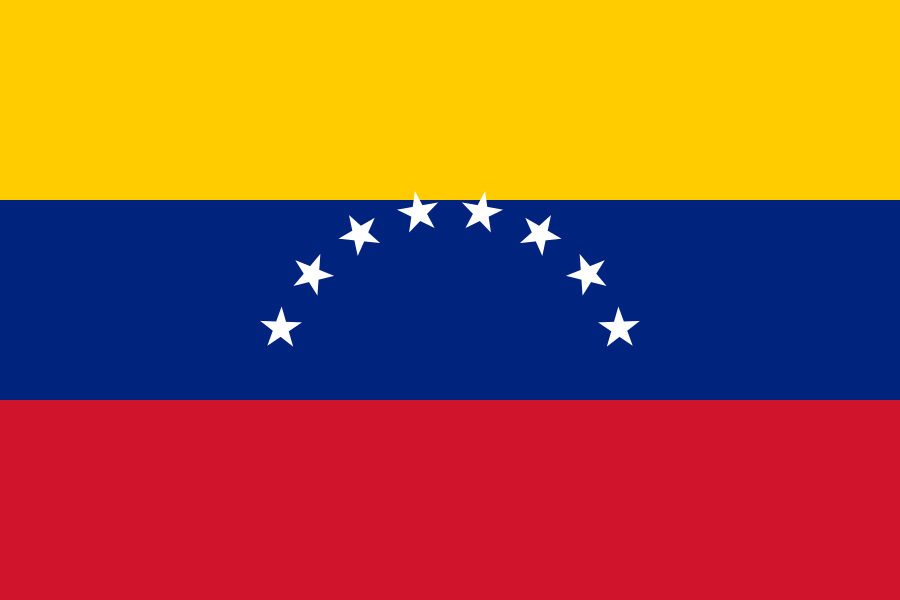
The Flag of Chile is commonly confused with or compared alongside the following flags due to shared colors, stripe geometry, or central emblems:

Visually and structurally similar flags
Ranked deterministically across layout family (35%), color overlap and stripe order (25%), symbols (20%), aspect ratio (10%), and stripe/symmetry geometry (10%):



Sources and image-rights provenance
- Law No. 2,597 & Supreme Decree No. 1,534 on the National Emblems of Chile
- World Factbook: Chile Flag Description
SVG artwork provenance: Constructed from statutory specifications (public-domain-statute, verified 2026-10-13, SHA-256 7de9844a164c…).