
Flag of France
Native & traditional name: Drapeau tricolore

| Flag | France (FR) |
|---|---|
| Type | National flag (national, civil, state, war) |
| Proportion | 2:3 (2:3) |
| Primary colors | blue, white, red |
| Main symbol | None (geometric bands) |
| Arrangement | vertical tricolor (blue · white · red) |
| Official adoption | 1794-02-15 — Decree of 27 Pluviôse Year II; constitutionalized under Article 2 of the 1958 Constitution |
| Region | Western Europe |
Plain-language visual description
The national flag of France is a 2:3 rectangle divided into three equal vertical stripes of navy blue at the hoist, white in the center, and red at the fly.
Construction and geometry
Proportion & symmetry: The Flag of France uses a statutory 2:3 height-to-width ratio on a rectangular field with horizontal mirror symmetry. Three equal vertical bands (1:1:1) of blue (hoist), white (center), and red (fly).
- All modern land and naval versions use three equal vertical bands (1:1:1) inside a 2:3 rectangle.
- For naval visibility at sea, the 1853 maritime ensign still uses slightly unequal optical widths of 30:33:37 so the fluttering red fly appears equal in width to the blue hoist.
Official colors and specification system
Rather than manufacturing false RGB precision where a statute specifies dyed cloth, Pantone, Munsell, or CIE coordinates, the table below records the governing color system alongside a calibrated display hex approximation.
| Color | Official shade name | Specification system | Statutory / standard code | Display hex |
|---|---|---|---|---|
| blue | Navy Blue (Bleu marine) | pantone | Pantone Reflex Blue / dark navy variant | #002654 |
| white | White | statute-named | Named in statute | #FFFFFF |
| red | Red | pantone | Pantone 186 C | #CE1126 |
Meaning and symbolism
Documented symbolism
Historically documented from the July 1789 Parisian cockade, blue and red are the traditional municipal colors of the City of Paris (associated with Saint Martin's blue cloak and Saint Denis's red oriflamme), joined with the white associated with the French state and monarchy to signify the union of the nation.
Article 2 of the Constitution of the Fifth Republic (1958) defines the national emblem simply as 'the tricolor flag, blue, white, red' without prescribing fixed shades in statute.
Common interpretations
The three bands are widely equated with the revolutionary motto 'Liberté, égalité, fraternité' or with the three pre-revolutionary estates (clergy, nobility, and commons), though historians note those associations emerged after the cockade and naval ensign were already in service.
History and design evolution
Days after the storming of the Bastille in July 1789, the Marquis de Lafayette and Mayor Jean Sylvain Bailly presented King Louis XVI with a cockade combining the blue and red of the Paris militia with the royal white. In October 1790 the Constituent Assembly placed a red-white-blue vertical canton on French naval ensigns.
Finding the white-field naval flag confusing in battle, the National Convention issued the decree of 27 Pluviôse Year II (15 February 1794), authored with input from painter Jacques-Louis David, establishing the full vertical blue-white-red tricolor across the entire field. Apart from the Bourbon Restoration (1814–1830), when the royal white banner briefly returned, the Tricolore has served continuously ever since.
In 1976 President Valéry Giscard d'Estaing introduced a brighter cobalt blue variant to harmonize visually with the European flag, while in 2020 President Emmanuel Macron restored the traditional darker navy blue on Élysée Palace flags; both shades remain constitutional.
Key historical milestones
- 1789Tricolor cockade of Paris: Parisian blue and red are combined with royal white following the storming of the Bastille.
- 1794Decree of 27 Pluviôse Year II: The National Convention establishes the vertical blue-white-red order still used today.
- 1958Constitution of the Fifth Republic: Article 2 codifies the blue, white, and red tricolor as the constitutional national emblem.
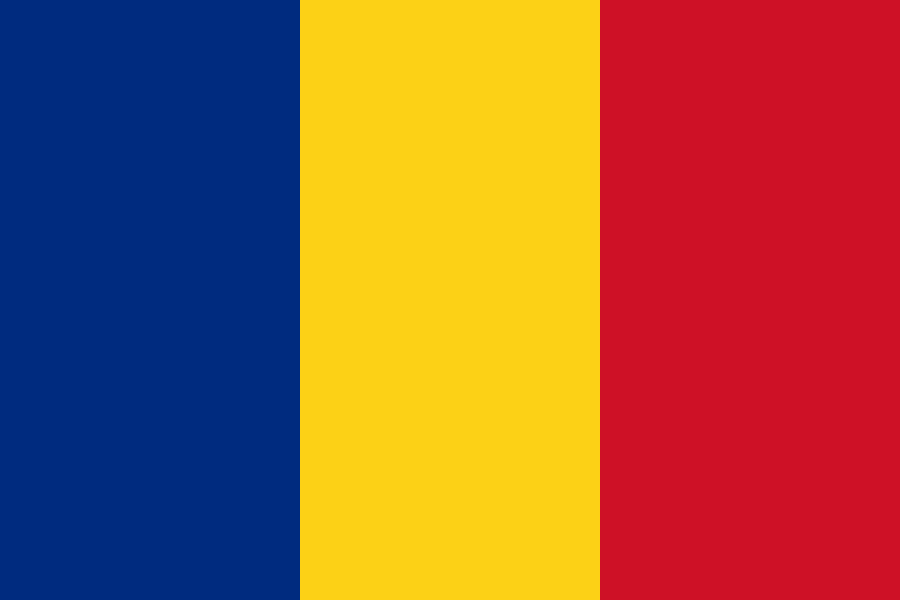
Frequently confused with
The Flag of France is commonly confused with the following national flags due to shared colors, stripe geometry, or central emblems:

Visually and structurally similar flags
Ranked deterministically across layout family (35%), color overlap and stripe order (25%), symbols (20%), aspect ratio (10%), and stripe/symmetry geometry (10%):




Sources and image-rights provenance
- Élysée — Presidency of the French Republic: The French Flag
- Constitution of the French Republic (1958), Article 2
SVG artwork provenance: Constructed from statutory specifications (public-domain-statute, verified 2026-10-13, SHA-256 1f77406c62ff…).