
Flag of Texas
Native & traditional name: Lone Star Flag

| Entity | Texas (US-TX) |
|---|---|
| Parent state | United States |
| Type | Subnational state / municipal flag (subnational, civil, state) |
| Proportion | 2:3 (2:3) |
| Primary colors | blue, white, red |
| Main symbol | star |
| Arrangement | horizontal canton (white · red) |
| Official adoption | 1839-01-25 |
| Region | Northern America |
Plain-language visual description
The state flag of Texas (the Lone Star Flag) has a vertical blue stripe at the hoist occupying one-third of the flag's length with a centered white five-pointed star, and two equal horizontal stripes of white (top) and red (bottom) occupying the remaining two-thirds.
Construction and geometry
Proportion & symmetry: The Flag of Texas uses a statutory 2:3 height-to-width ratio on a rectangular field with horizontal mirror symmetry. 2:3 ratio; vertical blue stripe at the hoist occupying 1/3 of the flag length, with two equal horizontal stripes (white over red) occupying the remaining 2/3, and a white star of diameter 3/4 of the blue stripe width.
- Aspect ratio is 2:3.
- Hoist blue vertical stripe width is 1/3 of fly length; white and red horizontal stripes are each 1/2 of hoist height and 2/3 of fly length.
- The white five-pointed star has one point straight up and a circumscribed circle diameter equal to 3/4 of the width of the blue stripe.
Official colors and specification system
Rather than manufacturing false RGB precision where a statute specifies dyed cloth, Pantone, Munsell, or CIE coordinates, the table below records the governing color system alongside a calibrated display hex approximation.
| Color | Official shade name | Specification system | Statutory / standard code | Display hex |
|---|---|---|---|---|
| blue | Old Glory Blue | cable-number | Standard Color Card of America Cable No. 70075 (Pantone 281 C) | #00205B |
| white | White | cable-number | Cable No. 70001 | #FFFFFF |
| red | Old Glory Red | cable-number | Cable No. 70180 (Pantone 193 C) | #BF0D3E |
Meaning and symbolism
Documented symbolism
Texas Government Code § 3100.001 explicitly codifies the official meaning of the three colors: 'The blue stripe stands for loyalty, the white stripe for purity, and the red stripe for bravery.'
The statute further states that the single star 'represents all of Texas and stands for our unity as one for God, State, and Country,' originating as the emblem of Texan solidarity during the 1835–1836 independence struggle from Mexico.
Common interpretations
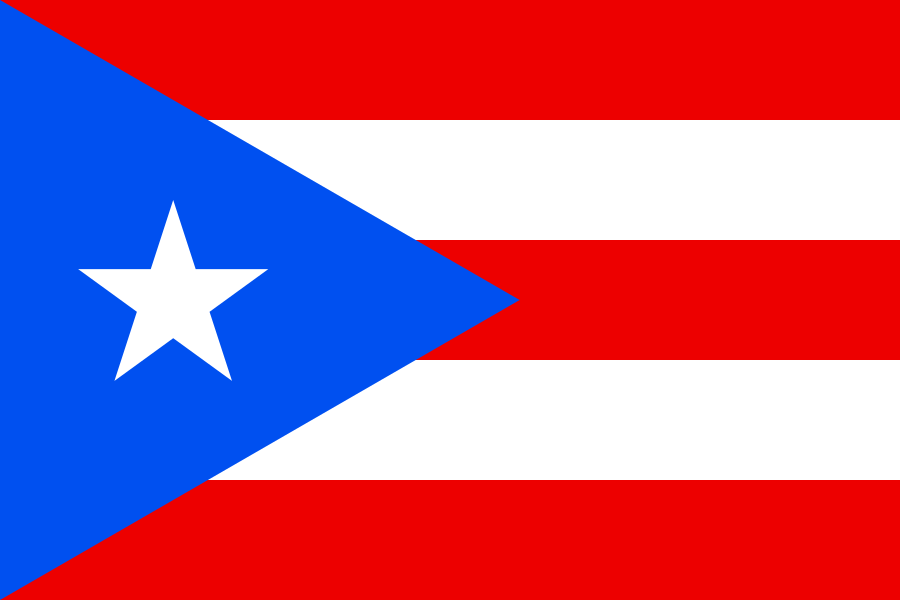
Because Texas and Chile share the same red, white, and blue colors and lone white star in a 2:3 ratio, the two flags are frequently confused on social media and in emoji usage; the definitive difference is that Texas's blue field extends from the top to the bottom of the hoist, whereas Chile's blue field is a square canton resting on top of the red stripe.
History and design evolution
During the Texas Revolution and the early Republic of Texas (1836–1839), Texans flew the 'Burnet Flag'—an azure field with a single large golden five-pointed star. In December 1838, Senator William H. Wharton introduced legislation in the Third Congress of the Republic of Texas to establish a permanent national flag and seal.
The resulting design, traditionally attributed to Dr. Charles B. Stewart (whose original colored drawing on linen survives in the Texas State Library and Archives), combined a vertical blue hoist stripe and lone white star with white-over-red horizontal fly stripes. President Mirabeau B. Lamar signed the Act into law on 25 January 1839.
When Texas joined the United States as the 28th state in December 1845, the 1839 Republic flag became the state flag. In 1933 (and recodified in 1993 and 2001 as Chapter 3100 of the Texas Government Code), the Texas Legislature standardized the exact star diameter (3/4 of the blue stripe width) and matched the red and blue shades to Old Glory Red and Old Glory Blue.
Key historical milestones
- 1836Burnet Flag: The Republic of Texas initially adopts a blue flag with a central gold star.
- 1839Lone Star Flag Act: President Mirabeau B. Lamar signs the Act adopting the Lone Star Flag on 25 January 1839.
- 1845US Statehood: The Republic flag becomes the state flag of Texas upon admission to the Union.
- 1933Statutory Geometry & Colors: Texas codifies exact star proportions and Old Glory color cables (now Government Code Chapter 3100).
Frequently confused with
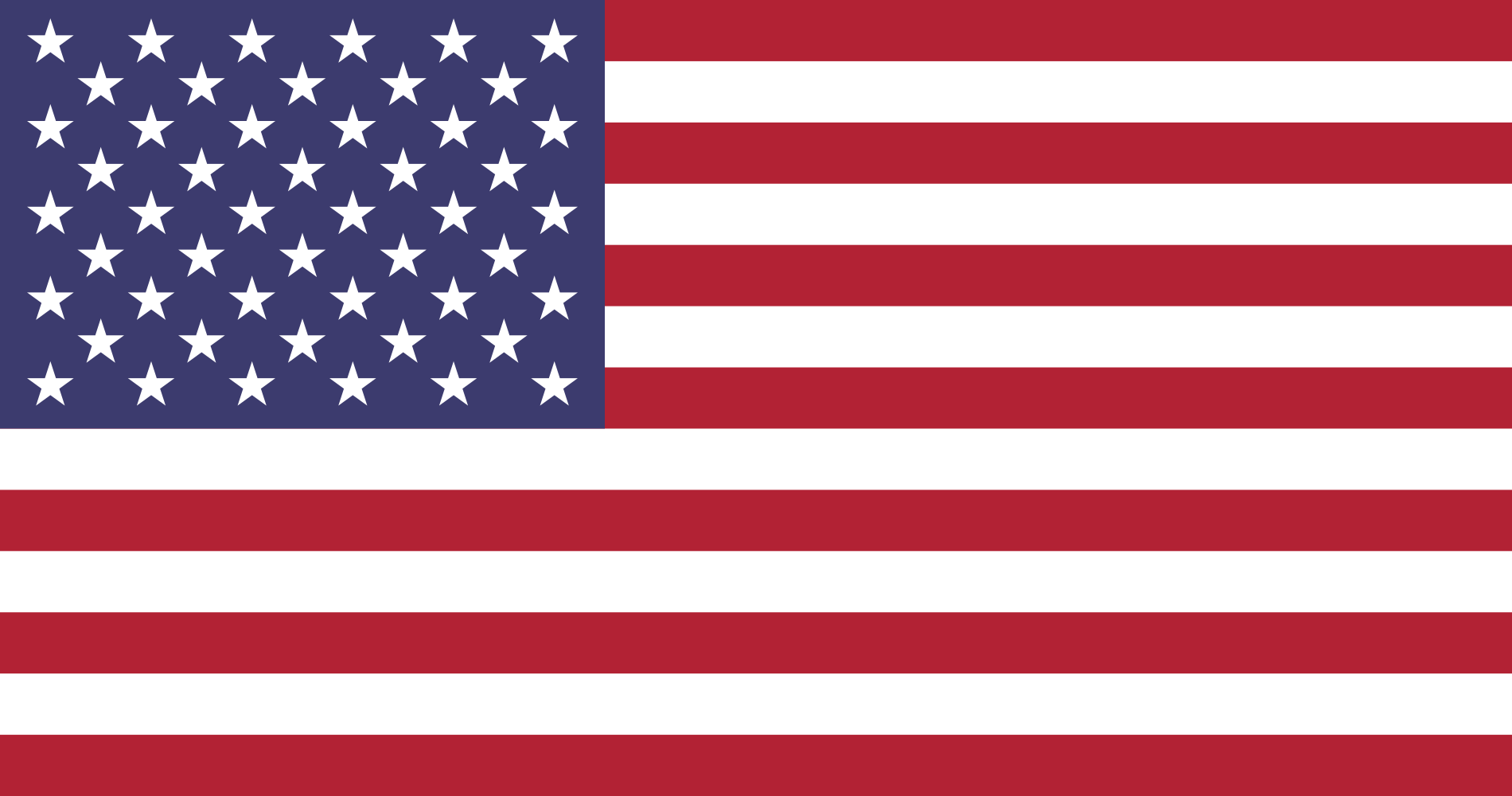
The Flag of Texas is commonly confused with or compared alongside the following flags due to shared colors, stripe geometry, or central emblems:

Visually and structurally similar flags
Ranked deterministically across layout family (35%), color overlap and stripe order (25%), symbols (20%), aspect ratio (10%), and stripe/symmetry geometry (10%):



Sources and image-rights provenance
SVG artwork provenance: Constructed from statutory specifications (public-domain-statute, verified 2026-10-13, SHA-256 2f3f62c36428…).