
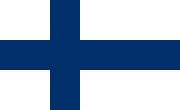
Flag of Finland
Native & traditional name: Siniristilippu
| Entity | Finland (FI) |
|---|---|
| Type | Sovereign national flag (national, civil) |
| Proportion | 11:18 (11:18) |
| Primary colors | white, blue |
| Main symbol | cross |
| Arrangement | horizontal nordic cross |
| Official adoption | 1918-05-29 |
| Region | Northern Europe |
Plain-language visual description
The national flag of Finland (the Siniristilippu) consists of a sea-blue Nordic cross shifted toward the hoist on a white rectangular field in an 11:18 aspect ratio.
Construction and geometry
Proportion & symmetry: The Flag of Finland uses a statutory 11:18 height-to-width ratio on a rectangular field with horizontal mirror symmetry. Horizontal proportions 5:3:10 (total 18); vertical proportions 4:3:4 (total 11).
- Aspect ratio is 11:18.
- Horizontal proportions along the width (18 units): 5 (hoist cantons) : 3 (cross arm width) : 10 (fly cantons).
- Vertical proportions along the height (11 units): 4 (upper cantons) : 3 (cross arm width) : 4 (lower cantons).
Official colors and specification system
Rather than manufacturing false RGB precision where a statute specifies dyed cloth, Pantone, Munsell, or CIE coordinates, the table below records the governing color system alongside a calibrated display hex approximation.
| Color | Official shade name | Specification system | Statutory / standard code | Display hex |
|---|---|---|---|---|
| white | White | cielab | CIE 1976 | #FFFFFF |
| blue | Sea Blue (Merensininen) | pantone | Pantone 294 C (CIE L*a*b* statutory) | #002F6C |
Meaning and symbolism
Documented symbolism
Under the Act on the Flag of Finland (380/1978), the blue cross represents Finland's thousands of lakes and clear northern sky, while the white field represents the snow that blankets the country in winter.
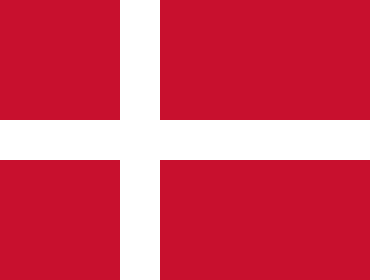
The off-center Nordic cross places Finland firmly within the constitutional and cultural family of the Nordic states alongside Denmark, Sweden, Norway, and Iceland.
Common interpretations
Poet Zacharias Topelius first described the colors in 1854 as 'the blue of our lakes and the white snow of our winters,' a phrase that guided yacht clubs and lawmakers alike.
History and design evolution
While Finland was an autonomous Grand Duchy within the Russian Empire (1809–1917), Finnish yacht clubs in the 1860s—beginning with the Nyländska Jaktklubben in Helsinki in 1861—adopted a white ensign with a blue cross modeled on both the Russian naval St. Andrew's ensign and the neighboring Swedish Nordic cross.
Following Finland's declaration of independence on 6 December 1917 and the 1918 Civil War, two competing national flag factions emerged in parliament: supporters of the historic red-and-gold Lion Flag and advocates of the blue-and-white Nordic cross. Artists Eero Snellman and Bruno Tuukkanen drafted the final geometric compromise combining a sea-blue Nordic cross on a white field for the civil national flag with the red-and-gold coat of arms placed at the cross intersection on the state and military flags.
The Parliament of Finland enacted the Flag Law on 29 May 1918, and the Siniristilippu was first officially raised over the country's fortifications in June 1918. Modern dimensions (11:18 ratio, 5:3:10 horizontal and 4:3:4 vertical) and CIE 1976 color coordinates are governed by Act 380/1978 and Government Decision 827/1993.
Key historical milestones
- 1861Yacht Club Ensigns: Nyländska Jaktklubben adopts a white flag with a blue cross for Finnish pleasure vessels.
- 1918Official Adoption: Parliament adopts the Siniristilippu designed by Eero Snellman and Bruno Tuukkanen on 29 May 1918.
- 1978Flag Act 380/1978: Modernizes statutory rules for the civil, state, and swallowtailed military flags.
Visually and structurally similar flags
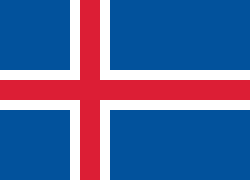
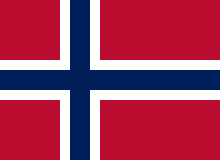
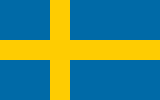
Ranked deterministically across layout family (35%), color overlap and stripe order (25%), symbols (20%), aspect ratio (10%), and stripe/symmetry geometry (10%):

Sources and image-rights provenance
- Act on the Flag of Finland (Laki Suomen lipusta 380/1978)
- Government Decision 827/1993 on the Colors of the Flag of Finland — 827/1993
SVG artwork provenance: Constructed from statutory specifications (public-domain-statute, verified 2026-10-13, SHA-256 ed759cf103a0…).