
Flag of India
Native & traditional name: Tiranga (तिरंगा)
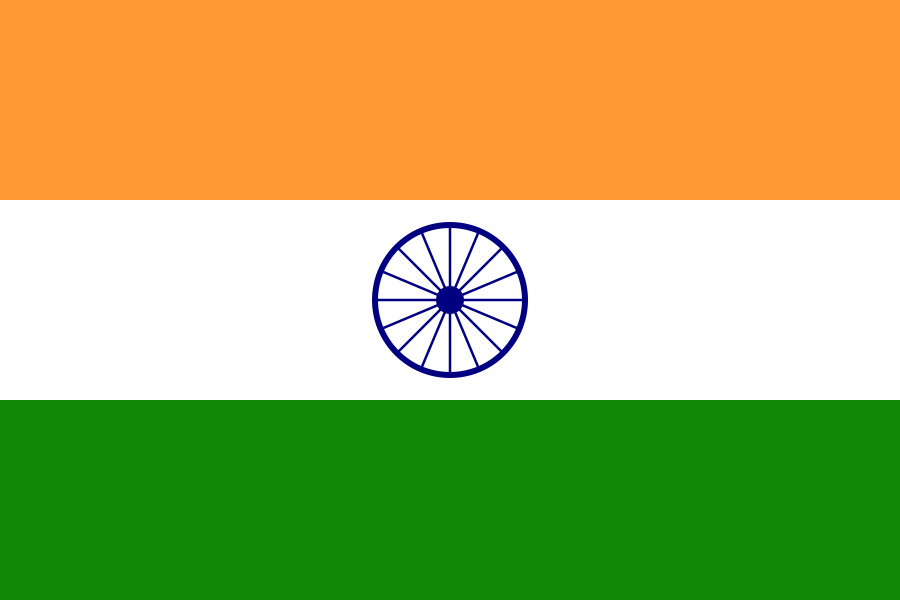
| Entity | India (IN) |
|---|---|
| Type | Sovereign national flag (national, civil) |
| Proportion | 2:3 (2:3) |
| Primary colors | orange, white, green, blue |
| Main symbol | other |
| Arrangement | horizontal tricolor (orange · white · green) |
| Official adoption | 1947-07-22 |
| Region | Southern Asia |
Plain-language visual description
The national flag of India (Tiranga) is a horizontal tricolor of saffron at the top, white in the middle, and green at the bottom in a 2:3 ratio, with the navy blue 24-spoke Ashoka Chakra in the center.
Construction and geometry
Proportion & symmetry: The Flag of India uses a statutory 2:3 height-to-width ratio on a rectangular field with none mirror symmetry. Three equal horizontal bands (saffron, white, green) with navy blue Ashoka Chakra in center.
Official colors and specification system
Rather than manufacturing false RGB precision where a statute specifies dyed cloth, Pantone, Munsell, or CIE coordinates, the table below records the governing color system alongside a calibrated display hex approximation.
| Color | Official shade name | Specification system | Statutory / standard code | Display hex |
|---|---|---|---|---|
| orange | India Saffron (Kesari) | statute-named | Named in statute | #FF9933 |
| white | White | statute-named | Named in statute | #FFFFFF |
| green | India Green | statute-named | Named in statute | #128807 |
| blue | Navy Blue (Ashoka Chakra) | statute-named | Named in statute | #000080 |
Meaning and symbolism
Documented symbolism
Dr. S. Radhakrishnan explained before the Constituent Assembly: saffron denotes renunciation and courage; white represents light and the path of truth; and green represents agriculture and fertility.
The Ashoka Chakra wheel represents the law of dharma, righteousness, and peaceful progress.
Common interpretations
In popular tradition, saffron is often associated with Hinduism, green with Islam, and white with peace and minority faiths, though the secular official definition emphasizes moral and philosophical virtues.
History and design evolution
The national flag of India, revered as the Tiranga ('tricolor'), evolved through several decades of the Indian independence movement led by the Indian National Congress against British colonial rule. In 1921, freedom fighter Pingali Venkayya presented a design for a national flag to Mahatma Gandhi at the All India Congress Committee session in Vijayawada. Venkayya's initial design comprised two bands: red for Hindus and green for Muslims. Gandhi suggested adding a white stripe for other religious communities and a spinning wheel (charkha) to symbolize self-reliance.
In August 1931, the Congress Working Committee in Karachi formally adopted a revised tricolor with horizontal bands of deep saffron at the top, white in the middle, and dark green at the bottom, bearing a navy blue charkha in the central white stripe. The resolution emphasized that the colors possessed communal harmony and national meaning: saffron for courage and sacrifice, white for peace and truth, and green for faith and chivalry.
On July 22, 1947, just weeks before India gained independence on August 15, 1947, the Constituent Assembly appointed an ad hoc committee headed by Dr. Rajendra Prasad to choose a flag for free India. The committee preserved Pingali Venkayya's tricolor but replaced Gandhi's spinning wheel with the Ashoka Chakra (the 'Wheel of the Law'), the ancient 24-spoke Buddhist wheel appearing on the abacus of the Lion Capital of Emperor Ashoka at Sarnath (dating to the 3rd century BCE). Dr. Sarvepalli Radhakrishnan eloquently explained to the Assembly that the wheel represented the dynamic motion of peaceful progress and the eternal rule of righteousness (dharma). The specifications of the flag were codified under the Flag Code of India.
Key historical milestones
- 1921Venkayya Design: Pingali Venkayya presents the tricolor design to Mahatma Gandhi.
- 1947Constituent Assembly: Adopted on 22 July 1947 with the Ashoka Chakra.
- 2002Flag Code of India: Modernized regulations allow citizens to fly the flag freely.
Visually and structurally similar flags
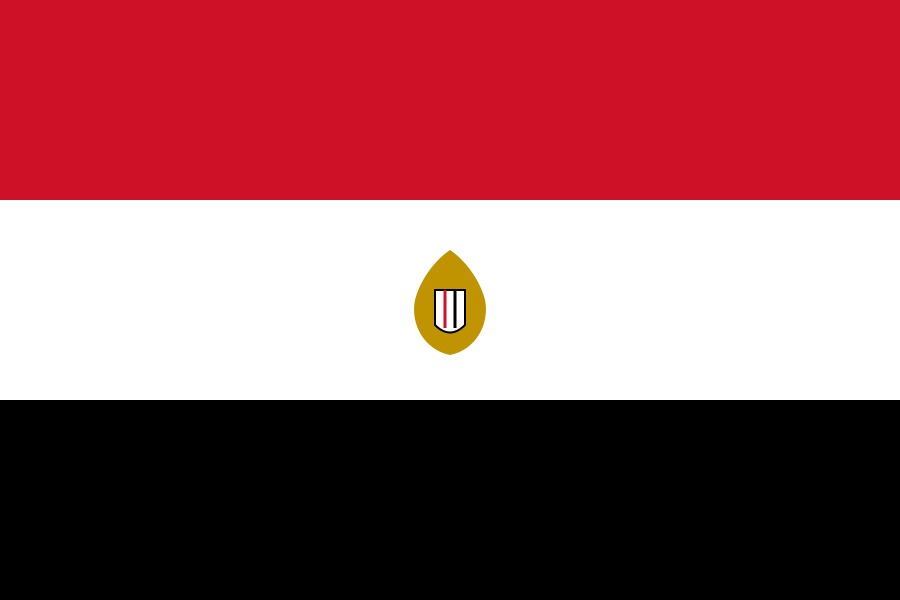
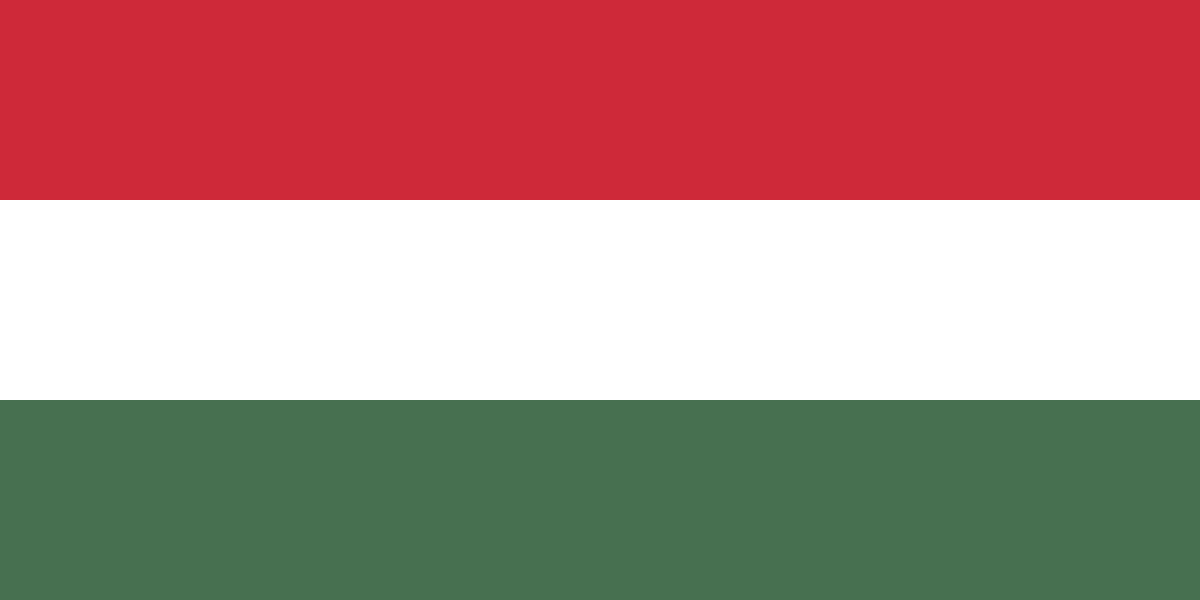
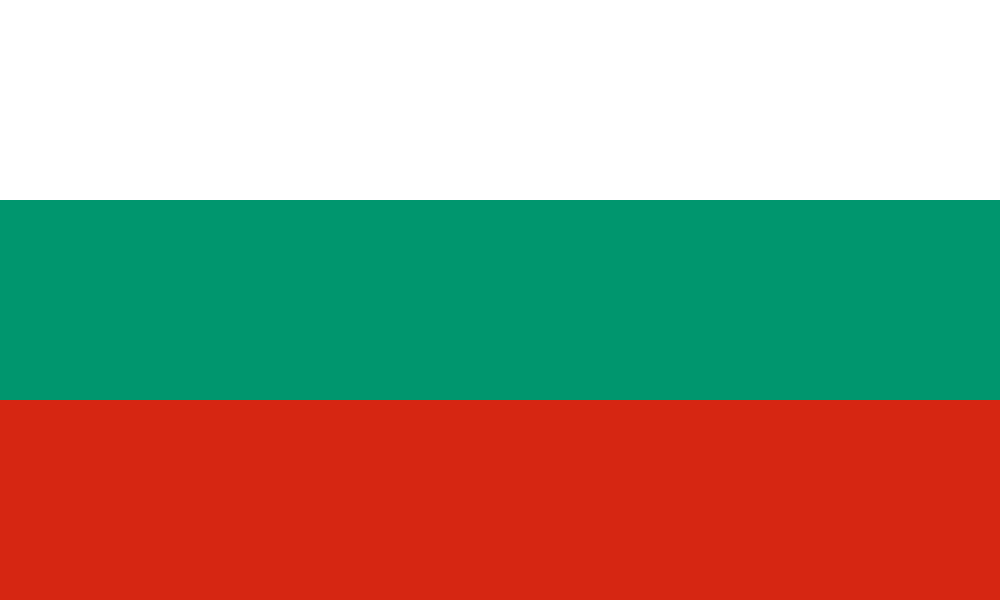
Ranked deterministically across layout family (35%), color overlap and stripe order (25%), symbols (20%), aspect ratio (10%), and stripe/symmetry geometry (10%):



Sources and image-rights provenance
- Flag Code of India, 2002
- Constituent Assembly Debates, Vol. IV — 22 July 1947 Proceedings
SVG artwork provenance: Constructed from statutory specifications (public-domain-statute, verified 2026-10-14, SHA-256 7417c1802801…).