
Flag of Egypt
Native & traditional name: علم مصر
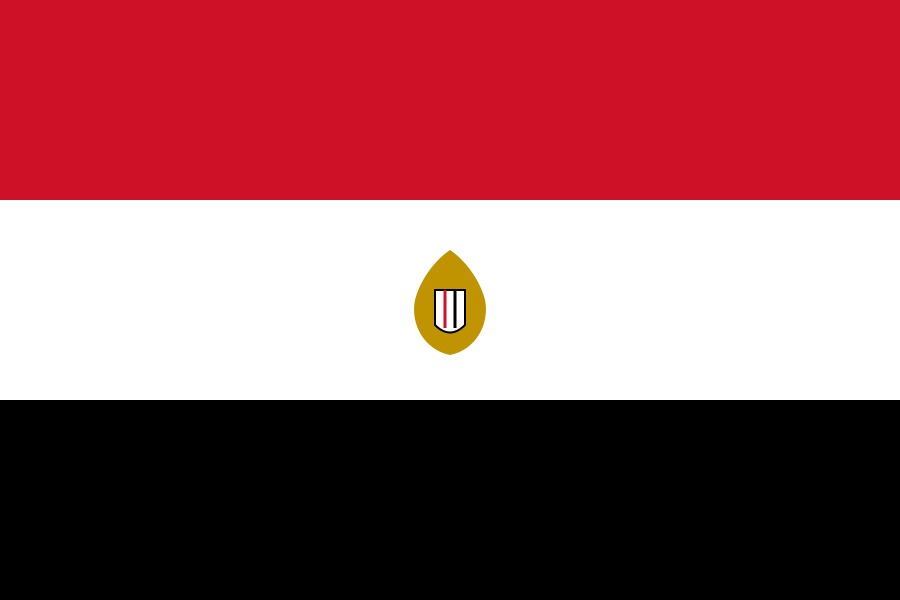
| Entity | Egypt (EG) |
|---|---|
| Type | Sovereign national flag (national, civil) |
| Proportion | 2:3 (2:3) |
| Primary colors | red, white, black, yellow |
| Main symbol | other |
| Arrangement | horizontal tricolor (red · white · black) |
| Official adoption | 1984-10-04 |
| Region | Northern Africa |
Plain-language visual description
The national flag of Egypt is a horizontal tricolor of three equal stripes of red at the top, white in the middle, and black at the bottom in a 2:3 ratio, with the golden Eagle of Saladin centered on the white band.
Construction and geometry
Proportion & symmetry: The Flag of Egypt uses a statutory 2:3 height-to-width ratio on a rectangular field with none mirror symmetry. Three equal horizontal stripes (red, white, black) with golden Eagle of Saladin in center.
Official colors and specification system
Rather than manufacturing false RGB precision where a statute specifies dyed cloth, Pantone, Munsell, or CIE coordinates, the table below records the governing color system alongside a calibrated display hex approximation.
| Color | Official shade name | Specification system | Statutory / standard code | Display hex |
|---|---|---|---|---|
| red | Red | pantone | Pantone 186 C | #CE1126 |
| white | White | statute-named | Named in statute | #FFFFFF |
| black | Black | statute-named | Named in statute | #000000 |
| yellow | Gold (Eagle of Saladin) | statute-named | Named in statute | #C09300 |
Meaning and symbolism
Documented symbolism
Law No. 144 of 1984 defines the flag: red represents sacrifices and martyrs' blood; white represents the peaceful 1952 revolution; black represents overcoming foreign oppression.
The golden Eagle of Saladin symbolizes national power, sovereignty, and Egypt's medieval defense against Crusaders.
Common interpretations
The red-white-black tricolor served as the template for the Pan-Arab Liberation tricolor adopted across the Arab world.
History and design evolution
The national flag of Egypt features a horizontal tricolor of red, white, and black with the golden Eagle of Saladin centered in the white stripe. The flag represents the culmination of Egypt's modern political evolution from an Ottoman province to a kingdom and ultimately an independent republic. In the 19th and early 20th centuries, Egypt flew red flags with crescent moons and stars under the Muhammad Ali dynasty, transitioning in 1923 to a green flag with three white stars inside a crescent following the unilateral declaration of independence by the United Kingdom.
Following the Egyptian Revolution of July 23, 1952, led by the Free Officers Movement under Gamal Abdel Nasser and Muhammad Naguib, revolutionary leaders introduced the Arab Liberation Flag. This horizontal tricolor of red, white, and black was designed to break with monarchical and colonial symbolism and foster Arab unity. Red symbolized the sacrifices and blood of the liberation struggle; white stood for a bright, peaceful future; and black commemorated the dark past of colonial oppression and foreign occupation.
The red-white-black tricolor served as the template for numerous Arab flags across the Middle East and North Africa. In 1958, when Egypt and Syria formed the United Arab Republic, two green stars were placed in the central white stripe. From 1972 to 1984, under the Federation of Arab Republics, the Hawk of Quraish was adopted as the central emblem. Finally, on October 4, 1984, under Law No. 144/1984, President Hosni Mubarak's administration established the definitive current national flag by replacing the hawk with the historic golden Eagle of Saladin (Uqab Saqr), facing hoistward with a shield upon its breast and a scroll inscribed 'Jumhuriyat Misr al-Arabiya' (Arab Republic of Egypt).
Key historical milestones
- 1952Free Officers Revolution: Arab Liberation tricolor introduced on 23 July 1952.
- 1984Law No. 144: Restores the golden Eagle of Saladin on 4 October 1984.
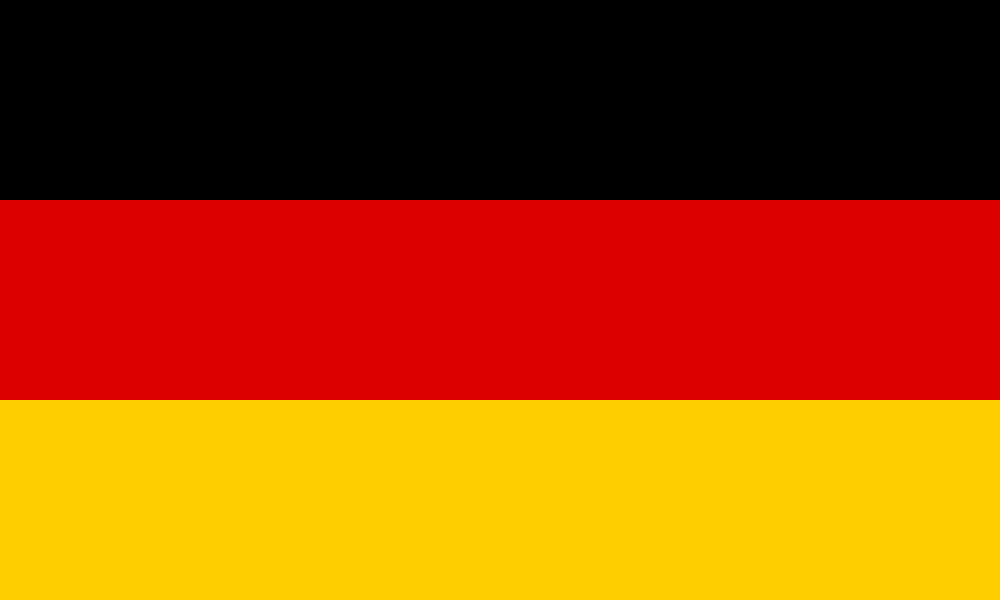
Visually and structurally similar flags
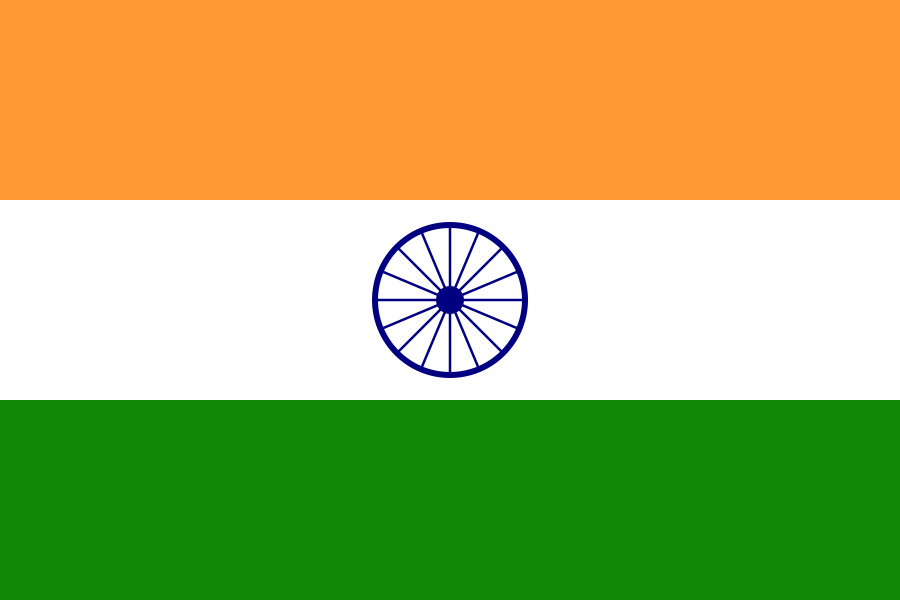
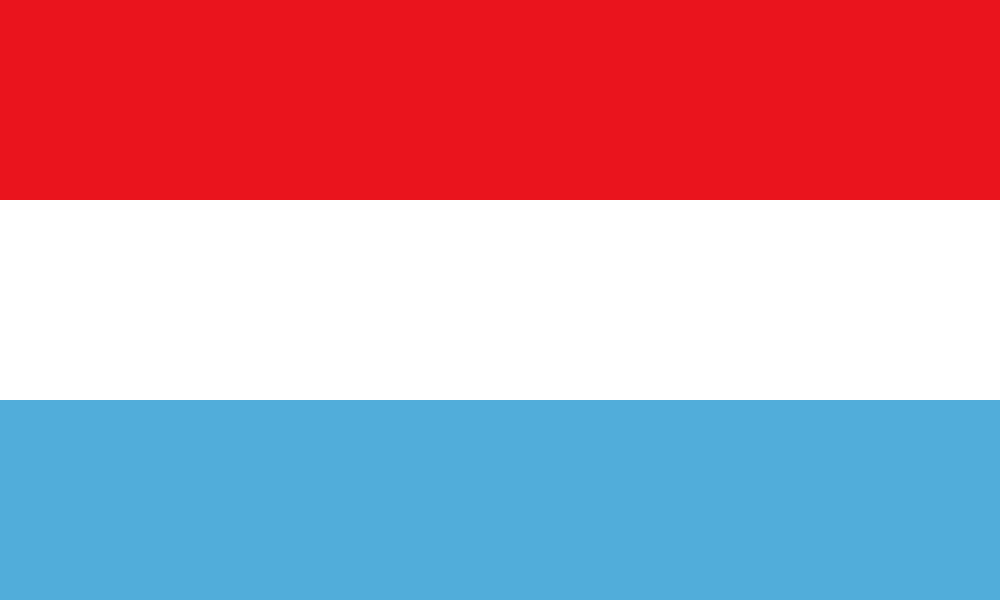
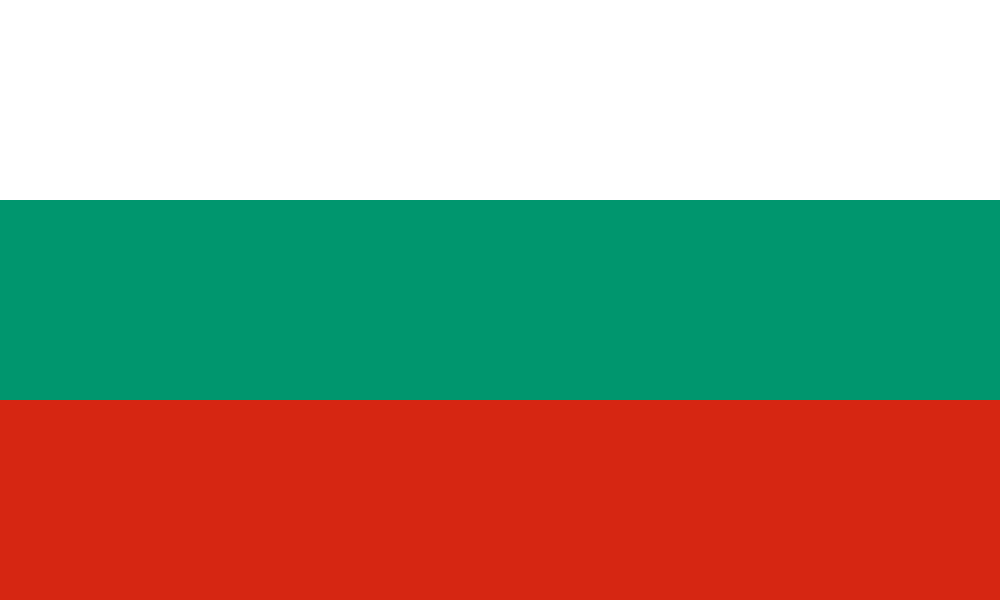
Ranked deterministically across layout family (35%), color overlap and stripe order (25%), symbols (20%), aspect ratio (10%), and stripe/symmetry geometry (10%):


Sources and image-rights provenance
- Law No. 144 of 1984 on the Flag of Egypt — Official Gazette of the Arab Republic of Egypt
- Flags Through the Ages and Across the World — McGraw-Hill, pp. 226–227
SVG artwork provenance: Constructed from statutory specifications (public-domain-statute, verified 2026-10-14, SHA-256 bc0f34d71f36…).