
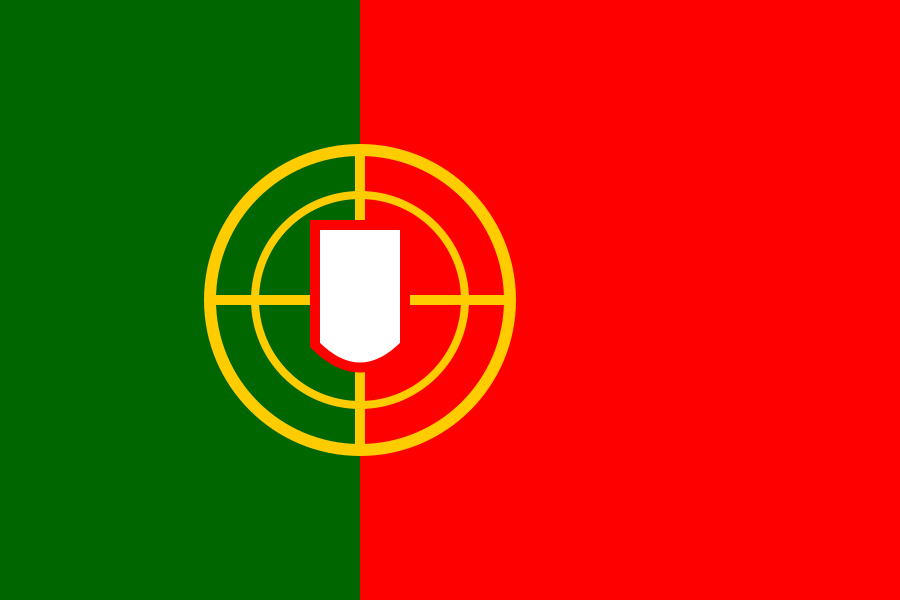
Flag of Portugal
Native & traditional name: Bandeira de Portugal (Bandeira das Quinas)
| Entity | Portugal (PT) |
|---|---|
| Type | Sovereign national flag (national, civil) |
| Proportion | 2:3 (2:3) |
| Primary colors | green, red, yellow, white |
| Main symbol | other |
| Arrangement | vertical bicolor (green · red) |
| Official adoption | 1911-06-30 |
| Region | Southern Europe |
Plain-language visual description
The national flag of Portugal is an unequal vertical bicolor of green at the hoist (2/5 width) and red at the fly (3/5 width) in a 2:3 ratio, with the armillary sphere and national shield centered on the color division.
Construction and geometry
Proportion & symmetry: The Flag of Portugal uses a statutory 2:3 height-to-width ratio on a rectangular field with none mirror symmetry. Unequal vertical bicolor: green 2/5 at hoist, red 3/5 at fly, centered with armillary sphere.
Official colors and specification system
Rather than manufacturing false RGB precision where a statute specifies dyed cloth, Pantone, Munsell, or CIE coordinates, the table below records the governing color system alongside a calibrated display hex approximation.
| Color | Official shade name | Specification system | Statutory / standard code | Display hex |
|---|---|---|---|---|
| green | Verde (Green) | pantone | Pantone 349 C | #006600 |
| red | Vermelho (Red) | pantone | Pantone 485 C | #FF0000 |
| yellow | Amarelo (Gold) | pantone | Pantone 116 C | #FFCC00 |
| white | Branco (White) | statute-named | Named in statute | #FFFFFF |
Meaning and symbolism
Documented symbolism
The 1911 decree specifies: green represents hope and red represents the blood shed for the nation.
The yellow armillary sphere celebrates the Age of Discoveries, and the white shield with five blue Quinas represents royal sovereignty and medieval victories.
Common interpretations
The seven golden castles on the red border of the shield are traditionally said to symbolize the Moorish fortresses reconquered in the Algarve.
History and design evolution
The national flag of Portugal, known as the Bandeira das Quinas or Bandeira Verde-Rubra, was created in the immediate aftermath of the October 5, 1910 revolution that overthrew King Manuel II and established the Portuguese First Republic. Under the constitutional monarchy, Portugal's national flag had consisted of vertical blue and white stripes charged with the royal coat of arms, colors that had represented the monarchy since the county of Portugal in 1095.
Following the republican triumph, the provisional government appointed a distinguished committee on October 15, 1910, to design a republican national banner. The committee included painter Columbano Bordalo Pinheiro, journalist João Chagas, writer Abel Botelho, and naval officer Afonso Palla. The committee chose green and red—the colors adopted by the Portuguese Republican Party and carried by the martyrs of the failed Porto uprising on January 31, 1891—to symbolize revolutionary rebirth, optimism, and sovereign labor.
The design features a vertical division with green taking two-fifths of the hoist width and red taking three-fifths of the fly width. Centered along the partition line is the golden armillary sphere, an astronomical navigation instrument associated with King Manuel I and the 15th-century Portuguese Age of Discovery, enclosing the traditional Portuguese heraldic shield (Escudo das Quinas) with its five blue quinas (representing the five Moorish kings defeated by Afonso Henriques at the Battle of Ourique) and seven golden castles. The design was approved by the Council of Ministers on November 29, 1910, and officially sanctioned by the National Constituent Assembly on June 19, 1911.
Key historical milestones
- 1910Republican Revolution: Overthrow of the monarchy introduces green and red livery.
- 1911Official Decree: Adopted by the Provisional Government on 30 June 1911.
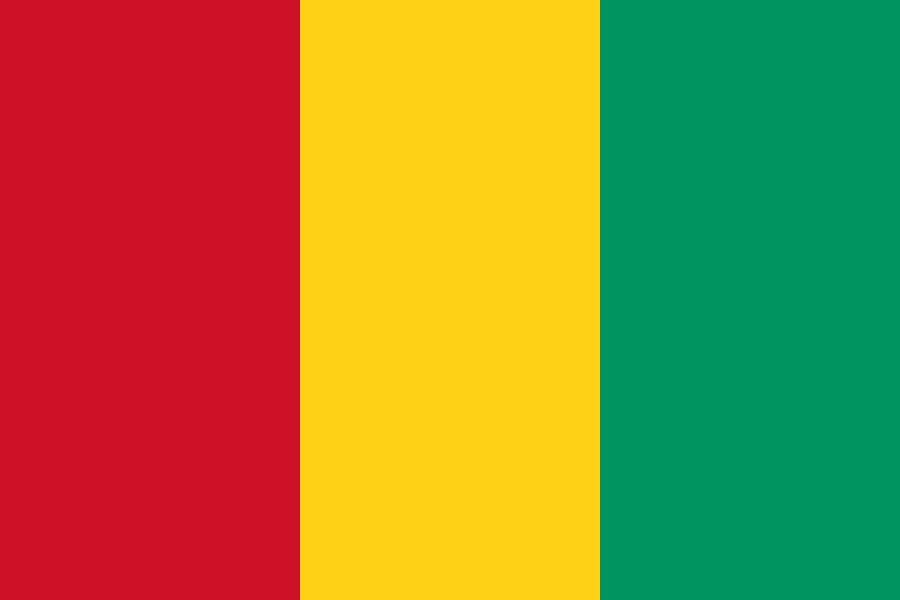
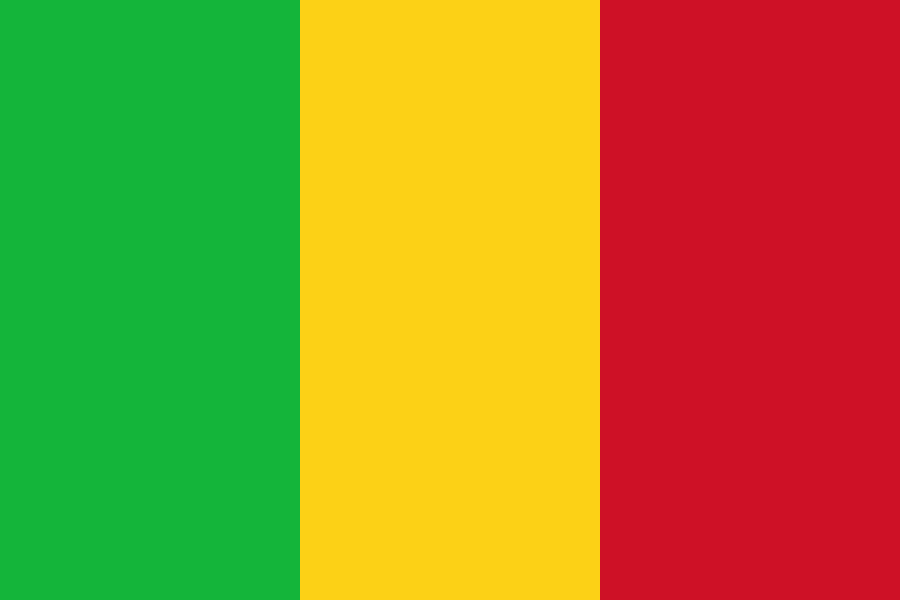
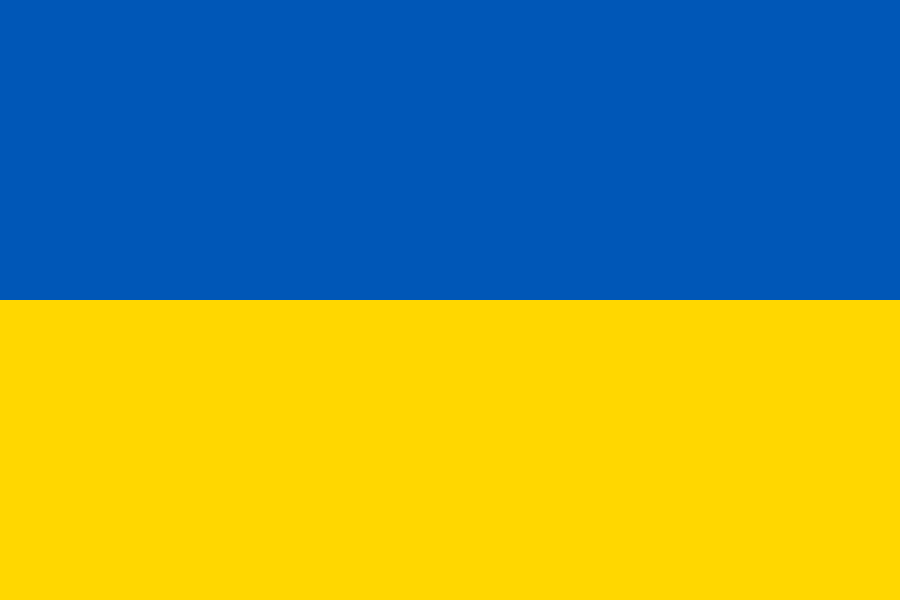
Visually and structurally similar flags
Ranked deterministically across layout family (35%), color overlap and stripe order (25%), symbols (20%), aspect ratio (10%), and stripe/symmetry geometry (10%):



Sources and image-rights provenance
- Decreto de 30 de Junho de 1911 — Diário do Govêrno No. 150/1911
- A Bandeira de Portugal
SVG artwork provenance: Constructed from statutory specifications (public-domain-statute, verified 2026-10-14, SHA-256 65b32b829e85…).