
Flag of Spain
Native & traditional name: Bandera de España (La Rojigualda)
| Entity | Spain (ES) |
|---|---|
| Type | Sovereign national flag (national, civil) |
| Proportion | 2:3 (2:3) |
| Primary colors | red, yellow |
| Main symbol | None (geometric bands) |
| Arrangement | horizontal triband (red · yellow · red) |
| Official adoption | 1978-12-29 |
| Region | Southern Europe |
Plain-language visual description
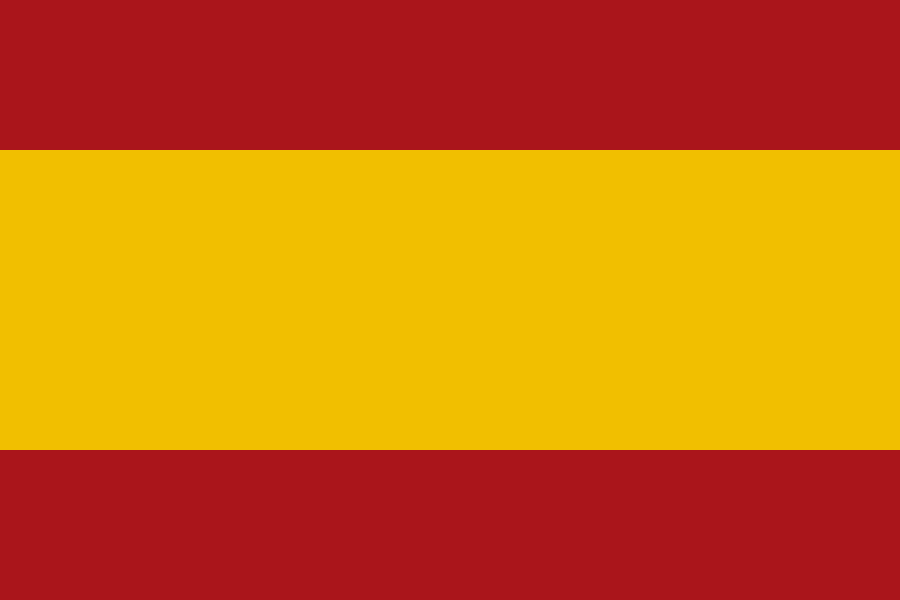
The national flag of Spain (La Rojigualda) is a horizontal triband of red, yellow, and red in a 2:3 aspect ratio, with the yellow stripe twice the width of each red stripe (Spanish fess 1:2:1).
Construction and geometry
Proportion & symmetry: The Flag of Spain uses a statutory 2:3 height-to-width ratio on a rectangular field with horizontal mirror symmetry. Spanish fess: red 1/4, yellow 1/2, red 1/4 (stripe ratio 1:2:1).
Official colors and specification system
Rather than manufacturing false RGB precision where a statute specifies dyed cloth, Pantone, Munsell, or CIE coordinates, the table below records the governing color system alongside a calibrated display hex approximation.
| Color | Official shade name | Specification system | Statutory / standard code | Display hex |
|---|---|---|---|---|
| red | Rojo bandera (Flag Red) | pantone | Pantone 7628 C | #AA151B |
| yellow | Amarillo-gualda (Weld Yellow) | pantone | Pantone 7406 C | #F1BF00 |
Meaning and symbolism
Documented symbolism
Article 4.1 of the 1978 Spanish Constitution codifies the red-yellow-red proportions (1:2:1).
The colors originate from the historic medieval heraldry of the Crown of Aragon and Castile, selected by King Charles III in 1785 for naval visibility.
Common interpretations
Popular tradition poetically associates yellow with Spanish sunshine and golden wealth, and red with the blood of defenders.
History and design evolution
The national flag of Spain, known traditionally as La Rojigualda ('the red and weld-yellow'), was created during the reign of King Charles III to resolve a perilous military dilemma. In the 18th century, the ruling Bourbon dynasties of Spain, France, the Two Sicilies, Parma, and Tuscany all flew naval ensigns consisting primarily of white fields charged with their royal coats of arms. In naval engagements, white flags quickly became indistinguishable through black gunpowder smoke, leading to frequent and catastrophic friendly-fire incidents at sea.
In 1785, Charles III organized a royal competition to design a new maritime war ensign that would be instantly identifiable from great distances under any weather conditions. Naval officer and diplomat Antonio Valdés y Fernández Bazán presented twelve distinct proposals to the king. Charles III selected a design featuring three horizontal stripes of red, yellow, and red, with the yellow stripe twice the width of each red stripe (a proportion known vexillologically as a 'Spanish fess'), charged with the royal arms in the hoist. The royal decree was promulgated on May 28, 1785.
The vibrant red-and-yellow ensign proved so successful at sea that Spanish land forces adopted it during the Peninsular War against Napoleon's invading armies. On October 13, 1843, Queen Isabella II issued a royal decree extending the flag across all Spanish armed forces, formally establishing it as the official national flag of Spain. Aside from the Second Spanish Republic (1931–1939), which replaced the lower red stripe with a purple mural stripe, the Rojigualda has remained the enduring national symbol of Spain, codified in Article 4.1 of the 1978 Constitution of Spain.
Key historical milestones
- 1785Charles III Decree: Selected as naval ensign on 28 May 1785.
- 1843National Standardization: Queen Isabella II extends the flag to land forces.
- 1978Constitutional Codification: Article 4.1 of the 1978 Constitution codifies the 1:2:1 proportions.
Visually and structurally similar flags
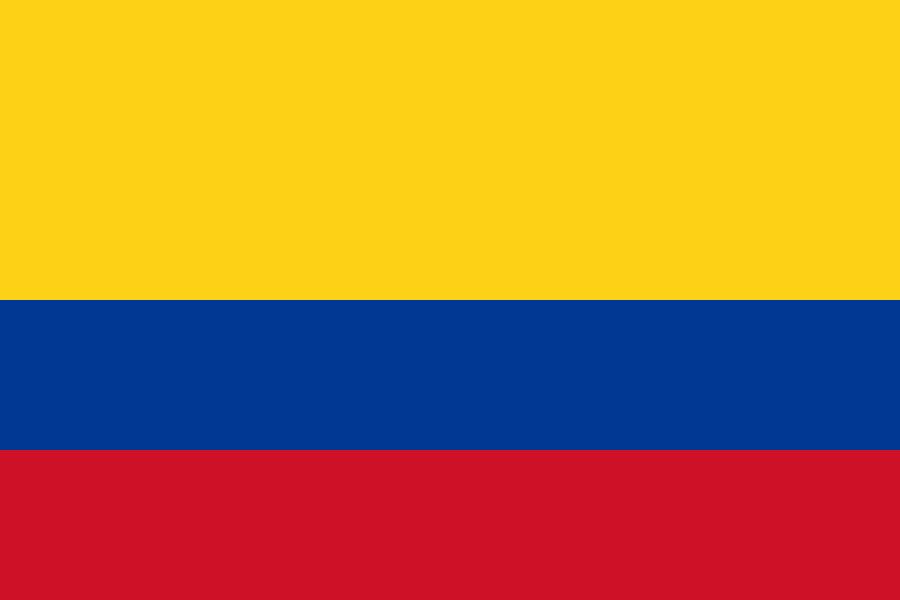
Ranked deterministically across layout family (35%), color overlap and stripe order (25%), symbols (20%), aspect ratio (10%), and stripe/symmetry geometry (10%):





Sources and image-rights provenance
- Constitución Española de 1978 (Artículo 4)
- Real Decreto 2964/1981 — Boletín Oficial del Estado No. 221
SVG artwork provenance: Constructed from statutory specifications (public-domain-statute, verified 2026-10-14, SHA-256 85d587d1ebc9…).