
Flag of Greenland
Native & traditional name: Erfalasorput / Aappalaartoq
| Entity | Greenland (GL) |
|---|---|
| Parent state | Denmark |
| Type | Dependent / autonomous territory flag (territorial, civil, state) |
| Proportion | 2:3 (2:3) |
| Primary colors | white, red |
| Main symbol | disc |
| Arrangement | horizontal centered emblem (white · red) |
| Official adoption | 1985-06-21 |
| Region | Northern America |
Plain-language visual description
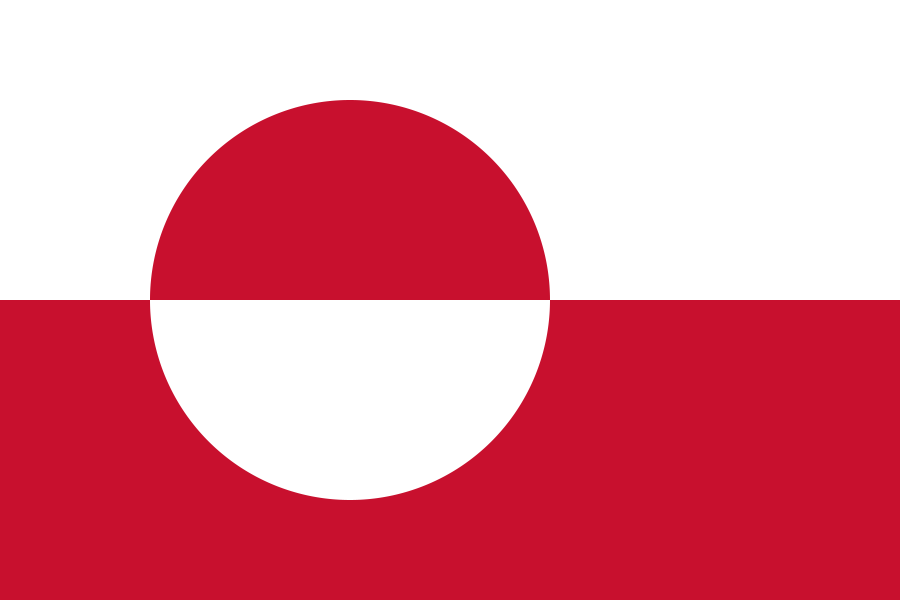
The flag of Greenland (Erfalasorput) consists of two equal horizontal bands of white (top) and red (bottom) with a large off-center disc shifted toward the hoist whose upper half is red and lower half is white.
Construction and geometry
Proportion & symmetry: The Flag of Greenland uses a statutory 2:3 height-to-width ratio on a rectangular field with vertical mirror symmetry. 12:18 grid (2:3 ratio); two equal horizontal bands (white over red) with a counterchanged disc of diameter 8 units centered at 7 units from the hoist.
- Aspect ratio is 2:3 on a 12 × 18 unit grid.
- Two equal horizontal bands of 6 units each (white over red).
- Counterchanged disc has a diameter of 8 units (radius 4 units), centered vertically on the dividing line and horizontally 7 units from the hoist (11 units from the fly).
Official colors and specification system
Rather than manufacturing false RGB precision where a statute specifies dyed cloth, Pantone, Munsell, or CIE coordinates, the table below records the governing color system alongside a calibrated display hex approximation.
| Color | Official shade name | Specification system | Statutory / standard code | Display hex |
|---|---|---|---|---|
| white | Glacier White | statute-named | Named in statute | #FFFFFF |
| red | Dannebrog Red (Pantone 186 C) | pantone | Pantone 186 C | #C8102E |
Meaning and symbolism
Documented symbolism
Designed by Greenlandic artist Thue Christiansen and adopted in 1985, the flag is known in Kalaallisut as Erfalasorput ('Our Flag') and Aappalaartoq ('The Red One').
Christiansen explained that the upper white stripe represents the glaciers and ice cap covering more than 80% of the island; the lower red stripe represents the ocean; the red upper semicircle represents the rising sun and deep fjords; and the white lower semicircle represents icebergs and pack ice floating on the sea.
Common interpretations
Greenland is the only Nordic country or autonomous territory whose official flag does not use a Nordic cross, instead using the red-and-white palette of the Danish Dannebrog in a circular geometric composition honoring Inuit solar motifs.
History and design evolution
For centuries Greenland flew the Danish Dannebrog without a separate territorial emblem. After Greenland achieved home rule within the Kingdom of Denmark in May 1979, the Home Rule Government invited public design proposals for a distinctive Greenlandic flag. More than 550 entries were submitted by citizens and artists, and a lively 1978–1984 public debate narrowed the choice between Sven Tito Achen's green-and-white Nordic cross and indigenous Arctic motifs.
In 1985, Greenlandic teacher, politician, and visual artist Thue Christiansen submitted his counterchanged red-and-white horizontal bicolor and off-center solar disc design, which preserved the historical red-and-white colors of the Kingdom of Denmark while introducing a bold non-cross geometry unique to the Arctic.
The Greenlandic parliament (Inatsisartut) approved Christiansen's flag by a 14–11 vote over the green Nordic cross, and Erfalasorput was officially hoisted for the first time on Greenland's National Day, 21 June 1985, using the exact Pantone 186 C red of the Dannebrog.
Key historical milestones
- 1979Greenland Home Rule: Home Rule is established, prompting a public competition for a Greenlandic flag.
- 1985Adoption of Erfalasorput: Thue Christiansen's counterchanged red-and-white disc design becomes official on 21 June 1985.
Visually and structurally similar flags
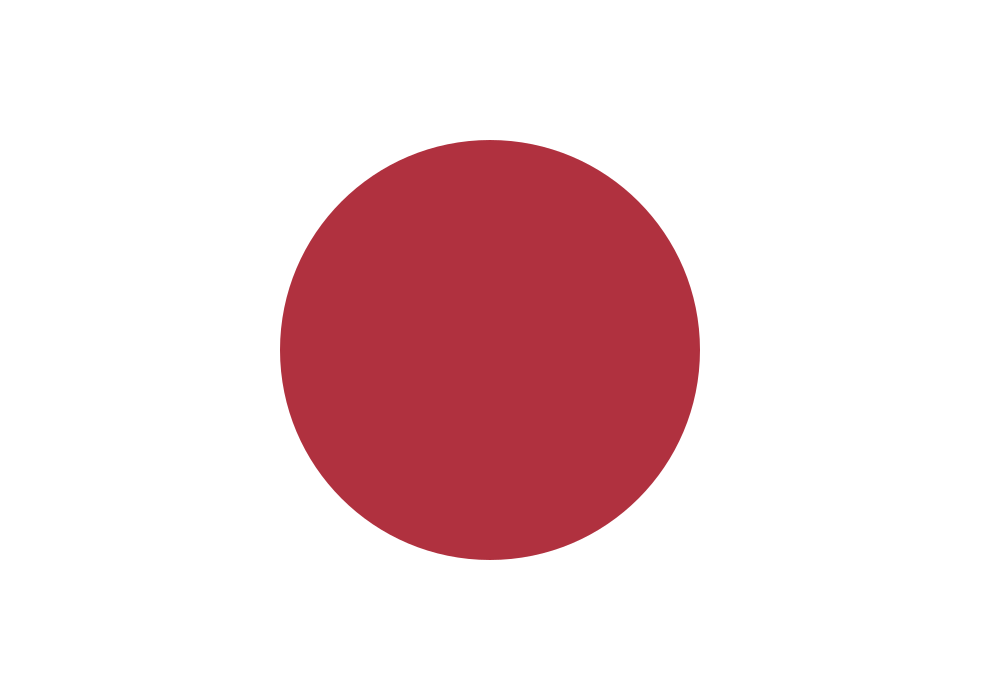
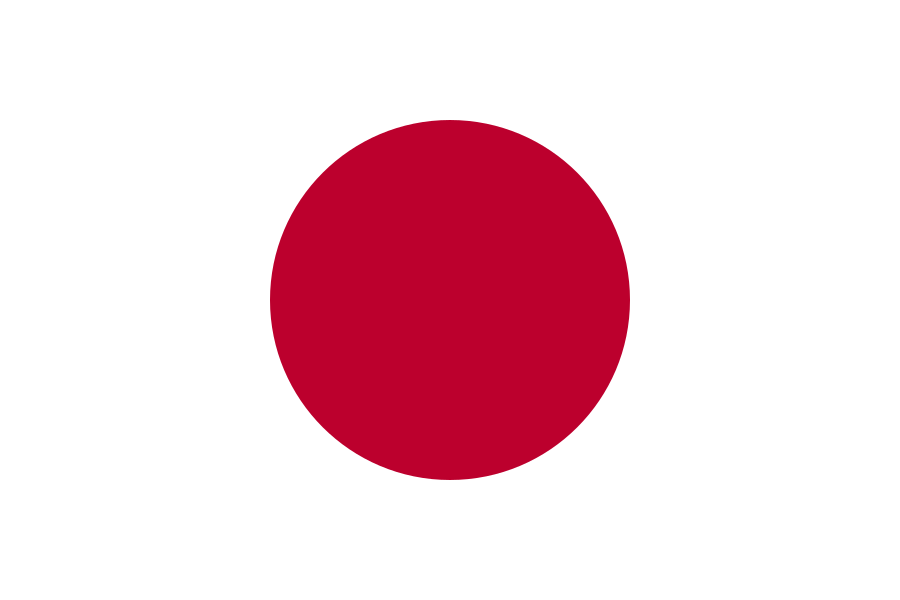
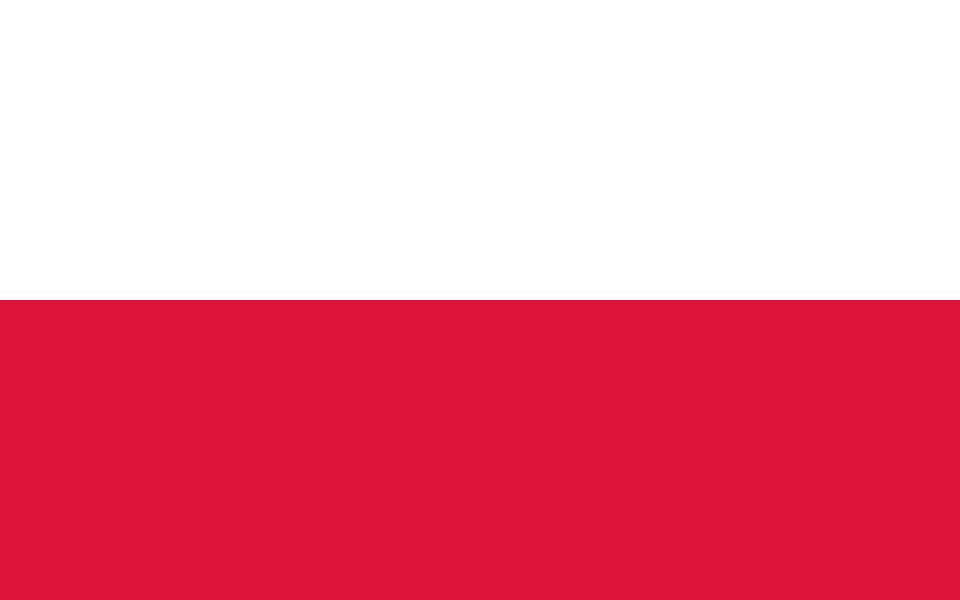
Ranked deterministically across layout family (35%), color overlap and stripe order (25%), symbols (20%), aspect ratio (10%), and stripe/symmetry geometry (10%):

Sources and image-rights provenance
- Landstingslov nr. 5 af 6. juni 1985 om det grønlandske flag
- World Factbook: Greenland Flag Description
SVG artwork provenance: Constructed from statutory specifications (public-domain-statute, verified 2026-10-13, SHA-256 6e2fbb3823dd…).