
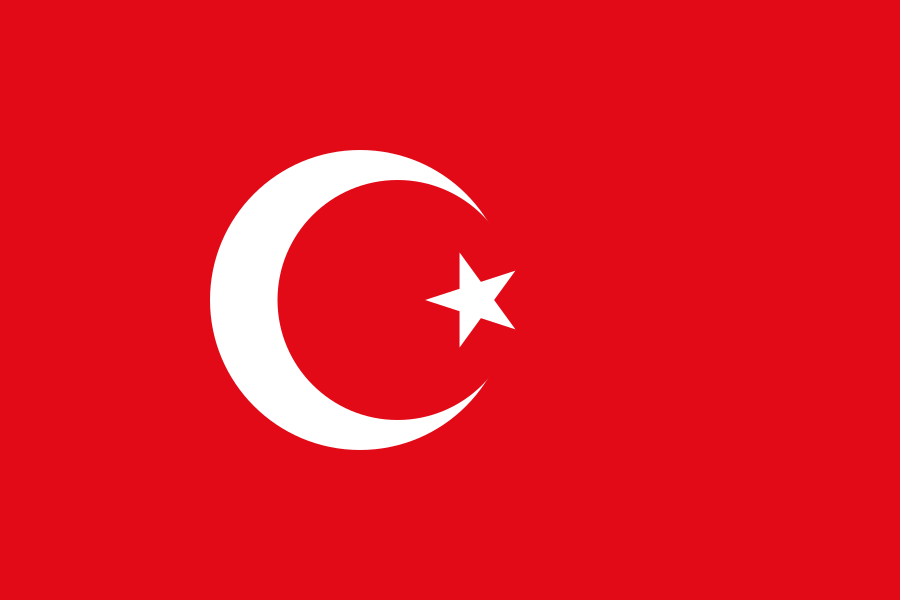
Flag of Turkey
Native & traditional name: Türk bayrağı (Al Bayrak)
| Entity | Turkey (TR) |
|---|---|
| Type | Sovereign national flag (national, civil) |
| Proportion | 2:3 (2:3) |
| Primary colors | red, white |
| Main symbol | crescent, star |
| Arrangement | centered centered emblem |
| Official adoption | 1936-05-29 |
| Region | Western Asia |
Plain-language visual description
The national flag of Turkey (Türk bayrağı) features a red field in a 2:3 ratio with a white crescent moon and five-pointed star offset slightly toward the hoist.
Construction and geometry
Proportion & symmetry: The Flag of Turkey uses a statutory 2:3 height-to-width ratio on a rectangular field with none mirror symmetry. Red 2:3 field with white crescent and five-pointed star offset toward the hoist per Law 2893.
Official colors and specification system
Rather than manufacturing false RGB precision where a statute specifies dyed cloth, Pantone, Munsell, or CIE coordinates, the table below records the governing color system alongside a calibrated display hex approximation.
| Color | Official shade name | Specification system | Statutory / standard code | Display hex |
|---|---|---|---|---|
| red | Al (Flag Red) | pantone | Pantone 186 C | #E30A17 |
| white | Beyaz (White) | statute-named | Named in statute | #FFFFFF |
Meaning and symbolism
Documented symbolism
Law No. 2893 codifies the geometric construction. The crescent and star represent national sovereignty, independence, and historical continuity from the Ottoman Empire.
Red symbolizes the blood shed by Turkish martyrs during the War of Independence and foundation of the Republic.
Common interpretations
A popular legend recounts that after the Battle of Kosovo (1389), a reflection of the crescent moon and evening star appeared in a pool of martyrs' blood, inspiring the flag.
History and design evolution
The national flag of Turkey, known poetically as Al Bayrak ('the Red Banner') or Ay Yıldız ('the Crescent and Star'), has origins deeply rooted in the vexillological traditions of the Ottoman Empire. The crescent moon and star have been symbols of Asia Minor and the city of Byzantium (later Constantinople/Istanbul) since classical antiquity, and the Ottoman Turks embraced the crescent emblem following their conquest of the city under Sultan Mehmed II in 1453.
In 1793, during the military modernization reforms (Nizam-i Djedid) instituted by Sultan Selim III, the Ottoman navy standardized its ensign as a red field bearing an eight-pointed white star and crescent. In 1844, during the Tanzimat reform era under Sultan Abdülmecid I, the eight-pointed star was formally replaced by a five-pointed star, establishing the classic configuration that served as the state and naval flag of the Ottoman Empire until its dissolution.
Following the defeat of the Ottoman Empire in World War I, the flag became the rallying symbol of the Turkish National Movement during the Turkish War of Independence (1919–1923), led by Mustafa Kemal Atatürk. After the proclamation of the Republic of Turkey in 1923, the Grand National Assembly adopted the historic Ottoman banner as the republic's sovereign national flag. On May 29, 1936, the parliament passed the comprehensive Turkish Flag Law (Law No. 2994), establishing exact geometric formulas for the crescent's inner and outer circles, the position of the five-pointed star, the 2:3 proportion, and the statutory shade of red. This law was updated and reinforced by Turkish Flag Law No. 2893 in September 1983.
Key historical milestones
- 1844Ottoman Standardization: Five-pointed star and crescent standardized under Sultan Abdülmecid I.
- 1936Law No. 2994: Republic of Turkey codifies statutory flag geometry.
- 1983Law No. 2893: Modern Turkish Flag Law enacted on 22 September 1983.
Visually and structurally similar flags
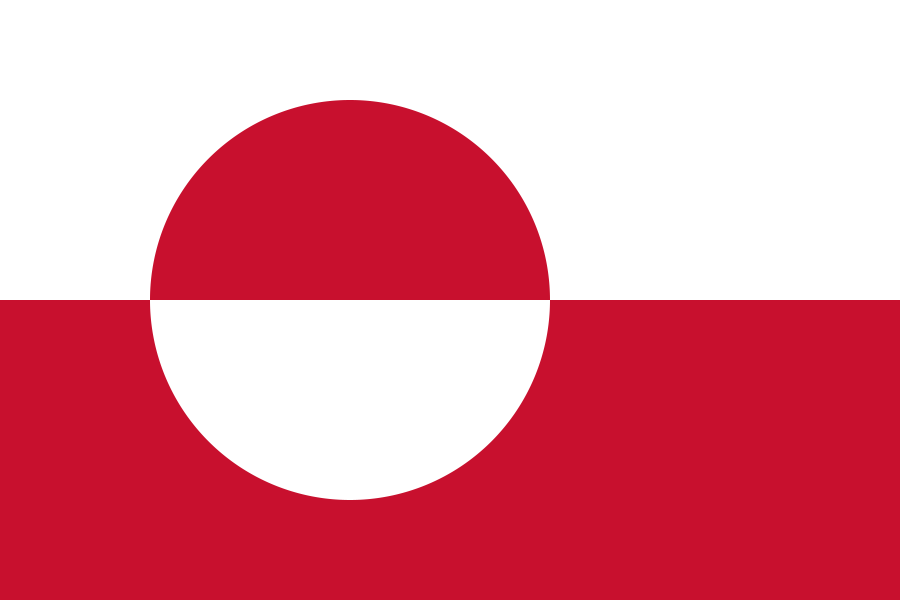
Ranked deterministically across layout family (35%), color overlap and stripe order (25%), symbols (20%), aspect ratio (10%), and stripe/symmetry geometry (10%):





Sources and image-rights provenance
- Türk Bayrağı Kanunu (Law No. 2893)
- The World Encyclopedia of Flags — Hermes House, pp. 166–167
SVG artwork provenance: Constructed from statutory specifications (public-domain-statute, verified 2026-10-14, SHA-256 f0de1a45e5ee…).