
Flag of Germany
Native & traditional name: Bundesflagge (Schwarz-Rot-Gold)
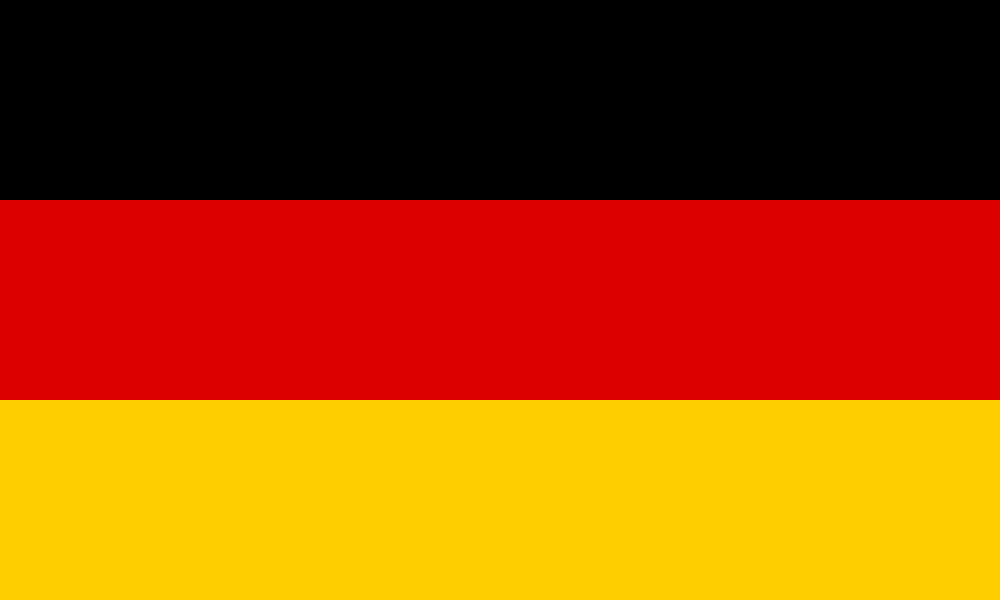
| Entity | Germany (DE) |
|---|---|
| Type | Sovereign national flag (national, civil) |
| Proportion | 3:5 (3:5) |
| Primary colors | black, red, yellow |
| Main symbol | None (geometric bands) |
| Arrangement | horizontal tricolor (black · red · yellow) |
| Official adoption | 1949-05-23 |
| Region | Western Europe |
Plain-language visual description
The national flag of Germany consists of three equal horizontal bands of black at the top, red in the middle, and gold (yellow) at the bottom in a 3:5 aspect ratio.
Construction and geometry
Proportion & symmetry: The Flag of Germany uses a statutory 3:5 height-to-width ratio on a rectangular field with vertical mirror symmetry. Three equal horizontal bands of black, red, and gold in a 3:5 aspect ratio.
- Aspect ratio is 3:5 (height to width) under the Federal Flag Order of 13 November 1996.
- Three equal horizontal stripes, each occupying 1/3 of the hoist height.
- Note that Federal government authorities fly the Bundesdienstflagge (Federal Service Flag), which adds the slightly off-center Bundeswappen shield; private citizens fly the plain civil and national tricolor.
Official colors and specification system
Rather than manufacturing false RGB precision where a statute specifies dyed cloth, Pantone, Munsell, or CIE coordinates, the table below records the governing color system alongside a calibrated display hex approximation.
| Color | Official shade name | Specification system | Statutory / standard code | Display hex |
|---|---|---|---|---|
| black | RAL 9005 Jet Black (Tiefschwarz) | rgb | RAL 9005 / RGB 0, 0, 0 | #000000 |
| red | RAL 3020 Traffic Red (Verkehrsrot) | pantone | RAL 3020 / Pantone 485 C | #DD0000 |
| yellow | RAL 1021 Rapeseed Yellow (Rapsgelb / Gold) | pantone | RAL 1021 / Pantone Yellow 012 C | #FFCE00 |
Meaning and symbolism
Documented symbolism
Article 22(2) of the 1949 Basic Law for the Federal Republic of Germany (Grundgesetz) establishes simply that 'The federal flag shall be black, red and gold' (Die Bundesflagge ist schwarz-rot-gold), linking the post-war democratic republic directly to the 1848 Frankfurt Parliament and the 1919 Weimar Constitution.
In German constitutional history, the black-red-gold triad represents republican democracy, civil liberty, and federal unity, deliberately contrasted against the black-white-red imperial tricolor of 1871–1918.
Common interpretations
The colors trace directly to the uniforms of the Lützow Free Corps (Lützowsches Freikorps) during the 1813–1815 Wars of Liberation against Napoleon, whose volunteer soldiers dyed their diverse civilian coats black, added red collar and cuff piping, and wore brass (gold) buttons.
A 19th-century poetic motto by Karl Förster and Ferdinand Freiligrath interpreted the sequence as 'Out of the blackness of servitude, through bloody battles, to the golden light of freedom.'
History and design evolution
Following the dissolution of the Holy Roman Empire in 1806 and the Napoleonic Wars, student fraternities founded at Jena in 1815 (the Urburschenschaft) adopted the black, red, and gold colors of the Lützow Free Corps as a banner for a united, constitutional German state. Carried by 30,000 demonstrators at the 1832 Hambach Festival, the colors became the defining emblem of the liberal-democratic movement.
On 9 March 1848, the German Confederation and subsequently the Frankfurt National Assembly proclaimed black-red-gold the official colors of the short-lived German Empire of 1848–1849. When Otto von Bismarck unified Germany under Prussian leadership in 1871, he rejected the liberal 1848 colors in favor of a black-white-red tricolor combining Prussian black-and-white with Hanseatic red-and-white.
After World War I, the Weimar National Assembly restored black-red-gold in Article 3 of the 1919 Constitution. Suppressed by the Nazi regime in 1933, the black-red-gold tricolor was readopted in 1949 by both the Federal Republic of Germany (West Germany) and the German Democratic Republic (East Germany). While East Germany added a hammer, compass, and rye wreath emblem to its center in 1959, German reunification on 3 October 1990 restored the plain black-red-gold 3:5 tricolor across the entire country.
Key historical milestones
- 1815Jena Urburschenschaft: Student veterans of the Lützow Free Corps adopt black, red, and gold as the colors of German constitutional unity.
- 1848Frankfurt Parliament: Black-red-gold is proclaimed the national flag during the March Revolution.
- 1919Weimar Constitution: Article 3 restores black-red-gold as the national colors of the Weimar Republic.
- 1949Basic Law Article 22: The Federal Republic of Germany codifies the 3:5 black-red-gold Bundesflagge.
- 1990German Reunification: The plain black-red-gold tricolor becomes the sole flag of reunified Germany.
Frequently confused with
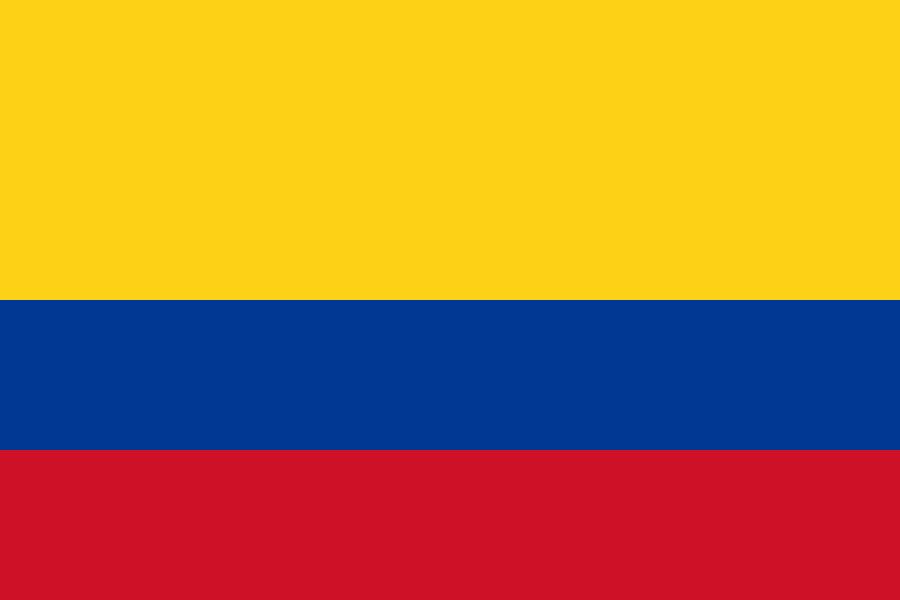
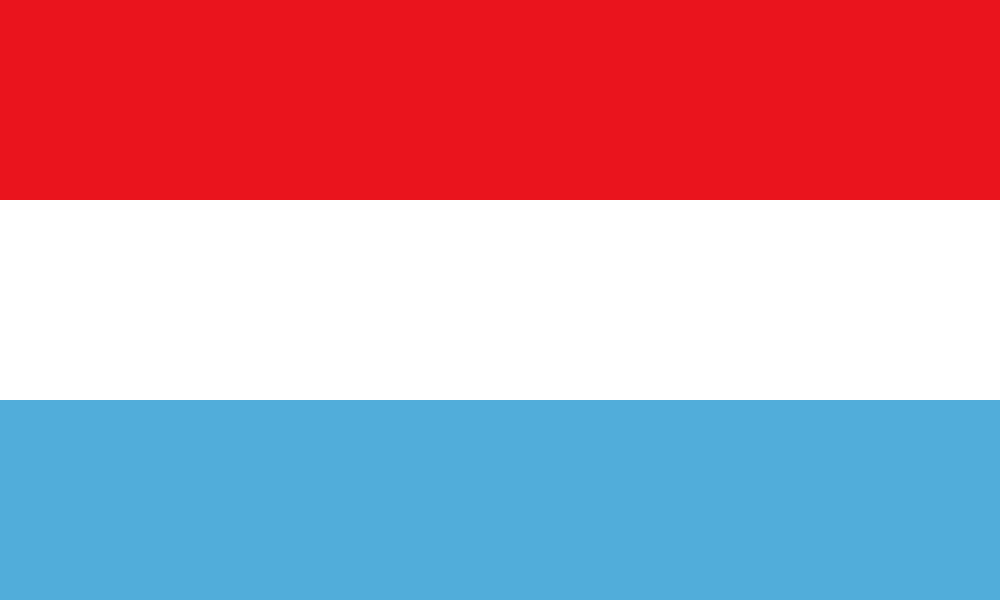
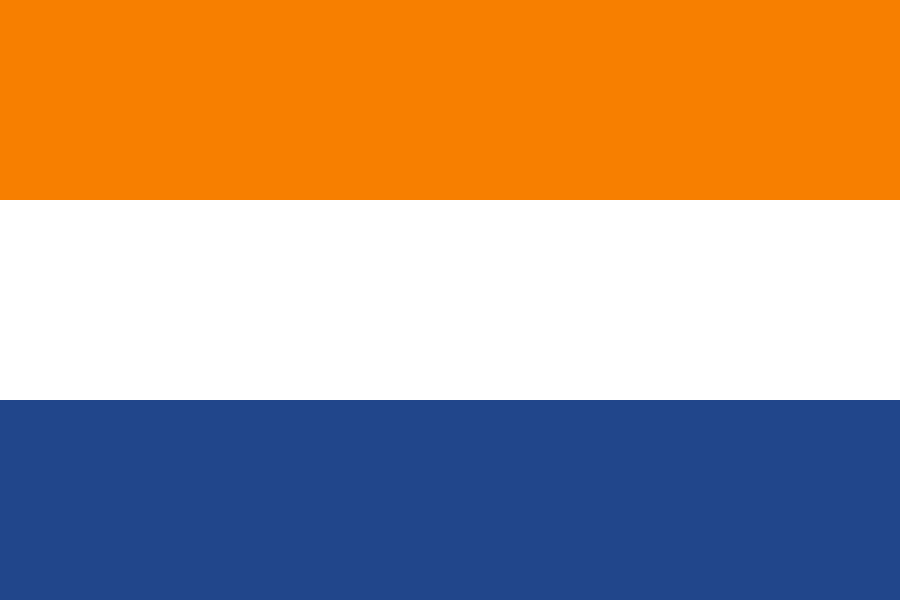
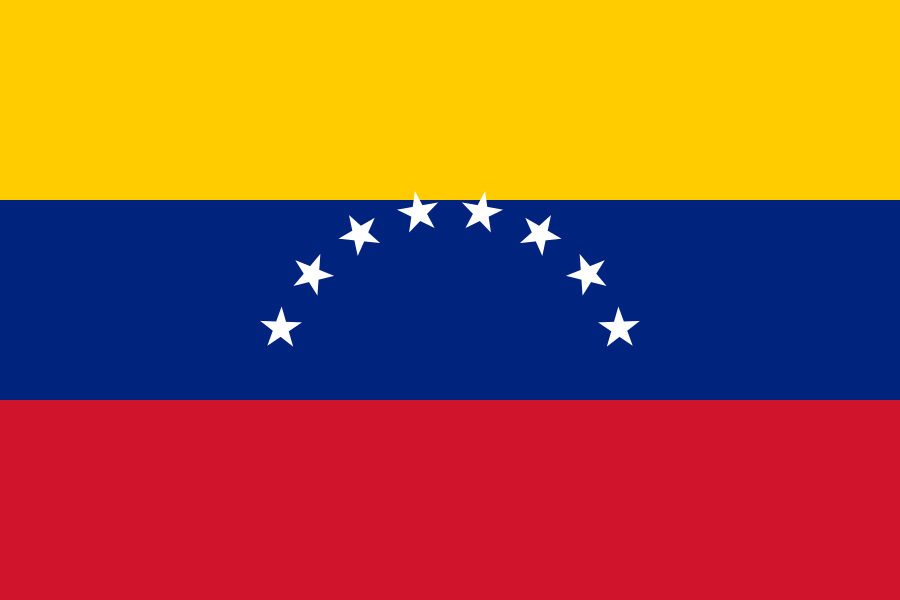
The Flag of Germany is commonly confused with or compared alongside the following flags due to shared colors, stripe geometry, or central emblems:
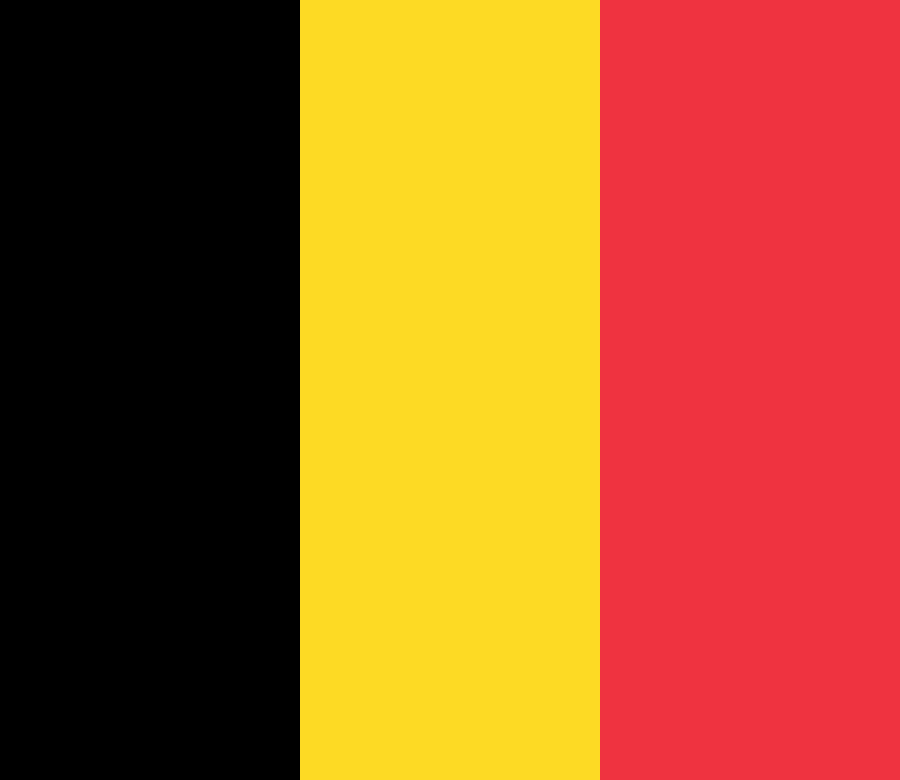
Visually and structurally similar flags
Ranked deterministically across layout family (35%), color overlap and stripe order (25%), symbols (20%), aspect ratio (10%), and stripe/symmetry geometry (10%):

Sources and image-rights provenance
- Basic Law for the Federal Republic of Germany (Grundgesetz), Article 22
- Anordnung über die deutschen Flaggen (Federal Flag Order) — BGBl. I S. 1729
SVG artwork provenance: Constructed from statutory specifications (public-domain-statute, verified 2026-10-13, SHA-256 0f6b4c458105…).