
Flag of South Africa
Native & traditional name: National Flag of South Africa
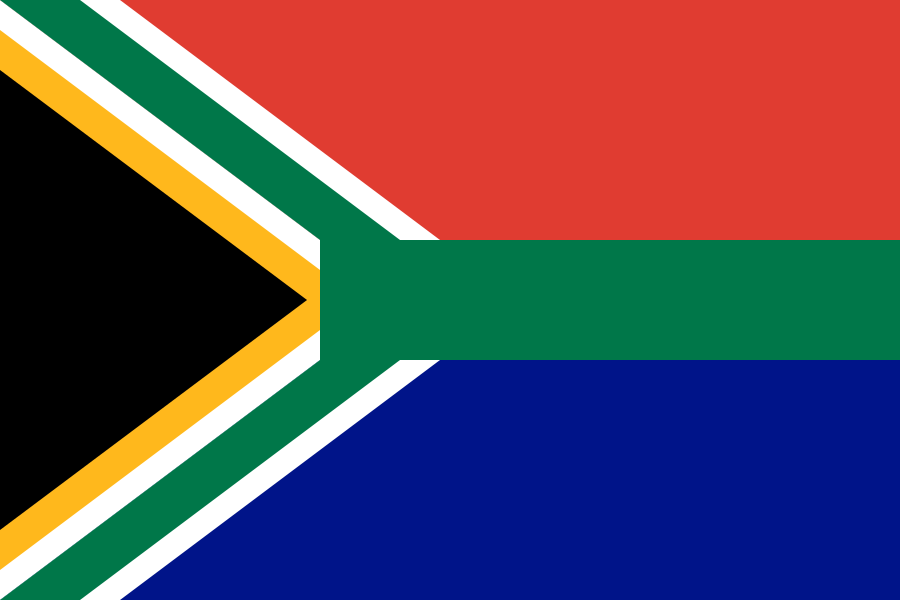
| Entity | South Africa (ZA) |
|---|---|
| Type | Sovereign national flag (national, civil) |
| Proportion | 2:3 (2:3) |
| Primary colors | green, black, yellow, white, red, blue |
| Main symbol | triangle |
| Arrangement | horizontal hoist triangle |
| Official adoption | 1994-04-27 |
| Region | Southern Africa |
Plain-language visual description
The national flag of South Africa features a green horizontal pall (Y) shape fimbriated white and gold, dividing chili red, cobalt blue, and a black hoist triangle in a 2:3 aspect ratio.
Construction and geometry
Proportion & symmetry: The Flag of South Africa uses a statutory 2:3 height-to-width ratio on a rectangular field with horizontal mirror symmetry. Green horizontal pall fimbriated white and gold, dividing chilli red, blue, and black hoist triangle.
Official colors and specification system
Rather than manufacturing false RGB precision where a statute specifies dyed cloth, Pantone, Munsell, or CIE coordinates, the table below records the governing color system alongside a calibrated display hex approximation.
| Color | Official shade name | Specification system | Statutory / standard code | Display hex |
|---|---|---|---|---|
| green | National Flag Green | pantone | Pantone 3415 C | #007749 |
| black | Black | statute-named | Named in statute | #000000 |
| yellow | Gold | pantone | Pantone 1235 C | #FFB81C |
| white | White | statute-named | Named in statute | #FFFFFF |
| red | Chilli Red | pantone | Pantone 179 C | #E03C31 |
| blue | National Flag Blue | pantone | Pantone Reflex Blue C | #001489 |
Meaning and symbolism
Documented symbolism
Designed by State Herald Fred Brownell, the central theme is the convergence of diverse paths into a unified road ahead, symbolized by the 'Y' shape of the green pall.
The government deliberately avoids assigning official rigid meaning to individual colors, emphasizing overall unity and reconciliation.
Common interpretations
The six colors blend historical European and African political traditions: red, white, and blue reflect Boer and British history; black, green, and gold reflect the African National Congress.
History and design evolution
The national flag of South Africa was adopted on April 27, 1994, coinciding with South Africa's first fully democratic, non-racial elections and the end of the apartheid era. Prior to 1994, South Africa flew the 1928 national flag (the Oranje, Blanje, Blou), which featured three miniature flags—the British Union Jack, the Orange Free State flag, and the Transvaal Vierkleur—in the central white stripe of an orange-white-blue horizontal triband. Because that flag was intimately associated with racial segregation and apartheid, a new national symbol was essential for democratic transition.
In 1993, the Negotiating Council held a nationwide public competition to design a new flag, drawing over 7,000 entries, but none was deemed suitable by the assessing committee. With the historic April 1994 elections rapidly approaching and no design agreed upon, State Herald Frederick Brownell was tasked with producing a compromise design. Brownell sketched the horizontal 'Y' (or pall) layout, cleverly harmonizing colors from the African National Congress banner (black, green, and gold) with colors from the historical flags of the Boers and British (red, white, and blue).
The flag was initially adopted as an interim measure under the 1993 Transitional Constitution, with a planned review after five years. However, the design achieved such immediate, overwhelming popularity and cultural affection across all racial and linguistic communities during Nelson Mandela's presidency and the 1995 Rugby World Cup that it was confirmed without alteration as the permanent national flag in Section 5 of the 1996 Constitution of South Africa. The horizontal pall represents the convergence of diverse paths into a unified nation moving forward.
Key historical milestones
- 1994Democratic Debut: Raised on 27 April 1994 for the first democratic elections.
- 1996Constitutional Confirmation: Confirmed permanently in Section 5 of the 1996 Constitution.
Visually and structurally similar flags
Ranked deterministically across layout family (35%), color overlap and stripe order (25%), symbols (20%), aspect ratio (10%), and stripe/symmetry geometry (10%):
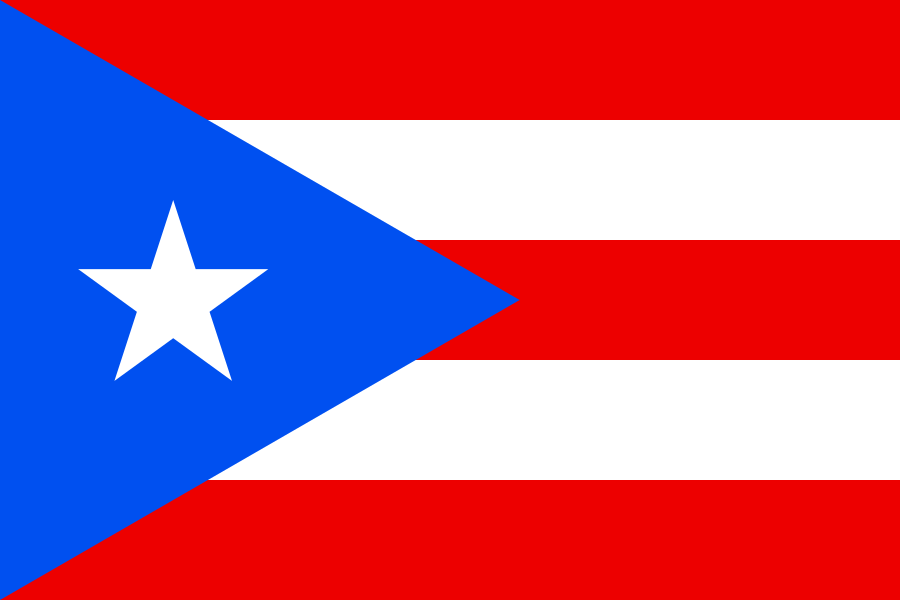
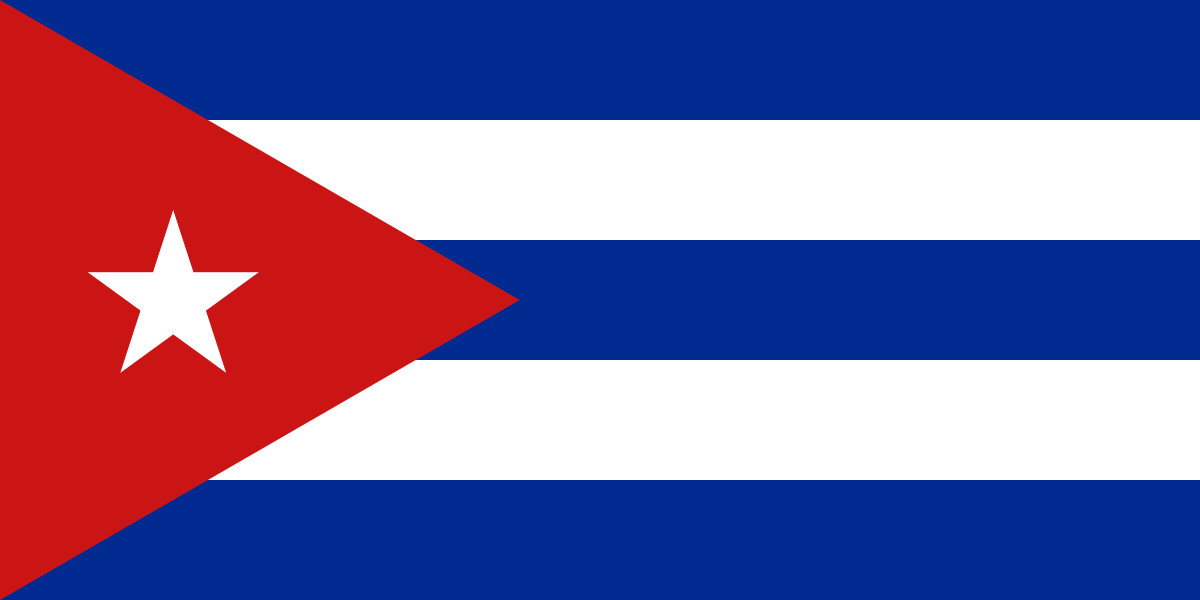
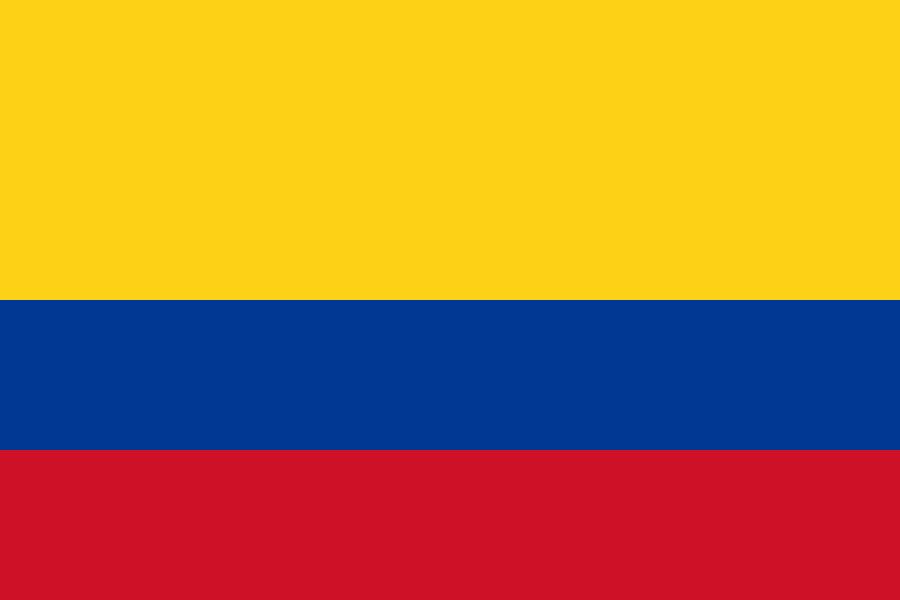

Sources and image-rights provenance
- Proclamation No. 208 of 1994 — Government Gazette Vol. 346, No. 15663
- Constitution of the Republic of South Africa (Section 5)
SVG artwork provenance: Constructed from statutory specifications (public-domain-statute, verified 2026-10-14, SHA-256 fed190cf16e5…).