
Flag of Chicago
Native & traditional name: Municipal Flag of Chicago
| Entity | Chicago |
|---|---|
| Parent state | United States |
| Type | Subnational state / municipal flag (subnational, civil) |
| Proportion | 2:3 (2:3) |
| Primary colors | white, light blue, red |
| Main symbol | star (×4) |
| Arrangement | horizontal multi stripe (white · light-blue · white · light-blue · white) |
| Official adoption | 1917-04-04 |
| Region | Northern America |
Plain-language visual description
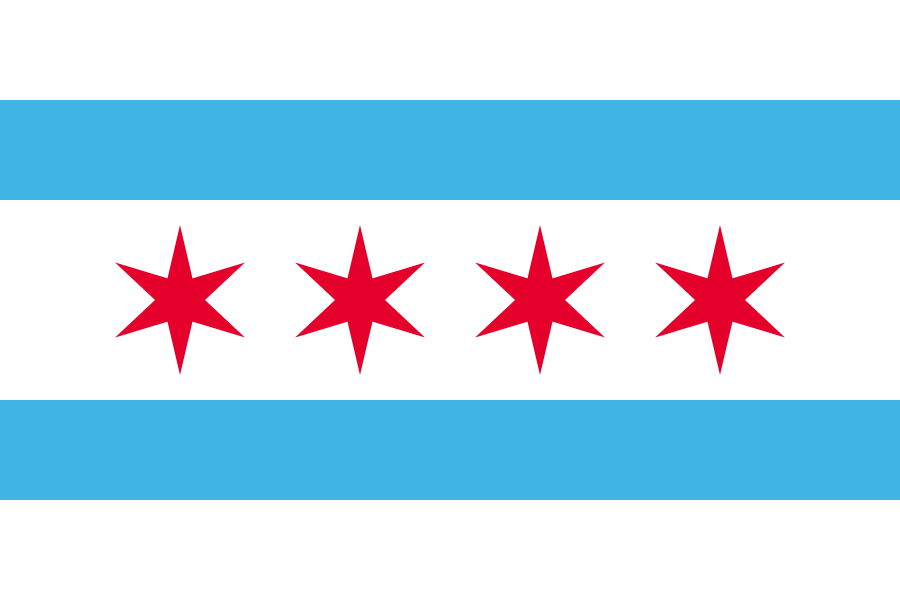
The municipal flag of Chicago consists of a white field divided by two horizontal light-blue bars, with four red six-pointed stars arranged in a horizontal row across the wide central white band.
Construction and geometry
Proportion & symmetry: The Flag of Chicago uses a statutory 2:3 height-to-width ratio on a rectangular field with both mirror symmetry. 2:3 ratio; divided horizontally into 1:1:2:1:1 bands (white, light blue, double-height white, light blue, white) with four red six-pointed stars centered on the middle white band.
- Aspect ratio is 2:3.
- Horizontal bands are proportioned 1:1:2:1:1 (each blue bar is 1/6 of the hoist height; the top and bottom white bands are 1/6; the middle white band is 1/3).
- Four six-pointed red stars with sharp points centered along the middle white band.
Official colors and specification system
Rather than manufacturing false RGB precision where a statute specifies dyed cloth, Pantone, Munsell, or CIE coordinates, the table below records the governing color system alongside a calibrated display hex approximation.
| Color | Official shade name | Specification system | Statutory / standard code | Display hex |
|---|---|---|---|---|
| white | White | statute-named | Named in statute | #FFFFFF |
| light blue | Sky / Columbia Blue | pantone | Pantone 298 C (City design standard) | #41B6E6 |
| red | Red | pantone | Pantone 185 C | #E4002B |
Meaning and symbolism
Documented symbolism
Under the Municipal Code of Chicago (§§ 1-8-030 to 1-8-040), the three white fields from top to bottom represent the North, West, and South Sides of the city.
The upper blue bar represents Lake Michigan and the North Branch of the Chicago River, while the lower blue bar represents the South Branch of the River and the Great Canal. The four red six-pointed stars commemorate four defining milestones in Chicago history: Fort Dearborn (1803, added 1939), the Great Chicago Fire (1871), the World's Columbian Exposition (1893), and the Century of Progress International Exposition (1933, added 1933), with each star's six points assigned specific civic virtues and historical jurisdictions.
Common interpretations
Designer Wallace Rice deliberately chose six-pointed stars with sharp 30-degree points because five-pointed stars represent sovereign states in American heraldry, whereas six-pointed stars had not been used on municipal flags.
In the North American Vexillological Association's (NAVA) landmark 2004 survey of 150 US city flags, Chicago ranked second only to Washington, D.C., and is widely cited in vexillology as the gold standard for civic flag design.
History and design evolution
In 1915, Chicago Mayor William Hale Thompson appointed a Municipal Flag Commission chaired by Alderman James A. Kearns and advised by writer, poet, and heraldic lecturer Wallace Rice alongside Art Institute impressionist painter Lawton S. Parker. Out of more than 1,000 public design submissions, the commission selected Rice's bold geometric layout of two light-blue horizontal bars on a white field charged with two red six-pointed stars.
The Chicago City Council adopted the original two-star flag by municipal ordinance on 4 April 1917. At that time, the two stars represented the Great Chicago Fire of October 1871 and the World's Columbian Exposition of 1893.
As the city's civic history expanded, the City Council amended the ordinance twice: in 1933 it added a third red star to celebrate the Century of Progress International Exposition, and in 1939 it added a fourth star (placed first at the hoist) to commemorate Fort Dearborn (founded 1803) and the 1812 Battle of Fort Dearborn.
Key historical milestones
- 1917Original Two-Star Flag: City Council adopts Wallace Rice's design with two red six-pointed stars on 4 April 1917.
- 1933Third Star Added: A third star is added for the Century of Progress International Exposition.
- 1939Fourth Star Added: A fourth star representing Fort Dearborn is added at the hoist, creating the modern four-star flag.
Visually and structurally similar flags
Ranked deterministically across layout family (35%), color overlap and stripe order (25%), symbols (20%), aspect ratio (10%), and stripe/symmetry geometry (10%):





Sources and image-rights provenance
- Municipal Code of Chicago, Chapter 1-8: Corporate Seal and Emblems (§§ 1-8-030 to 1-8-050)
- The American City Flag Survey of 2004 — Vol. 12, pp. 27–62
SVG artwork provenance: Constructed from statutory specifications (public-domain-statute, verified 2026-10-13, SHA-256 c8104de445ed…).